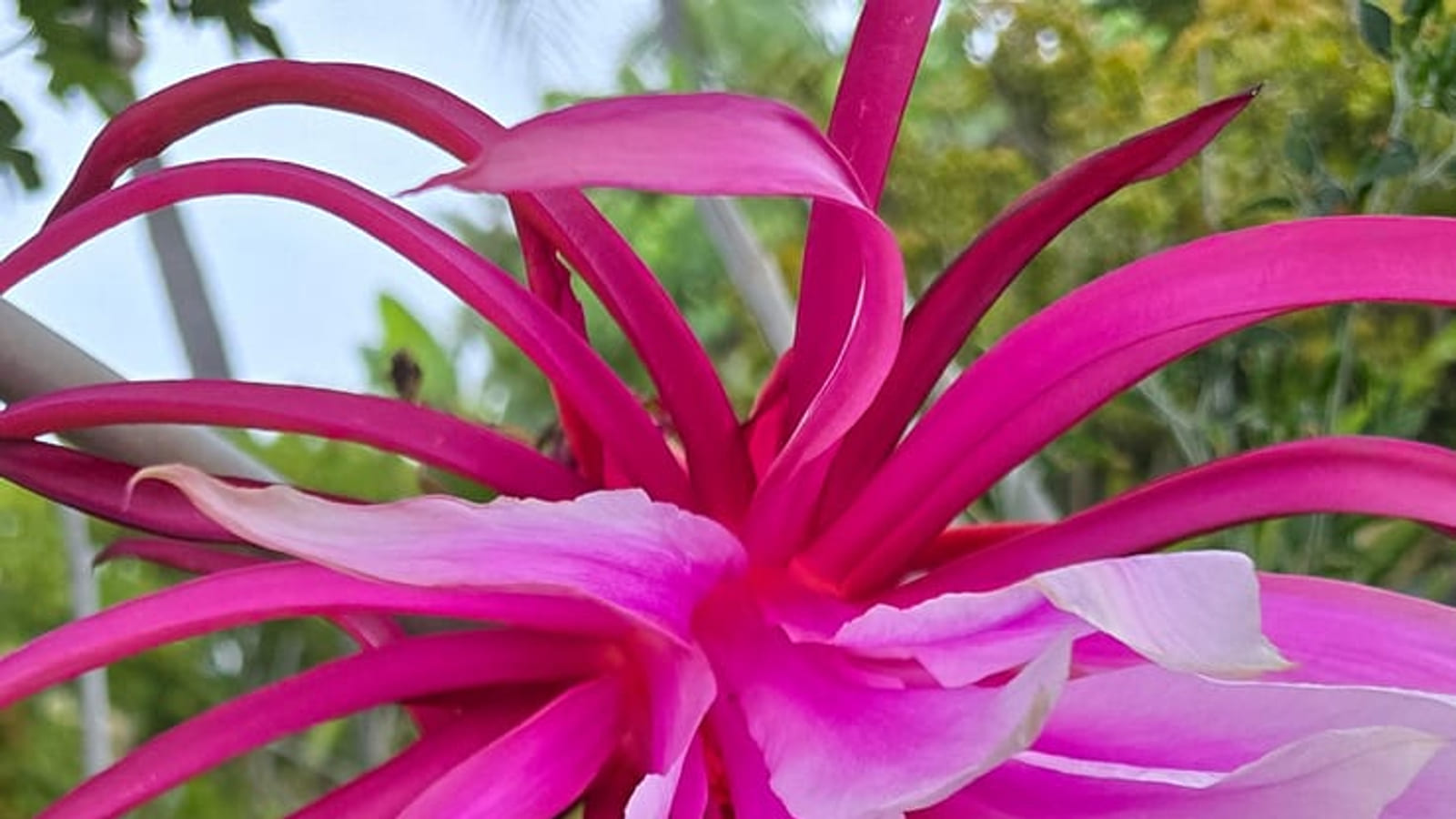
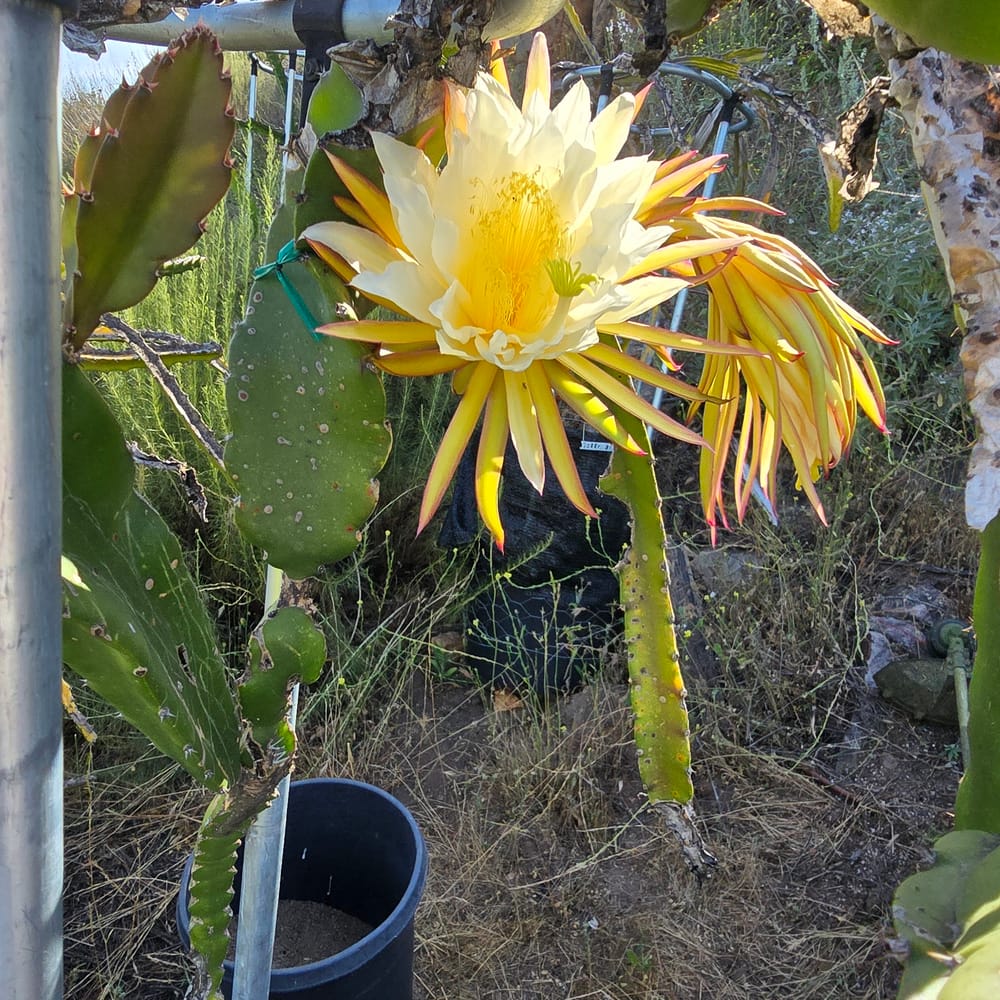
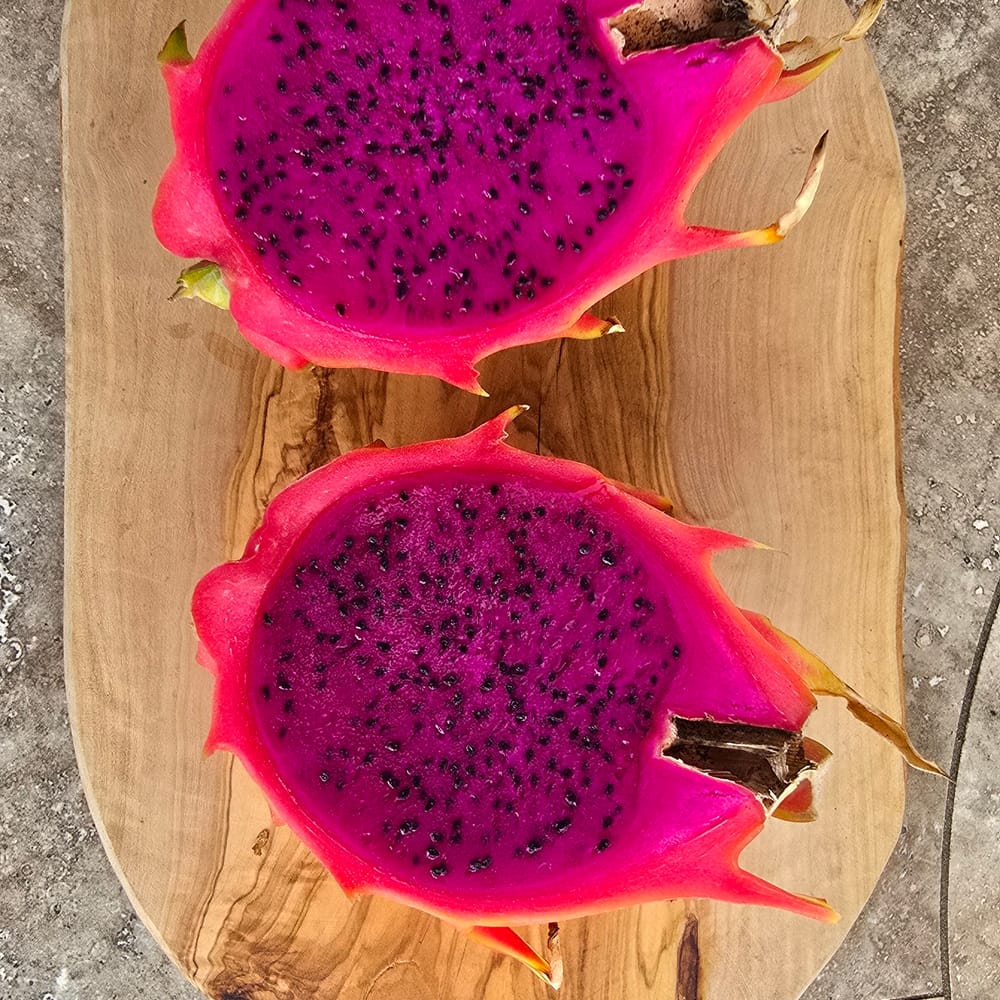
Dark Star Dragon Fruit: Sweet Purple Variety Guide
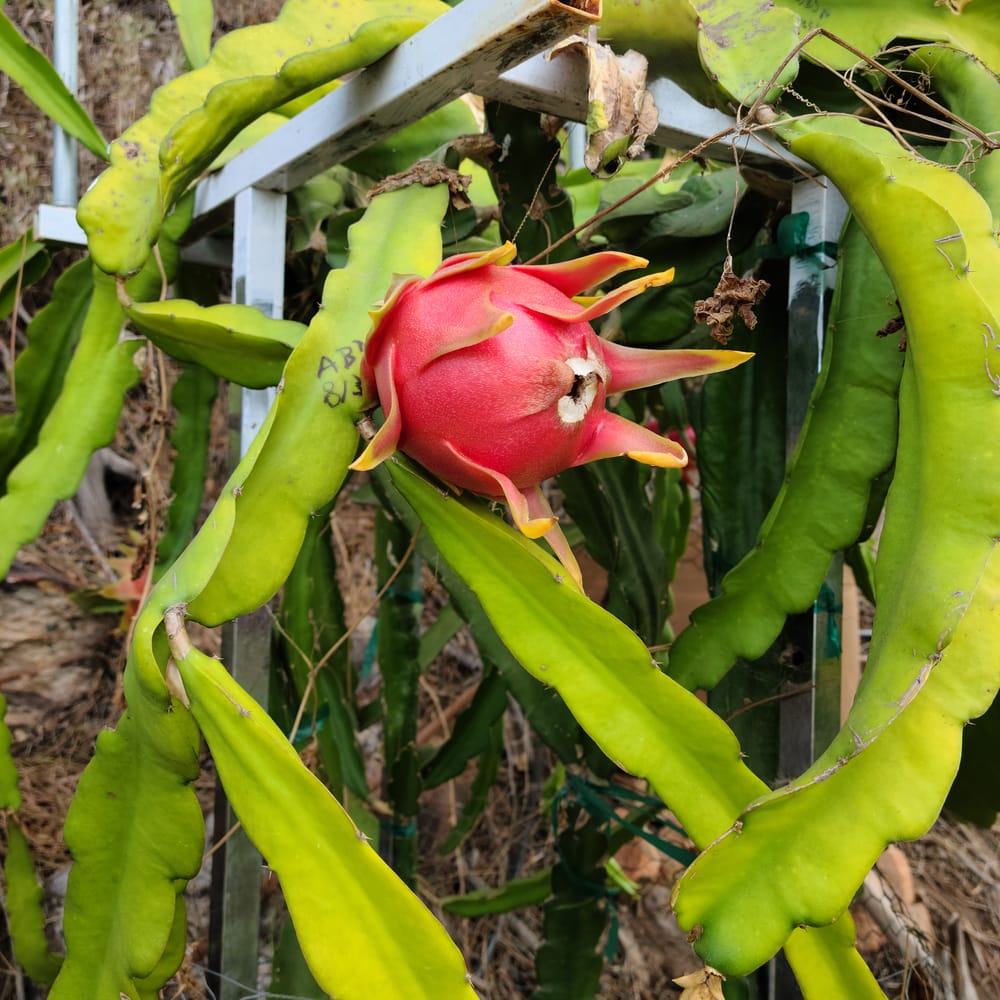
Dark Star is a purple-fleshed dragon fruit bred from Hylocereus guatemalensis and Hylocereus undatus, and it is worth growing if you want a reliable, sweet, medium-to-large fruit with reported Brix around 19 to 21, a mild grape-like flavor, and strong performance in warm USDA zone 10a conditions like Escondido, Southern California.
For backyard growers, that direct answer matters more than hype. Dark Star is not just pretty fruit for Instagram. It is a real collector variety with enough sweetness, color, and size to justify trellis space. At Sky Botanicals, we grow in Escondido, Southern California, where heat, dry air, cool winter nights, and fast drainage shape what actually succeeds. In that setting, Dark Star fits naturally beside the 50+ varieties we trial because it combines flavor, vigor, and visual appeal without being a novelty-only plant.
If you are comparing purple types, Dark Star is usually described as one of the sweeter mainstream options, with reported fruit weights from about 0.75 to 1.5 pounds, and some growers pushing closer to 2 pounds under strong heat and mature canopies. That makes it useful for fresh eating, gifting, and side-by-side tasting against varieties like Purple Haze, Physical Graffiti, and Sugar Dragon (S8).
Dark Star at a glance
| Trait | Dark Star | Why it matters |
|---|---|---|
| Breeding | Hybrid of Hylocereus guatemalensis x Hylocereus undatus | Explains the color, vigor, and commercial appeal |
| Flesh color | Magenta to purple | Strong visual appeal and richer-looking fruit |
| Reported sweetness | About 19 to 21 Brix | Firmly in the sweet dessert-fruit range |
| Fruit size | Roughly 0.75 to 1.5 pounds, sometimes larger | Good balance of size and eating quality |
| Flavor notes | Mild grape, kiwi-lychee, sweet finish | More character than bland white-fleshed fruit |
| Pollination | Usually treated as self-sterile or needing a pollinator backup | Plan for better fruit set with another blooming variety |
| Climate fit | USDA zone 10a to 11 outdoors | Well suited to Southern California with frost protection |
What makes Dark Star different from other dragon fruit varieties?
Dark Star sits in the sweet spot between collector appeal and practical garden value. Some dragon fruit varieties look dramatic but end up bland. Others taste excellent but need perfect conditions, perfect pollination, or a lot of patience. Dark Star tends to earn its place because the fruit is colorful, the sweetness numbers are real, and the plant has enough vigor to reward competent growers instead of only expert hobbyists.
Several specialty nursery listings describe average Brix around 19 or 20, while other grower listings report 19 to 21. Those numbers matter because many casual dragon fruit buyers have only tasted under-ripe grocery fruit. Once Brix climbs into the high teens and low twenties, the eating experience changes. You get a fuller finish, more obvious berry or grape notes, and a fruit that feels dessert-like instead of watery.
Dark Star also has marketable skin, typically dark pink to red with longer green bracts. If you care about fruit that looks premium in a harvest basket, Dark Star has that visual edge. For home growers, though, the bigger win is that the sweetness is not a one-off claim from a single seller. Multiple grower sources describe it in the same range, which makes the variety more believable.
Flavor, sweetness, and fruit quality
The short version is this, Dark Star is grown because it tastes good. Reported sweetness commonly lands around 19 to 21 Brix. That range is high enough that fully ripe fruit tastes notably sweeter than many commercial white-fleshed dragon fruits. The flavor is usually described as mild grape, sometimes kiwi-lychee, with a clean finish rather than a syrupy one.
Sweetness still depends on management. A Dark Star fruit harvested too early may show color but not full sugar. A fruit pushed with excess water near harvest may look big yet taste diluted. In Southern California, dry late-summer weather often helps concentrate flavor, especially when the plant gets warm nights and full morning sun. That is one reason local growers in Escondido can produce better-tasting dragon fruit than shoppers expect from supermarket fruit.
| Condition | Likely effect on Dark Star |
|---|---|
| Warm nights, full ripening | Higher Brix, better flavor depth |
| Heavy irrigation near harvest | More dilution, softer flavor |
| Strong pollination | Better shape, fuller fruit, more even ripening |
| Shaded dense canopy | Lower sugar, slower ripening, more disease pressure |
Fruit texture also matters. Dark Star is usually described as refreshing rather than dense or jammy. That makes it a good variety for people who want a sweet fruit that still feels light. Served cold, it is one of those dragon fruits that can convert people who think all pitaya taste the same.
How big does Dark Star get?
Most Dark Star descriptions place the fruit around 0.75 to 1.5 pounds, with some listings mentioning fruit near 2 pounds in good conditions. That is a useful size range. It is large enough to feel impressive, but not so oversized that flavor disappears. A medium-to-large fruit often gives you the best compromise between market appeal and concentration of sweetness.
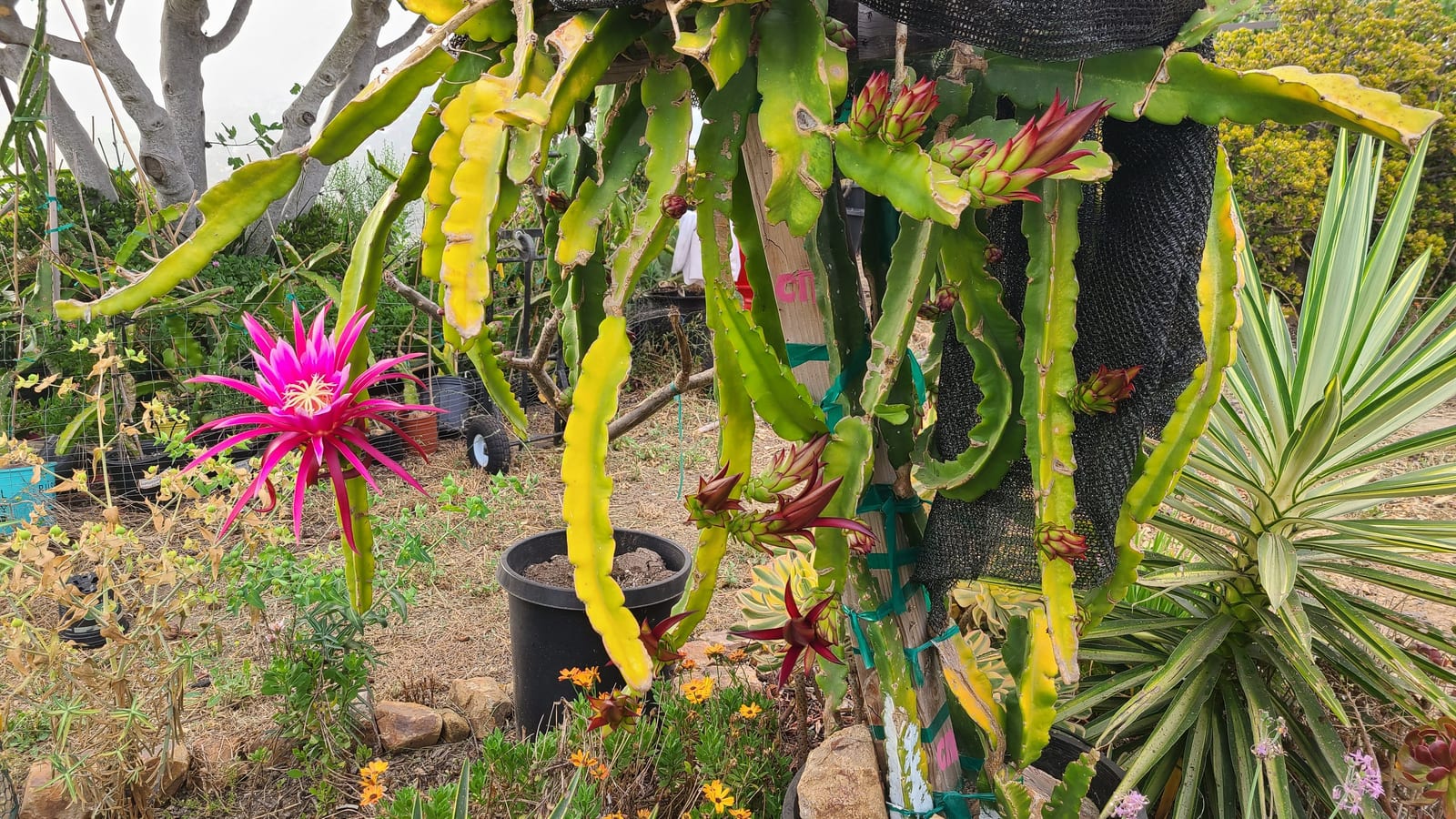
The plant itself behaves like a typical vining dragon fruit cactus. It needs a trellis, a post, or an arbor. Stems climb, branch at the top, then hang down where flowering and fruiting become heaviest. University of Florida Extension notes that dragon fruit stems may reach about 20 feet long and that mature trellises must support several hundred pounds of canopy weight. That is not a Dark Star-only rule, but it is very relevant if you plan to give this variety permanent ground space.
Climate fit, temperatures, and USDA zones
Dark Star is best treated as an outdoor variety for USDA zones 10a to 11, with extra protection in marginal winters. UF/IFAS notes that pitaya grows best at about 65°F to 77°F and tolerates warm conditions if temperatures stay below about 100°F. Epic Gardening gives a similar target range and warns that damage increases as temperatures drop below the mid-40s, with prolonged freezing becoming a real problem.
That lines up well with Southern California reality. In Escondido, zone 10a conditions usually give enough summer heat to ripen Dark Star well, but winter cold still matters. A south-facing wall, frost cloth on the coldest nights, and excellent drainage are part of the package. If you are inland and collect frost in low spots, Dark Star can still work, but smart siting matters more than the plant tag.
| Climate factor | Useful target | Dark Star response |
|---|---|---|
| Optimum growth temperature | 65°F to 77°F | Fast vegetative growth and stronger flowering |
| Heat ceiling to watch | Near 100°F | Can tolerate heat, but severe sun can scorch stems |
| Cold caution zone | Below mid-40s°F | Growth slows, tissue becomes more vulnerable |
| Freeze danger | 31°F and below | Potential stem injury and flower loss |
Because Sky Botanicals grows in Southern California zone 10a, we care about varieties that can handle real sun and still taste good. Dark Star is strong enough to make sense here, especially when planted where it gets morning sun and some relief during brutal inland heat spikes.
Pollination, fruit set, and bloom strategy
Dark Star is commonly sold as a variety that benefits from cross-pollination, and several grower listings treat it as self-sterile. In practical terms, you should not build your planting plan around solo performance. If you want dependable fruit set, keep a proven pollinator nearby and hand-pollinate when flowers open at night.
UF/IFAS recommends planting two or three different genetic types when self-incompatibility is uncertain. That is smart advice. Dragon fruit flowers are large, fragrant, and nocturnal, and pollination often happens best from evening through early morning. If you are building a serious backyard collection, pairing Dark Star with varieties that overlap bloom windows can improve set, fruit size, and consistency.
This is also why beginners often start with Sugar Dragon (S8). It is useful as both a fruiting variety and a pollination helper. Dark Star becomes even more attractive when it is part of a mixed planting instead of a solo experiment.
Soil, pH, and fertilizer targets
Dark Star wants exactly what most quality dragon fruit wants, fast drainage, oxygen around the roots, and enough nutrition to support flowering without creating soft, weak growth. A soil pH around 6.0 to 7.0 is a practical target. UF/IFAS notes that dragon fruit tolerates a range of soils if they are well drained, while poor drainage invites root issues fast.
For feeding, extension and grower guidance converge on balanced fertilizer early, then lower nitrogen and stronger phosphorus-potassium emphasis around flowering and fruiting. UF/IFAS lists common mixes such as 6-6-6, 8-3-9, and 8-4-12 with magnesium for general growth. Epic Gardening also recommends balanced formulas like 6-6-6 or 10-10-10, with higher-phosphorus options later in the season. In plain language, use balanced feed while building canopy, then avoid blasting the plant with nitrogen once bloom season starts.
| Growth stage | Fertilizer approach | Examples |
|---|---|---|
| Establishment | Light balanced feeding every couple of months | 6-6-6, 8-3-9, 8-4-12 |
| Pre-bloom | Moderate nitrogen, keep micronutrients available | Balanced cactus or fruiting feed |
| Bloom and fruit | Shift lower on nitrogen, higher on phosphorus and potassium | Grower-style fruiting blends, not lush-leaf formulas |
At Sky Botanicals in Escondido, we also treat drainage as non-negotiable. A premium cactus mix cut with coarse mineral material, bark, or pumice is usually better than rich black soil that stays wet after irrigation.
How we grow Dark Star at Sky Botanicals
Southern California dragon fruit growing is not the same as growing in humid Florida or tropical Asia. Our air is drier, our sun can be harsher, and our winter nights can cool off fast. That means we want trellised plants with airflow, a canopy that is pruned enough to keep light inside, and irrigation that is deep but not constant.
For Dark Star, the practical system looks like this. We give the plant a sturdy support, train one or a few main stems upward, top them when they reach the structure, and let the fruiting canopy form at the top. We watch sunburn on young tissue during heat waves, reduce water in winter, and keep flowers accessible for hand pollination during bloom season. That approach is simple, repeatable, and much more useful than generic advice that assumes every climate behaves like a tropical greenhouse.
If you are still building fundamentals, start with our dragon fruit care guide and our Southern California growing guide. Dark Star makes more sense when the support, pruning, and watering basics are already locked in.
Dark Star compared with other popular varieties
| Variety | Main strength | Typical appeal |
|---|---|---|
| Dark Star | Sweet purple flesh, marketable fruit, good size | Collectors and flavor-focused home growers |
| Purple Haze | Large fruit with grape-like notes | People who want dramatic purple fruit |
| Physical Graffiti | Big flavor and strong production | Backyard growers who want output plus taste |
| Sugar Dragon (S8) | Pollination value and strong flavor | Beginners and mixed plantings |
| Vietnamese White | Easy, classic white-flesh standard | Entry-level growers and reliable cropping |
Dark Star is not always the first beginner choice, but it is a very good second or third variety. Once you know how to manage trellis structure and pollination, it rewards you with fruit that feels like a genuine upgrade.
Should you grow Dark Star?
Grow Dark Star if you want a sweet purple-fleshed variety with broad grower respect, fruit in the roughly one-pound class, and flavor that stands out from bland grocery-store pitaya. It is especially good for warm-climate growers in Southern California who want a cultivar that earns its space with both looks and eating quality.
Skip it only if you want a one-plant setup with zero pollination planning or if your site is too cold for reliable outdoor dragon fruit. Otherwise, it is one of the more sensible collector varieties you can add to a zone 10a garden.
FAQ
How sweet is Dark Star dragon fruit?
Most grower sources place Dark Star around 19 to 21 Brix, which is high enough to count as a legitimately sweet dessert fruit when picked ripe.
Is Dark Star self-fertile?
Treat it as a variety that benefits from cross-pollination. Many sellers describe it as self-sterile or more dependable with another compatible variety nearby.
What does Dark Star taste like?
Growers usually describe it as sweet with mild grape or kiwi-lychee notes, plus refreshing texture rather than heavy jamminess.
What USDA zone is best for Dark Star?
USDA zone 10a to 11 is the safest outdoor target. In colder spots, use containers, greenhouse protection, or frost protection.
How large are Dark Star fruits?
Most reported fruit sizes land around 0.75 to 1.5 pounds, with some mature plants producing fruit closer to 2 pounds in strong conditions.
What soil pH should I use?
A practical target is about pH 6.0 to 7.0 in a very fast-draining mix. The plant cares more about drainage and airflow than about chasing a narrow number.
Why is Dark Star a good fit for Southern California?
Because it combines sweetness, color, and vigorous growth in a climate where warm summers and dry air can produce high-quality fruit, especially in Escondido and other zone 10a areas.
Sky Botanicals grows and compares 50+ dragon fruit varieties in Escondido, Southern California, USDA zone 10a. Dark Star remains one of the smarter purple-fleshed picks because it is not just attractive, it actually tastes like something worth growing.