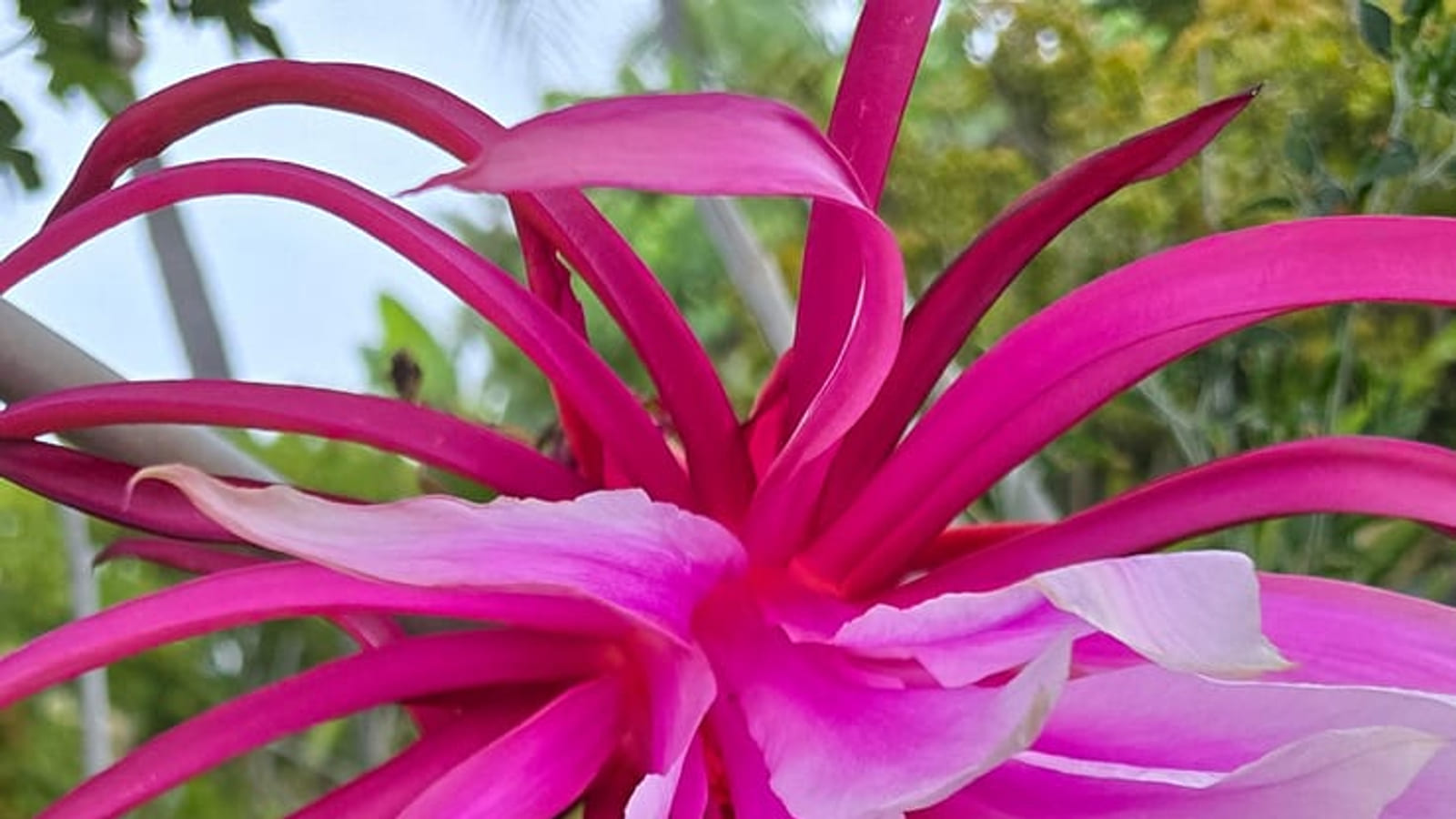
Purple Haze Dragon Fruit: One of the Largest, Sweetest Purple Varieties
Purple Haze is one of the largest and sweetest purple-fleshed dragon fruit varieties you can grow, combining 1-2 lb fruits, about 19° Brix sweetness, and noticeably fewer seeds than most cultivars. At Sky Botanicals in Escondido, California (USDA zone 10a), it has become a favorite among our 50+ dragon fruit varieties for people who want a serious eating fruit rather than a novelty.
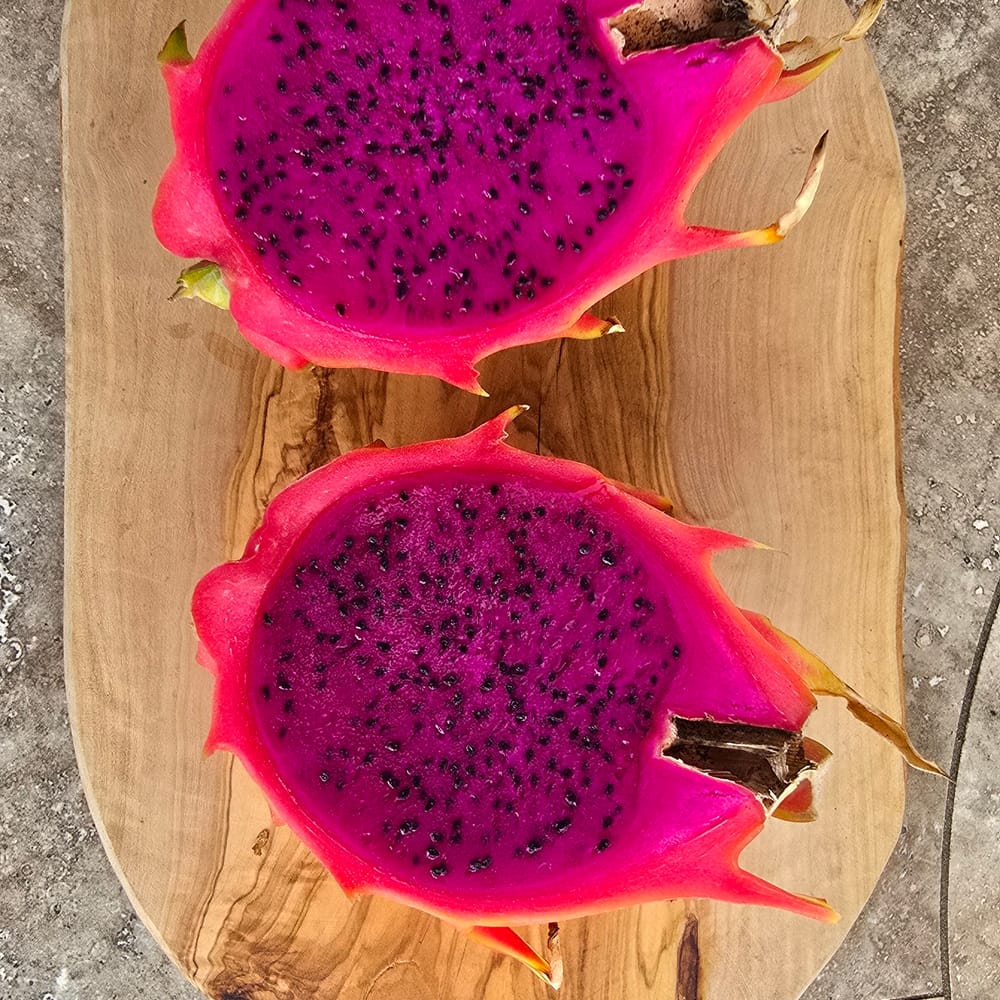
It is also one of the few varieties whose name you will remember: Purple Haze is named after the 1967 Jimi Hendrix song, a nod to the cultivar's smoky purple flesh and psychedelic color payoff when you cut one open.
Overview
Purple Haze is a purple-fleshed Selenicereus hybrid, part of the same broad group of night-blooming cacti that produces most of the dragon fruit sold in the United States. The skin is pink to red with the classic green-tipped fins. Inside, the flesh is a deep, saturated purple that stains cutting boards and smoothies the way a blackberry does.
What makes Purple Haze stand out in a lineup of purple varieties is the combination of traits growers usually have to choose between: big fruit size, high sweetness, refined flavor, and fewer seeds. Most purples deliver one or two of those. Purple Haze delivers all four.
Key facts at a glance
| Trait | Purple Haze | Why it matters |
|---|---|---|
| Species | Selenicereus hybrid (purple-fleshed) | Places it in the modern dragon fruit hybrid family |
| Named after | Jimi Hendrix song, "Purple Haze" (1967) | Memorable brand, easy to recommend by name |
| Skin color | Pink / red with green fins | Classic dragon fruit look, strong shelf appeal |
| Flesh color | Deep purple | Rich anthocyanin color, dramatic slice |
| Fruit size | 1-2 lb (about 450-900 g) | One of the largest purple varieties |
| Sweetness | About 19° Brix | Very sweet, well above the 12-14° range of most white-flesh types |
| Flavor | Sweet grape, refreshing | Distinct from earthy red-flesh profiles |
| Seeds | Noticeably few for a dragon fruit | Smoother eating experience |
| Self-fertile | No — requires cross-pollination | Plan a second compatible variety nearby |
| USDA zone | 9-11, best 10-11 | Matches Southern California growing windows |
What makes Purple Haze special
Most purple-fleshed dragon fruit varieties are grown for color first and flavor second. Purple Haze flips that. The deep purple flesh is certainly photogenic, but growers keep it in their collections because the eating quality earns the space on the trellis.
Three features drive that reputation:
- Size. Fruits commonly run 1 to 2 pounds, which puts Purple Haze in the same weight class as large-fruited varieties like Halley's Comet and San Ignacio. One well-ripened fruit can feed a family.
- Sweetness. A Brix reading around 19 is high for any dragon fruit. For reference, most white-flesh types land around 12-14° Brix. That 5-7 point gap is the difference between a mild, crisp fruit and a candy-sweet one.
- Fewer seeds. Dragon fruit normally has thousands of small black seeds distributed through the flesh. Purple Haze has noticeably fewer, which makes it feel smoother and more "fruit-like" compared with seedier cousins. For customers new to dragon fruit, this is often the feature that converts them.
If you are just starting to compare cultivars, the dragon fruit varieties guide walks through the broader landscape of reds, whites, purples, and yellows before you commit to a single plant.
Flavor and eating experience
Purple Haze tastes like a sweet grape with a clean, refreshing finish. It is not the earthy, slightly floral profile you get from some red-flesh varieties. It is brighter, more fruit-punch in character, with the kind of sugar push that lingers but does not turn cloying.
Because the seed load is lower than average, the texture is smoother. Bite through a slice and you get more flesh and less of the poppy-seed crunch that first-time dragon fruit buyers sometimes find distracting.
Serving ideas that play to those strengths:
- Chilled wedges. Cut in half, scoop out the flesh, and eat cold with a spoon. The cold temperature sharpens the grape notes.
- Smoothies. The deep purple color holds up well against banana, pineapple, or mango, and one 1.5 lb fruit is usually enough for two large smoothies.
- Fruit salads. Purple Haze cubes keep their color and hold shape longer than softer red varieties, so they look clean the next day.
- Sorbet and ice cream. The 19° Brix means less added sugar is needed, and the anthocyanin pigment dyes the dessert naturally.
Growing requirements
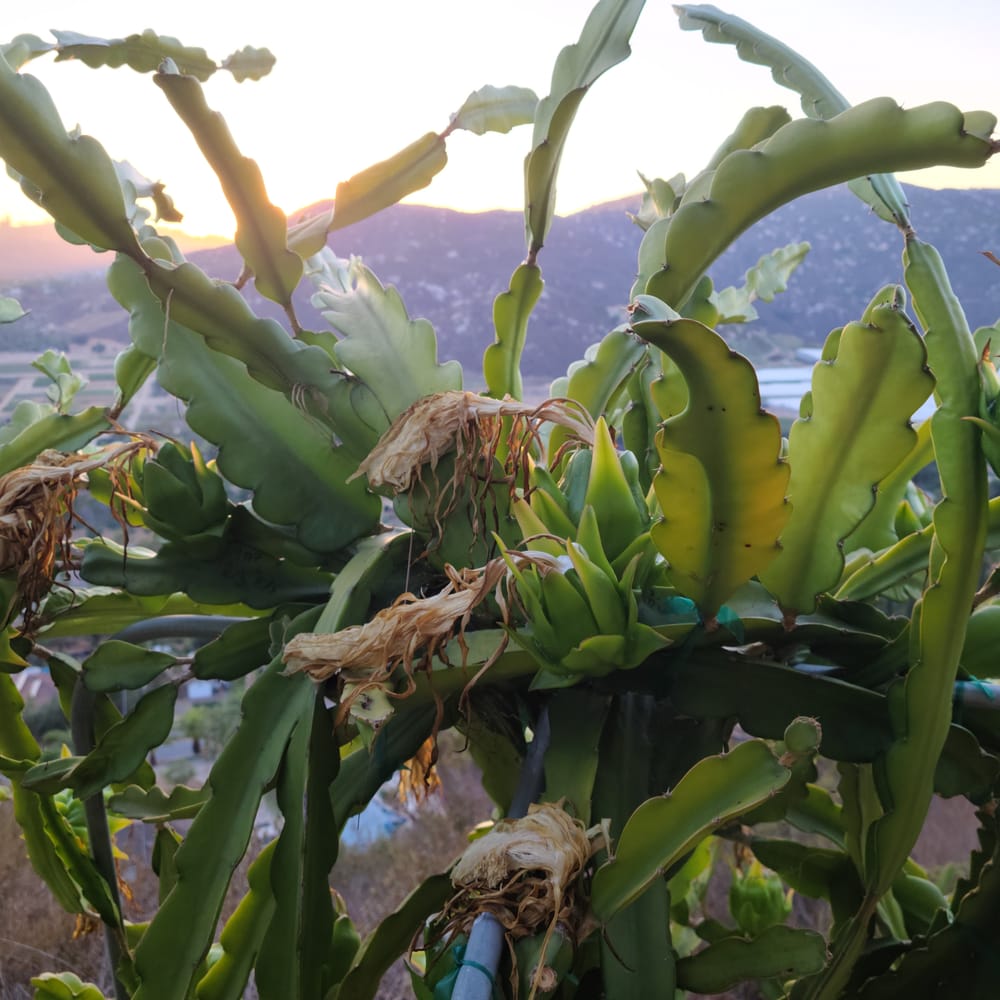
Purple Haze grows like most commercial dragon fruit: it is a climbing cactus that wants warmth, strong light, fast-draining soil, and consistent water during the growing season. In zone 10a Escondido, it runs a long bloom window from late spring through early fall, with fruit sizing up in 30-50 days after pollination.
Baseline conditions to target:
- Temperature: 65-85°F for active growth. Growth slows below 50°F. Extended exposure below 40°F risks stem damage, especially on young plants.
- Soil: Fast-draining, slightly acidic (pH 5.5-6.5). Raised beds or large containers with a cactus-friendly mix work well in heavier native soils.
- Light: Full sun to afternoon shade in the hottest inland sites. In Escondido summers, filtered afternoon light prevents stem scald without hurting bloom count.
- Support: A sturdy post, trellis, or T-post with a top frame. Purple Haze produces vigorous stems, and the 1-2 lb fruits need a support system that will not wobble once loaded.
- Fertilizer: A balanced 6-6-6 or 10-10-10 during the active season, plus a bloom-focused feed (lower N, higher P and K) leading into flowering.
For the complete growing framework that applies to every cultivar in the collection, see our dragon fruit care guide.
Pollination requirements and compatible partners
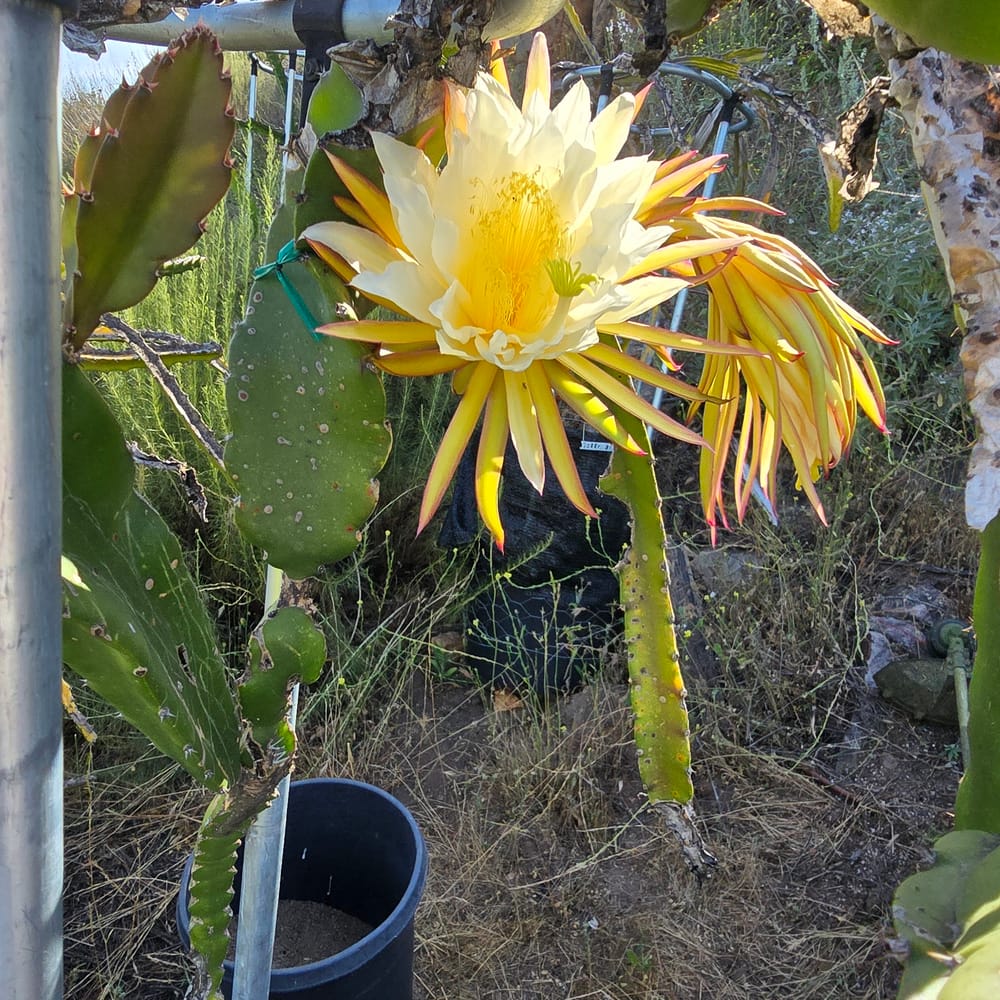
This is the single most important thing to get right with Purple Haze: it is not self-fertile. A Purple Haze plant on its own, no matter how perfectly grown, will not reliably produce fruit. It needs pollen from a different, compatible cultivar to set fruit.
Two partners we rely on at Sky Botanicals:
- Sugar Dragon (S8). Vigorous, generous bloomer, widely considered a near-universal pollinator for purple-fleshed hybrids. It is also an excellent stand-alone eater, so you are not giving up a slot just to service Purple Haze.
- Vietnamese White. Self-fertile, heavy bloomer, and a reliable pollen donor. Blooms tend to overlap well with purple-fleshed hybrids in a Southern California season, which is the other half of the equation.
Practical setup:
- Plant Purple Haze and at least one compatible partner within about 20-30 feet of each other, ideally on the same trellis run or adjacent posts.
- Watch bloom timing in the first season. If the partner blooms on different nights, you will still need to hand-pollinate. Keep a small paintbrush or cotton swab nearby during peak bloom weeks.
- Hand-pollinate at night. Dragon fruit flowers open after sunset. Transfer pollen from the partner's anthers to the Purple Haze stigma (and vice versa) in the first few hours of bloom for the best set.
Even with the pollination requirement, Purple Haze is worth the planning. The size, sweetness, and flavor premium more than pay for the second plant.
Comparison to other large purples
Three big purple-fleshed varieties come up in the same conversation: Purple Haze, Halley's Comet, and San Ignacio. Each has its own character. The table below summarizes the practical differences growers care about most.
| Variety | Typical size | Sweetness | Flavor notes | Self-fertile | Best fit |
|---|---|---|---|---|---|
| Purple Haze | 1-2 lb | ~19° Brix | Sweet grape, refreshing, fewer seeds | No | Premium eating variety with dramatic color |
| Halley's Comet | 1-2 lb | ~18-20° Brix | Sweet, juicy, classic purple profile | Partially, cross-pollination boosts yield | Full-sun tolerance and large fruit |
| San Ignacio | 1.5-3 lb | ~17-19° Brix | Mild sweet, watermelon-like, softer flesh | No | Largest fruit size on the trellis |
Short version: choose Purple Haze when flavor and a lower seed count matter most, Halley's Comet when you need a purple that tolerates harsher sun, and San Ignacio when pure fruit size is the goal.
How we grow Purple Haze at Sky Botanicals
Sky Botanicals is a dragon fruit nursery in Escondido, California, USDA zone 10a, with 50+ varieties in active production. Purple Haze is one of the cultivars we recommend when someone asks for a "serious eating" plant rather than a first-time beginner variety.
Our standard setup for Purple Haze is a single plant per post, paired on the same trellis run with either Sugar Dragon or Vietnamese White for cross-pollination. We prune to a strong single leader, then let the top branch out over a top frame so the fruit hangs freely, which matters when fruits are pushing toward the 2 lb end of the range.
If you are planning a backyard or small-farm planting, our general rule is simple: never plant a non-self-fertile variety like Purple Haze alone. Pair it from day one, and you will spend your second and third seasons harvesting instead of troubleshooting.
FAQ
Is Purple Haze self-fertile?
No. Purple Haze requires cross-pollination from a different compatible variety. Sugar Dragon and Vietnamese White are two of the most reliable partners.
How big do Purple Haze dragon fruits get?
Fruits commonly reach 1-2 pounds, which makes Purple Haze one of the largest purple-fleshed varieties in cultivation.
How sweet is Purple Haze?
Purple Haze typically measures around 19° Brix, which is very sweet. For comparison, most white-flesh dragon fruit varieties fall in the 12-14° Brix range.
What does Purple Haze taste like?
Sweet grape with a refreshing finish, distinct from the earthier profile of many red-flesh varieties. The lower seed count also makes it feel smoother on the palate.
Why is it called Purple Haze?
It is named after the 1967 Jimi Hendrix song "Purple Haze," a fitting reference for a cultivar whose flesh turns a deep, saturated purple when sliced.
What should I plant next to Purple Haze for pollination?
Sugar Dragon (S8) and Vietnamese White both work well. Plant at least one within 20-30 feet, ideally on the same trellis run, so bloom timing overlaps and pollinators can move between them.
Does Purple Haze grow well in Southern California?
Yes. Southern California, including USDA zone 10a around Escondido, is well-suited to Purple Haze. Warm days, mild nights, and long bloom windows all match what the plant wants.
Does Purple Haze really have fewer seeds?
Yes. Compared with most commercial dragon fruit varieties, Purple Haze has a noticeably lower seed load, which is one of the reasons it is often recommended as a premium eating variety. For more answers to common buyer questions, see our dragon fruit FAQ.
If you want to keep narrowing in on the right cultivar for your yard or farm, start with the varieties guide, then layer in the care guide once you have a shortlist. Purple Haze rewards growers who plan ahead, and for the right setup it is one of the most satisfying dragon fruits you can grow.