Physical Graffiti Dragon Fruit: The SoCal Winner
If you want the most reliable red-fleshed dragon fruit for Southern California, Physical Graffiti is the answer. UC rated it the most preferred and widely planted variety in the region, topping a 20-cultivar trial with 23,429 g of marketable fruit per plant. It is not the sweetest pitaya on the refractometer, but it is the best balanced one you can grow here. The 17.93 Brix reading reflects a deliberate sugar-acid equilibrium that makes it delicious rather than just sugary, while its joint-highest heat score and vigorous growth make it forgiving in our climate.
| Spec | Detail |
|---|---|
| Parentage | Selenicereus guatemalensis x S. undatus |
| Fruit Weight | 374 g avg (0.75-1.5 lb) |
| Sugar | 17.93 Brix |
| Bloom to Harvest | 40 days |
| Harvest Window | July-December |
| Pollination | Self-sterile |
| Cold/Heat Tolerance | 4.5 of 5 |
| Marketable Yield | 23.4 kg per plant |
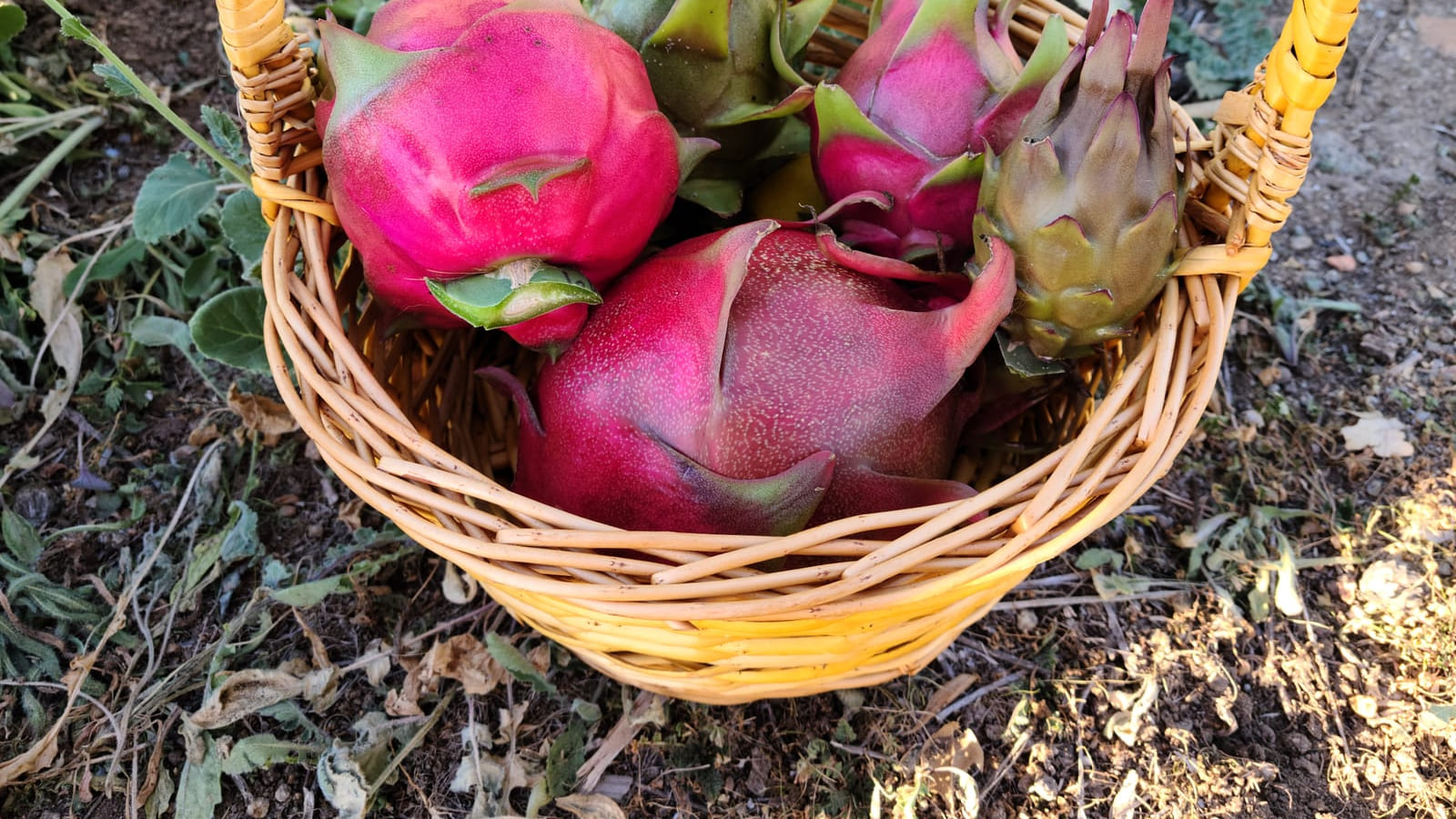
What Physical Graffiti actually is
Physical Graffiti is a purple-fleshed pitaya hybrid. The peer-reviewed literature treats it as an interspecific cross between Selenicereus guatemalensis and S. undatus[2]. You will see this written as Hylocereus guatemalensis x H. undatus in older sources. That is not a contradiction. The genus Hylocereus was merged into Selenicereus after molecular phylogeny studies reorganized the cactus family[12]. The plant did not change. The name did.
The variety is a Southern California selection, not an import. The commercial cultivar description published in HortScience records Physical Graffiti as Hylocereus sp., selected by Paul Thomson in San Diego County in the early 1980s[6]. It is roughly 40 years old. That origin story matters for growers in our climate. You are planting a variety bred and selected right here, not one adapted from tropical trials.
On the name. The Led Zeppelin reference is nursery folklore. The trade convention of naming dragon fruit hybrids after rock records is real. Purple Haze, American Beauty, Halley's Comet, and David Bowie are all named cultivars. Physical Graffiti is the 1975 Led Zeppelin double album. But no primary source documents who applied the name to Paul Thomson's selection[6]. It is a fun story. It is not cultivar history.
Growers also say Physical Graffiti and '1-S' are the same clone. 1-S is recorded by Paul Thomson in his book Pitahaya as a seedling of Rixford (a purple-fleshed Guatemalan type) crossed with Niezel (a white-fleshed S. undatus)[12]. That parentage is consistent with the S. guatemalensis x S. undatus cross given in the scientific literature. But the 1-S identity remains a grower claim rather than a documented registration[2]. Treat it as useful context, not a registry fact.
One practical note on propagation. The scion and the rootstock can be different varieties. An Iberian establishment checklist lists Physical Graffiti among imported cultivars accepted in the Iberian Peninsula and notes that seedling rootstock of any cultivar is used as a base for grafting less cold-tolerant or vigorous cultivars[2]. If you buy a grafted plant, the vigorous growth you see may partly come from the rootstock. For more on how this variety stacks up against other pitayas, see our complete dragon fruit varieties guide.
The fruit: colour, size, and what 'purple-fleshed' really means
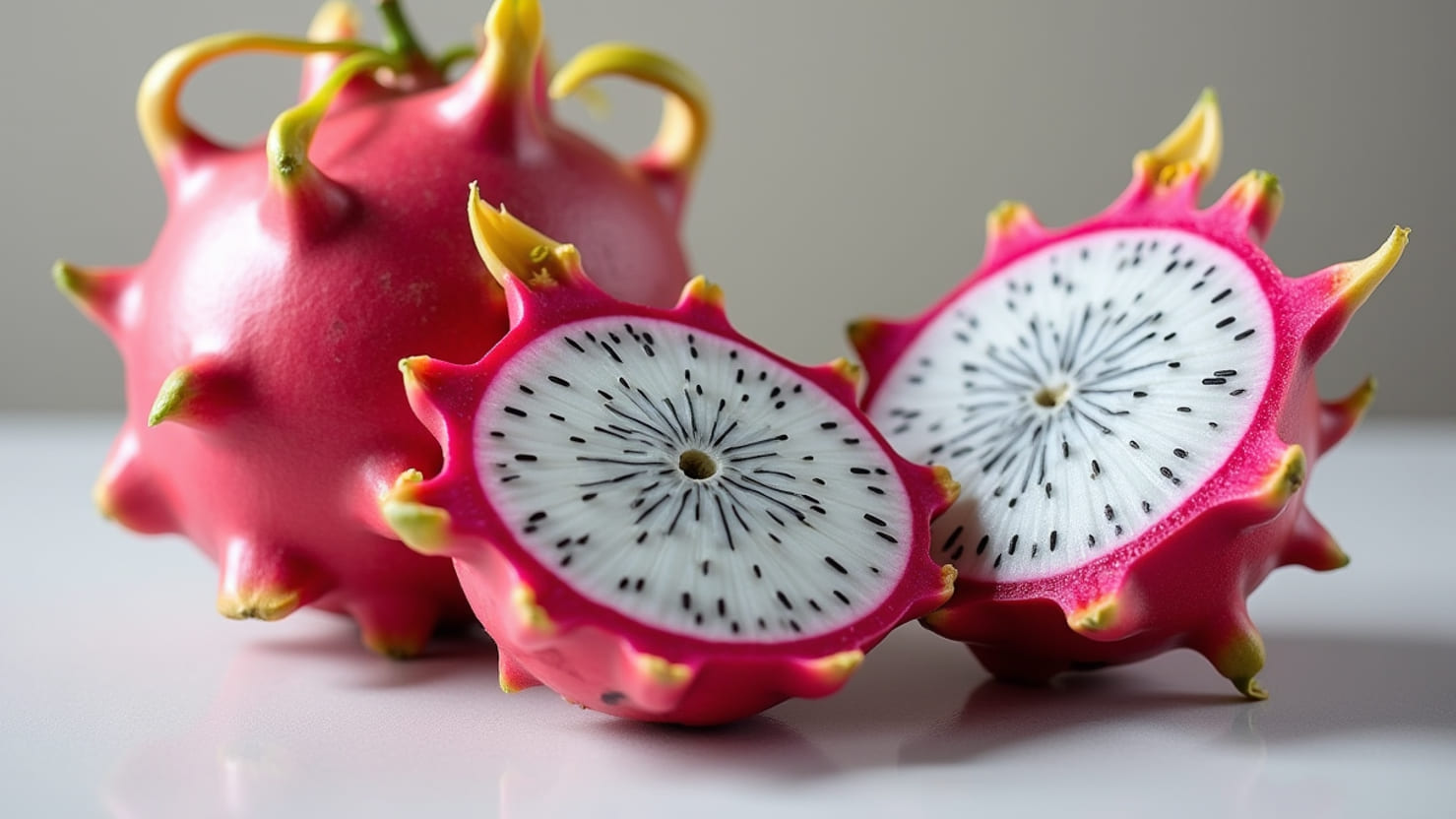
Physical Graffiti produces oblong fruit with a relatively thin, bright red rind that carries few bracts. Inside, the flesh is a hot-pink to magenta colour, speckled with small seeds. The University of California evaluation measured the average fruit weight at 374 g, which sits comfortably within the nursery range of 0.75 to 1.5 lb for this cultivar.[12] Despite the modest size, it earned the highest sensory score of all 20 cultivars in the trial, proving that market preference often favors flavor and texture over sheer bulk.[6]
Growers often assume that "purple-fleshed" means the fruit is packed with the same red pigments found in beets or red-fleshed pitayas. The lab data tells a different story. In the only head-to-head comparison of seven varieties, the red-fleshed types like Costa Rica and Nicaragua held the highest levels of betalain pigments. Physical Graffiti and Purple Haze clustered instead on phenolics and flavonoids.[1] This means the honest claim for Physical Graffiti is antioxidant and phenolic density, not betalain content.
| Metric | Physical Graffiti | Purple Haze | Red-fleshed types | White-fleshed types |
|---|---|---|---|---|
| Phenolics | Highest (~190 mg GAE/100g) | High (~180 mg GAE/100g) | Lower | Lowest (~90 mg GAE/100g) |
| Flavonoids | High (~400 mg RE/100g) | Highest (~550 mg RE/100g) | Variable (Nicaragua ~440) | Low (180-220 mg RE/100g) |
| Betalains | Lower | Lower | Highest | Lowest |
| Antioxidant (DPPH) | Highest (~92%) | High (~90%) | Moderate | Low (30-52%) |
| Antioxidant (FRAP) | Highest (~120) | High | Moderate | Low |
| Antioxidant (ABTS) | Highest (4.2 mg Trolox/100g) | High | Moderate | Low |
Physical Graffiti recorded the highest antioxidant capacity of all seven varieties in three independent assays. It achieved about 92% radical scavenging in the DPPH assay, the highest FRAP reducing power at about 120, and the highest ABTS value at 4.2 mg Trolox per 100 g fresh weight.[1] While Purple Haze edged it out in flavonoid content, Physical Graffiti took the top spot for total phenolics.[1] This chemical profile explains why the fruit looks magenta rather than deep red. The color comes from a complex mix of phenolic compounds rather than a single dominant betalain pigment.
One practical note for growers aiming to maximize these health compounds: boron is a priority micronutrient. It specifically increases total soluble solids, protein, ascorbic acid, and flavonoid concentrations in pitaya fruit.[2] This is especially relevant in acidic soils where boron availability can be limited. If you are growing Physical Graffiti for its phenolic density, ensuring adequate boron levels is a simple way to support the plant’s chemistry. For a broader look at how this variety stacks up against other pitayas, see our complete dragon fruit varieties guide.
Flavour: why 17.93 Brix beats 20 Brix on the palate
Refractometers do not lie, but they do not tell the whole story either. In the head-to-head comparison of seven pitaya varieties, Physical Graffiti and Purple Haze recorded among the lowest total soluble solids, while Connie Mayer peaked at 14.4 Brix and white- and red-fleshed types typically ran 13.2 to 13.7 Brix.[1] The University of California measurement of 17.93 Brix for Physical Graffiti grown in Southern California is higher than those baseline comparisons, yet it still trails the sugar content of yellow-skinned pitayas like Palora or Yellow Dragon, which can reach up to 22 Brix.[1] If you judge dragon fruit solely by sweetness, you will always prefer the yellows. But sweetness is not flavour.
The study authors concluded that palatability is decided by the balance of sugars and acids, not sugar alone.[1] Physical Graffiti and Purple Haze carried the highest titratable acidity of the seven varieties tested, resulting in the lowest maturity index (the ratio of total soluble solids to titratable acidity).[1] This acidity is not a defect. It is the structural element that prevents the fruit from tasting flat or cloying. The low acidity across all pitaya varieties is part of why the fruit is generally pleasant, but the specific sugar-acid equilibrium in Physical Graffiti is what elevates it from merely sweet to complex.[1]
| Variety Type | Sugar Profile | Palate Impact |
|---|---|---|
| Yellow Pitaya (e.g., Palora) | Up to ~22 Brix | High sweetness, often flat finish |
| Physical Graffiti | 17.93 Brix (UC data) | Balanced, complex, highest sensory score |
| Standard White/Red | 13.2-14.4 Brix | Lower sugar, variable acidity |
Growers describe the resulting taste in terms that lab data cannot capture. The flesh delivers notes of blackberry, raspberry, and plum, rather than just generic sugar. This complexity is why Physical Graffiti earned the highest sensory score of all 20 cultivars in the UC trial, despite not being the sweetest on the refractometer.[6] The fruit is not trying to be a candy bar. It is trying to be a berry. The acidity cuts through the sugar, creating a clean finish that lingers, whereas higher-Brix varieties often leave a coating sensation on the tongue.
This balance is also why the fruit remains desirable even as it ripens. Pitaya is non-climacteric, meaning it does not gain sugar after picking, so the 17.93 Brix reading is final.[4] Because the acidity is high, the fruit does not taste "green" or astringent at harvest, nor does it taste overly fermented if you wait a day or two. The sugar-acid ratio holds the flavour profile steady. For a grower, this means you can harvest at peak colour without worrying that the fruit will taste bland if it sits on the counter for a short time. The flavour is locked in by chemistry, not just by sugar content.
If you are choosing varieties for a home garden, consider what you value in the fruit. If you want maximum sweetness, look at the yellows. If you want the best overall eating quality, with depth, complexity, and a refreshing finish, Physical Graffiti is the superior choice. It proves that the best dragon fruit is not the one with the highest number on the meter, but the one with the best balance. For more on how this variety stacks up against other pitayas, see our complete dragon fruit varieties guide.
The nutrition numbers nobody else publishes
Most variety guides stop at Brix and yield. They miss the chemical profile that makes Physical Graffiti distinct in a lab setting. When researchers assayed seven pitaya varieties, Physical Graffiti pulp measured the highest phenolic content at about 190 mg GAE per 100 g fresh weight. That figure sits ahead of Purple Haze at roughly 180 and is nearly double the white-fleshed Imperial, which measured about 90.[1]
The antioxidant capacity tells the same story. In three independent assays, Physical Graffiti pulp recorded the highest values of all seven varieties. It achieved about 92% radical scavenging in the DPPH assay, compared to 90% for Purple Haze and 30-52% for white-fleshed types like Imperial and Golden de Israel. The FRAP reducing power hit about 120, and the ABTS value reached 4.2 mg Trolox per 100 g fresh weight.[1]
Mineral density is where the peel becomes relevant. Physical Graffiti had the highest mineral macronutrient levels of the seven varieties tested. The peel alone contained 76.2 g/kg potassium, 7.1 g/kg magnesium, 10.1 g/kg calcium, and 10.2 g/kg nitrogen. The pulp contributed the highest measured nitrogen value at 24.6 g/kg.[1]
Peel is not waste. It accounts for roughly 30% of the fruit mass and is studied as a source of pectin and colourant. Physical Graffiti peel also carried the highest boron (131.7 mg/kg) and zinc (57.0 mg/kg) of the varieties tested.[1]
| Mineral | Peel (g/kg) | Pulp (g/kg) |
|---|---|---|
| Potassium | 76.2 | - |
| Calcium | 10.1 | - |
| Nitrogen | 10.2 | 24.6 |
| Magnesium | 7.1 | - |
| Boron (mg/kg) | 131.7 | - |
| Zinc (mg/kg) | 57.0 | - |
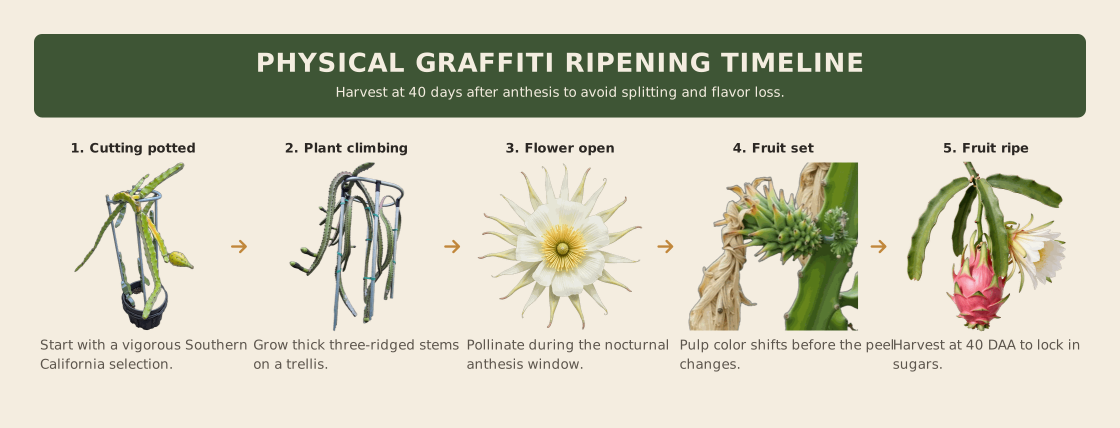
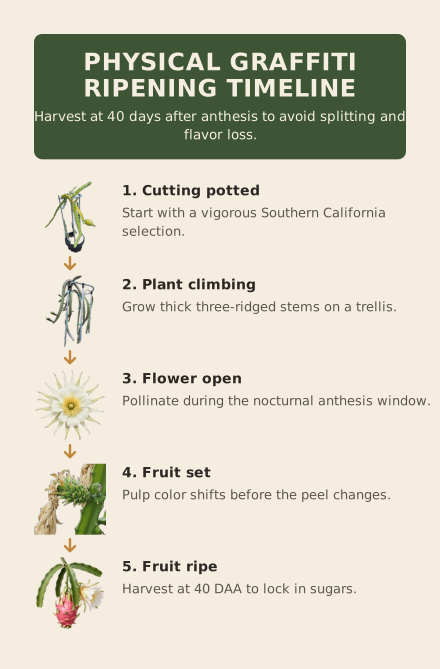
One practical note on harvest timing. The pulp of pitaya starts changing colour 3-5 days before the peel does. Fruit reach maximum colouration about four to five days after that shift begins. Skin colour alone lags the eating quality inside, so rely on the days-from-bloom clock rather than the rind hue.[8]
Self-sterile: the one non-negotiable
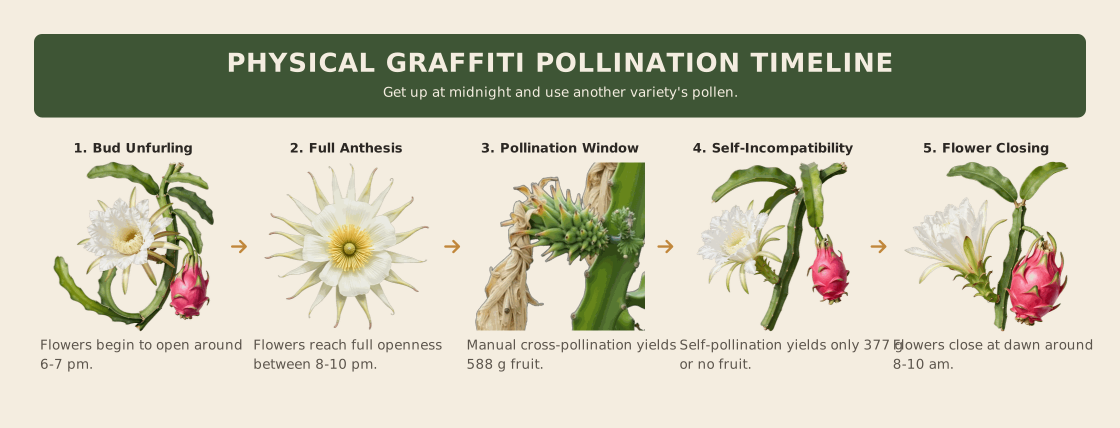
Physical Graffiti is self-sterile. This is the single most consequential fact about growing this cultivar. You cannot rely on a lone plant to produce fruit. Spicy Exotics, the largest US nursery trade source for this cultivar, states plainly that it requires pollen from another compatible variety to set fruit, though it will accept pollen from most red-fleshed types.[12]
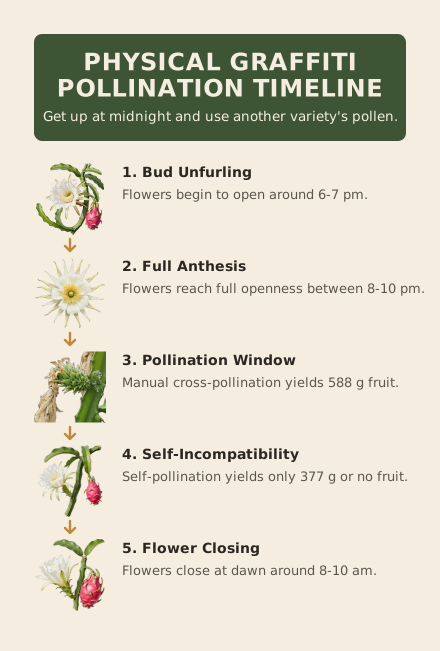
The science backs this up with hard numbers. In a two-year controlled trial, a red/purple-fleshed clone set fruit only when manually cross-pollinated. It was strictly self-incompatible. Manual cross-pollination produced the largest fruit at 588 g, compared to 377 g under manual self-pollination and about 200 g under open pollination in a self-compatible white clone.[3] If you want the heavy, well-filled fruit that makes Physical Graffiti worth the space, you must provide compatible pollen.
UF/IFAS extension guidance recommends planting 2-3 different genetic types, not clones of one another, to ensure cross-pollination improves both fruit set and fruit size.[7] However, there is honest uncertainty here. A UF/IFAS specialist notes that information on the self-incompatibility of available cultivars and selections is not well documented, which makes specific variety recommendations unreliable.[7] You must test in your own garden.
Farm experience: At Sky Botanicals, we have found Physical Graffiti sets reliably with Vietnamese White, Sugar Dragon/S8, Neitzel, and American Beauty. Keep these pollination partners within 30-40 feet to ensure bloom synchrony and easy hand-pollination access.
Because fruit size tracks the number of fertilized ovules, incomplete or late pollination sets fruit that is smaller and misshapen even when it does set.[3] Hand-pollination is not a nitpick; it is a yield practice. For more on pairing Physical Graffiti with compatible partners, see our complete dragon fruit varieties guide.
The 16-hour flower: timing your hand-pollination
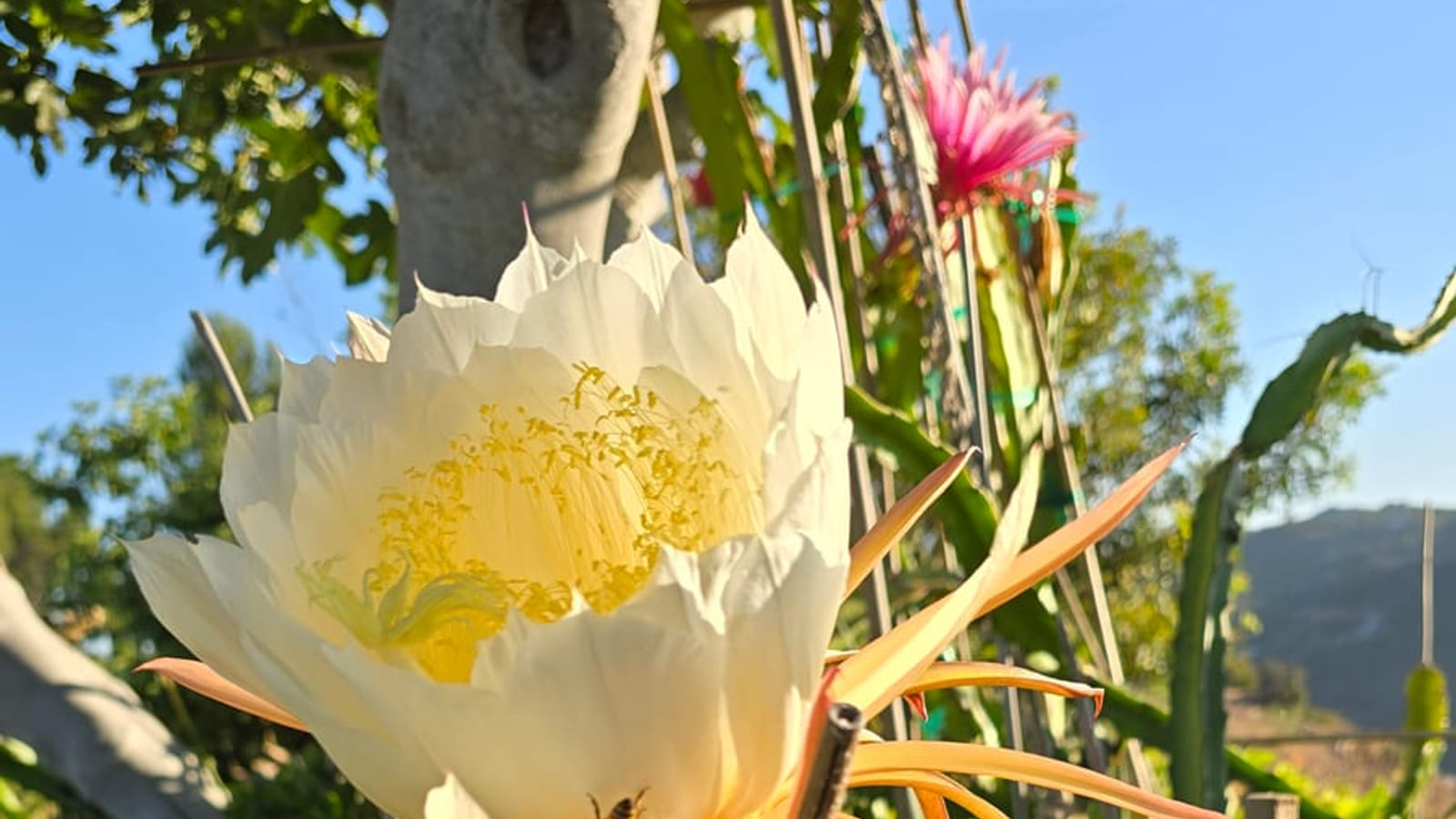
Physical Graffiti flowers are nocturnal and functionally timed. Buds begin to unfurl around dusk, roughly 6 to 7 pm, and reach full anthesis between 8 and 10 pm. By dawn, the flower starts closing.[3] This short lifespan dictates your schedule. The effective pollination window runs from about 4 hours before anthesis to 12 hours after it.[3] If you miss this window, the stigma loses receptivity and the pollen loses viability, regardless of how much effort you put in later.
In pitaya, fruit size tracks the number of fertilised ovules. Incomplete or late pollination sets fruit that is smaller and misshapen, even if it does set.[3] Commercial plantings rely on hand-pollination because it produces larger, better-filled fruit than insect pollination alone.[3] While nocturnal moths, bats, flies, and chafers visit the open flower, they are unreliable for a consistent crop.[3] Relying on them leaves money on the table.
Timing tip: Prepare your pollen source in the evening. Collect pollen from a compatible variety when its flower is fully open (8-10 pm) and apply it to the Physical Graffiti stigma immediately. If you cannot pollinate at night, do it early the next morning, but understand that effectiveness drops as the flower closes.
For growers looking to optimize their cross-pollination partners, consult our complete dragon fruit varieties guide to identify compatible pollen sources that will maximize fruit size and quality.
Bloom to harvest: the 40-day clock
Dragon fruit is non-climacteric. This means the fruit does not ripen or gain sugar after you cut it from the stem. The sugar reading you take off the plant is final. There is no ripening on the counter. If you pick it early, it stays early. If you wait too long, it degrades. Physical Graffiti follows a tight biological schedule that rewards precision.
In Southern California trials, University of California researchers measured exactly 40 days from bloom to harvest for this cultivar[6]. This sits squarely within the general framework for pitaya maturity. You can track progress by watching the peel. Colour break usually appears 25 to 30 days after flowering[8]. However, skin colour lags behind internal quality. The pulp begins changing colour 3 to 5 days before the peel does, and maximum colouration happens about four to five days after that shift[8]. Relying on the rind alone often leads to picking too early.
For the best eating quality, aim for the optimum window. For fruit you intend to eat at home, harvest between 35 and 38 days after anthesis[8]. If you are shipping fruit or selling it at a market, cut it earlier, between 32 and 34 days after anthesis, to account for transit time[8]. A soluble-solids to acid ratio of about 40 is the proposed maturity target for peak flavour[8].
| Stage | Days After Anthesis (DAA) | Action |
|---|---|---|
| Colour Break | 25-30 | Peel shifts from green to red. Internal pulp is still developing. |
| Minimum Maturity | 30-32 | Earliest safe harvest. Flavour may be sharp. |
| Travel Window | 32-34 | Best for shipping or market sales. Firm texture. |
| Optimum Home Use | 35-38 | Peak sugar-acid balance. Best flavour for immediate eating. |
| UC Trial Average | 40 | Documented average for Physical Graffiti in SoCal. |
Do not let it hang too long. Growers often advise leaving fruit on the vine for 3 to 5 extra days past the estimated maturity date to ensure sweetness. This is risky. Over-mature pitaya is a real failure mode. Delaying harvest a few days past maturity causes fruit splitting, a decline in total soluble solids, water-soaked flesh translucency, and off-odours[8]. Once the sugar is locked at the cut, waiting only invites decay.
Watch the scales. The bracts on the fruit are your visible clock. Scale yellowing and wilting appear within 3 days at ambient temperature, and scale-base rot follows within 7 days[4]. After that, rot spreads into the pericarp. For Physical Graffiti, the thin bright-red rind makes these signs easy to spot. If the scales look tired, cut the fruit. Do not gamble on extra days on the vine. The balance of sugars and acids decides palatability, and that balance peaks within the 35 to 38 day window[8]. For more on how this timing compares to other varieties, see our complete dragon fruit varieties guide.
Season and productivity in a Southern California garden
UC’s seasonality chart places Physical Graffiti in a long fruiting window from March through November in Southern California[6]. The cultivar description lists a harvest window of July to December[6]. These are not contradictions. They describe the same phenomenon from two angles. The March-November range reflects when flowers open and set fruit. The July-December range reflects when those fruits reach maturity and are ready to cut. You will see blooms early in the season, but the first ripe fruit arrives later. Expect a steady drip of harvests rather than a single glut.
Our own observations on the farm align with this. We see 3 to 5 distinct flushes between May and November. Each flush represents a wave of flowering followed by fruit development. This pattern explains the high yield. In the UC trial, Physical Graffiti produced 23,429 g of marketable fruit per plant, topping all 20 cultivars tested[6]. That is about 52 lb per plant. For context, American Beauty yielded 5,566 g, while the best white-fleshed types managed just over 20,000 g[6]. Physical Graffiti outperformed them all.
At maturity, a well-established plant can yield about 220 lb (100 kg) of fruit per year[7]. This level of production is sustainable for a long time. The useful life of a planting is estimated at about 20 years[7]. You are not planting a short-term experiment. You are installing a long-term fruit source. Time to first fruit varies. From seed, it can take as long as 7 years. From a good rooted cutting, you may see fruit in 6 to 9 months[7]. Most growers start with cuttings or young plants to skip the wait.
Canopy management is critical. Physical Graffiti is a vigorous grower. Without regular pruning, the canopy becomes overcrowded. Dense foliage blocks light and air, which reduces flower initiation and invites disease. Thin out stems aggressively. Keep the structure open enough to see through. This is not optional for this cultivar. It is the key to sustaining the high yields seen in trials.
Fertilization supports this heavy load, but it does not need to be excessive. For home plantings, start with light applications. In year 1, use about 0.25 lb (118 g) per plant every 2 months[7]. Choose a balanced or palm-type fertilizer that contains 2-3% magnesium. As the plant matures, increase the rate. From year 4 onward, apply 0.50-0.75 lb (227-341 g) per plant per year, split into 3 to 4 applications[7]. Supplement this with 5 lb of manure or compost twice a year[7]. This staged approach matches the plant’s growing capacity. It avoids burning young roots while feeding mature vines that are producing hundreds of pounds of fruit.
Water and feed are inputs. Pruning is the control. If you neglect the canopy, the yield drops. If you manage it, Physical Graffiti rewards you with a long, productive life. It is a commitment, but one that pays off in steady harvests for decades.
Climate tolerance: what 4.5 out of 5 actually protects
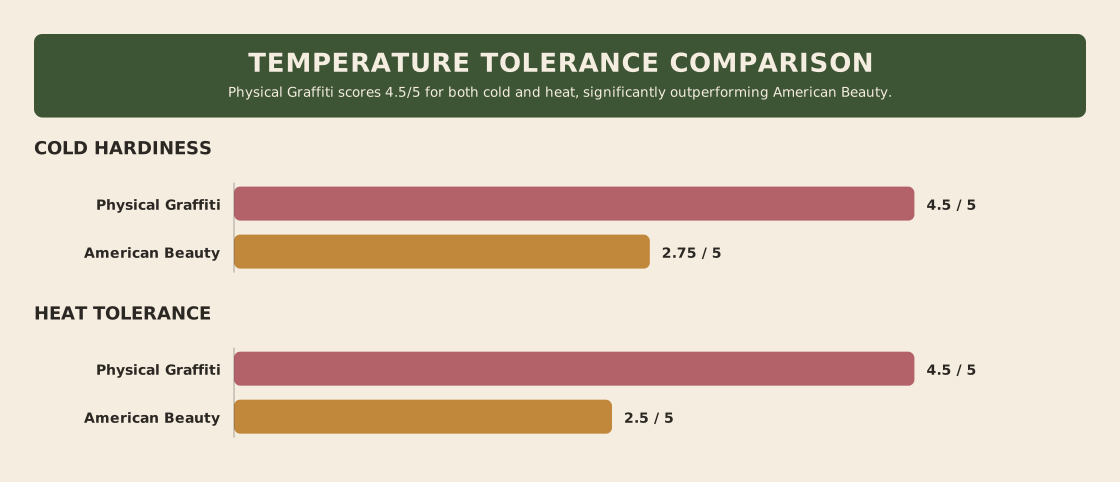
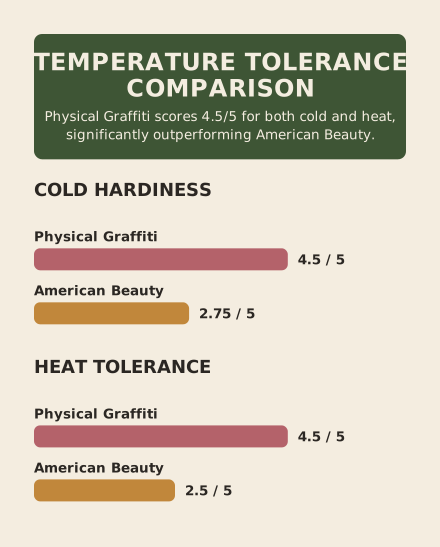
UC rated Physical Graffiti 4.5 out of 5 for both cold hardiness and heat tolerance. That heat score was the joint-highest in the trial, and the cold score tied for the top with Halley's Comet.[6] For a grower in Zone 9b or higher, this means the plant handles the extremes of Southern California better than most pitayas, but it does not mean it is indestructible. The limits are asymmetric. Frost is the single greatest limitation to cultivation, while heat is a productivity brake rather than an immediate killer.[2]
Understanding the temperature ladder helps you manage risk. The plant thrives in a narrow sweet spot. Outside that range, you are managing damage control. The table below maps the physiological responses to specific temperatures.
| Condition | Temperature | Plant Response |
|---|---|---|
| Optimum Growth | 65-77°F (18-25°C) | Peak vegetative and reproductive activity. |
| Flowering Inhibition | Above 100°F (38°C) | Bloom initiation stops; heat stress accumulates.[11] |
| Heat Maximum | ~104°F (40°C) | Survivable only with adequate root water. |
| Frost Minimum | ~28°F (-2°C) | Lower limit of tolerance; tissue injury likely. |
| Lethal Threshold | ~25°F (-4°C) | Plant death. |
Heat tolerance is high, but it is conditional. The plant withstands up to about 40°C only when roots have water. If the soil dries out during a heat spike, the stems will scorch and the plant will stall. Above 38°C, flowering is inhibited. This is why inland growers often see a bloom gap during peak summer heat, even if the plant looks healthy. The plant survives the heat, but it stops reproducing until temperatures drop.
Cold tolerance is where the 4.5 score earns its keep. Physical Graffiti is one of the most cold-hardy varieties available, but it is not a tropical plant. Frost is the primary threat. In Zone 9b, you must provide frost protection. Covering the plant or moving potted specimens to a sheltered location is necessary when temperatures approach 28°F. If temperatures drop near 25°F, the plant will likely die regardless of protection.[8]
Sunburn risk: Severe stem sunburn has been recorded in low-humidity or high-altitude regions. About 30% shading is recommended for the first 3-4 months after planting and wherever insolation reaches damaging levels.[7] However, too much shade cuts production. Balance is key.
Extreme sunlight can injure the crop, particularly in inland areas with low humidity.[7] If you are planting in a hot, dry microclimate, consider temporary shade cloth for young plants. Once established, the vigorous growth of Physical Graffiti helps it recover from minor sun damage, but prevention is easier than treatment. For a broader look at how different varieties handle climate stress, see our complete dragon fruit varieties guide.
Light: how growers push it out of season
Physical Graffiti naturally fruits from March through November in Southern California, but you do not have to stop harvesting when the days shorten. Flower initiation in pitaya is photoperiod-regulated, meaning the plant reads day length to decide when to bloom. This biological switch is what allows growers to induce winter flowering using supplemental light and night-interruptive lighting.[11] The mechanism is hormonal. When you interrupt the dark period, cytokinin levels rise first, followed by gibberellin, auxin, salicylic acid, and jasmonic acid. This cascade triggers the plant to produce flowers out of its normal seasonal window.
For practical application, LED supplemental lighting is the current standard. Reviews of pitaya orchard practice identify three-dimensional, precisely targeted LED supplementation as the most effective route to staged, repeat flowering and multi-cropping. This works in both open-field settings and controlled facility production.[9] By controlling the light spectrum and timing, you can manipulate the phytohormone biosynthesis described above to keep the plant in a reproductive state longer than nature would allow.
Water as a trigger. Rain acts as a floral inducer in subtropical pitaya. Inter-annual variation in flowering often tracks early summer rains. Growers extend the reproductive window by manipulating microclimate with fogging, sprinklers, or rain guns to simulate these rain events during dry periods.[3]
Extending the season requires balancing light with other stress factors. While light pushes the hormonal switch, remember that a dry period in winter and early spring is typically required for abundant bloom induction in standard conditions.[7] Using lights allows you to bypass the need for this dry-down, but you must manage water carefully to avoid bacterial or fungal issues when the plant is forced to flower in cooler, wetter months. For more on how different varieties respond to seasonal manipulation, see our complete dragon fruit varieties guide.
Site, soil, water and feed
Physical Graffiti is a vigorous grower, but its success depends on respecting its specific physiological limits. While it is a cactus, it has a fairly high water requirement and is sensitive to salinity, which can quietly sabotage yields in inland Southern California.[10] The goal is to provide deep, infrequent moisture and a distinct dry rest period to trigger blooms, while feeding heavily with potassium to support fruit quality and shelf life.
Spacing and support: Mature plants are large and spreading. Keep them 15-25 ft (4.5-6.1 m) or more from trees, structures, and power lines.[7] You need a trellis rated for several hundred pounds of stem weight. A weak structure will buckle under the load of a healthy, productive vine.
Soil structure is non-negotiable. Pitaya requires fast-draining soil high in organic matter. Excessive soil moisture causes bacterial and fungal disease, so avoid heavy clay or poor drainage.[7] For fertilization, we follow a staged approach. In the first year, apply light doses of about 0.25 lb (118 g) per plant every 2 months using a balanced or palm-type fertilizer containing 2-3% magnesium.[7] By year 4, increase this to 0.50-0.75 lb (227-341 g) per plant per year, split into 3-4 applications, alongside 5 lb of manure or compost twice a year.[7]
At our farm, we use a 5-5-5 base fertilizer supplemented with sulfate-of-potash. This is a deliberate choice. Potassium is the nutrient most strongly associated with fruit quality, sugar content, and post-harvest life.[2] In S. undatus, potassium is the primary nutrient accumulated in shoots and represents the largest share of nutrient export in the fruit.[2] Boron is also critical, particularly for purple-fleshed varieties grown for their phenolic density. Boron increases total soluble solids, protein, ascorbic acid, betalain, and flavonoid concentrations in the fruit.[2]
| Factor | Target | Consequence of Ignoring |
|---|---|---|
| Soil Drainage | Fast-draining, high organic matter | Bacterial and fungal disease from excess moisture[7] |
| Irrigation | Deep, infrequent; dry winter-spring rest | Poor bloom induction; root rot[7] |
| Salinity (EC) | Below 1.5 dS/m | Reduced photosynthesis; yield drop above 3.0 dS/m[10] |
| Potassium | High (e.g., sulfate-of-potash) | Poor sugar development; short shelf life[2] |
| Boron | Adequate levels | Lower phenolic and flavonoid content[1] |
| Spacing | 15-25 ft from structures | Physical damage; poor air circulation[7] |
Salinity is the quiet yield-killer for inland growers. Pitaya is classified as sensitive to salinity. Irrigation water with an electrical conductivity (EC) above about 1.5 dS/m reduces photosynthesis.[10] When EC exceeds 3.0 dS/m, you see a significant drop in flower production, fruit set, yield, and quality.[10] This is a practical limit in many inland Southern California municipal and well water sources. Test your water before planting. If your EC is high, consider rainwater harvesting or filtration to protect your investment.
Water management also drives flowering. Although pitaya needs water to grow, a dry period in winter and early spring is required for abundant bloom induction.[7] Do not overwater during this rest phase. Once you see flower buds forming, resume deep irrigation to support the rapid expansion of the fruit. For more on how different varieties handle these conditions, see our complete dragon fruit varieties guide.
What goes wrong
Physical Graffiti is a vigorous, forgiving plant, but it is not immune to the specific biological and physical constraints of pitaya cultivation. Because the variety is self-sterile, the most common frustration for new growers is a vine that blooms profusely but sets no fruit. This is rarely a disease; it is a lack of compatible pollen. If you see flowers but no fruit, you are missing a cross-pollination partner. If the fruit does set but comes in small or lopsided, the pollination likely happened too late in the flower’s brief window, or too few ovules were fertilized. Fruit size in pitaya tracks the number of fertilized ovules, so incomplete pollination results in misshapen fruit even when it technically sets.[3]
Once the fruit is on the vine, the challenges shift from pollination to pathology. In Southern California, two fungal issues dominate the conversation. Lasiodiplodia stem rot presents as yellowing followed by softening of the stem tissue, often with visible fungal fruiting bodies in the affected area.[13] Neoscytalidium dimidiatum is another significant threat, particularly in California, where it causes sunken cankers and dieback that growers often misdiagnose as generic rot.[14] Below ground, root-knot nematodes are a universal concern. In UC trials, every pitahaya cultivar tested, including Physical Graffiti, was susceptible to Meloidogyne incognita, showing root galling and reduced shoot weight.[5] Above ground, Cactus Virus X is a biosecurity risk that spreads through pruning tools and root grafts, causing odd mottling on leaves that may otherwise look healthy.[5]
The following table maps visible symptoms to their likely causes, helping you distinguish between a cultural error, a pest issue, or normal post-harvest decline.
| Symptom | Likely Cause | Action/Context |
|---|---|---|
| No fruit despite flowers | Self-sterility | Requires compatible pollen donor from another variety. |
| Small or lopsided fruit | Incomplete pollination | Too few ovules fertilized; pollination occurred too late. |
| Brown peel spots / browning flesh | Chilling injury | Storage below 5°C damages the pericarp and flesh. |
| Yellowing scales (3 days) / Scale-base rot (7 days) | Post-harvest decline | Normal aging clock for cut fruit, not disease. |
| Stem yellowing then softening | Lasiodiplodia stem rot | Look for fungal fruiting bodies in the soft tissue. |
| Sunken cankers and dieback | Neoscytalidium dimidiatum | High prevalence in California; often misdiagnosed as rot. |
| Galled roots and stalled shoots | Root-knot nematode | UC trials showed susceptibility in all tested cultivars. |
| Odd mottling on leaves | Cactus Virus X | Spread by tools and root grafts; isolate or destroy infected plants. |
Storage Note: Physical Graffiti is sensitive to cold. Brown spots on the peel and browning of the flesh indicate chilling injury from storage below 5°C. This damage is progressive and irreversible.
For growers looking to mitigate these risks, starting with clean, virus-free stock is the most effective defense against Cactus Virus X. Regular scouting and sterilizing pruning tools between plants can prevent mechanical spread. If you are managing a mixed planting, ensure you have adequate spacing to prevent root grafting, which allows the virus to move from plant to plant underground.
Storage: it stops ripening the moment you cut it
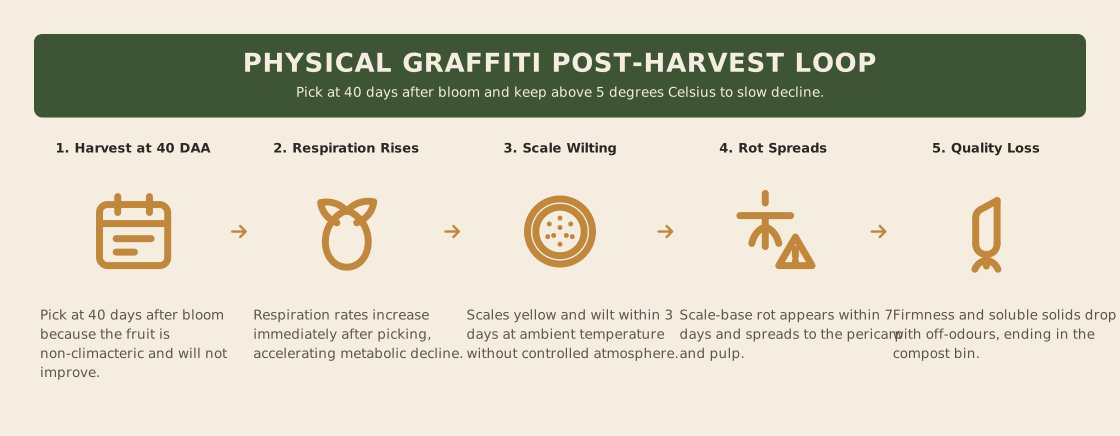
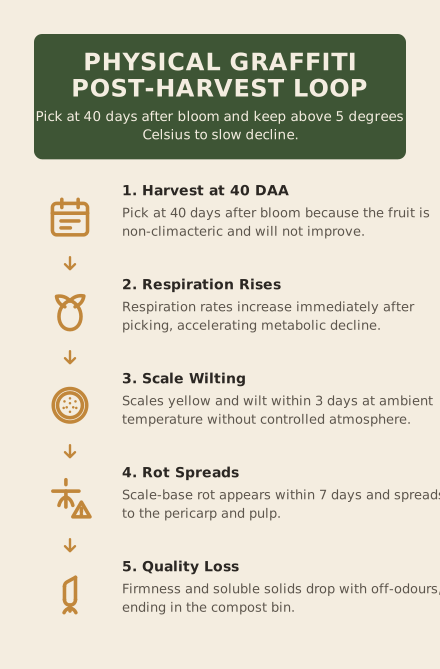
Dragon fruit is non-climacteric. Once you cut the stem, the sugar content is locked in. There is no ripening on the counter, no softening into sweetness, and no waiting game. If you pick a Physical Graffiti that is not ready, it stays that way. The 17.93 Brix reading you measured on the vine is the final number you will taste. This makes harvest timing critical, but it also simplifies storage. You are not managing a ripening process. You are managing decay.
Respiration continues after harvest, and it accelerates as the fruit sits. The visible clock is the scales. At ambient temperature, scale yellowing and wilting appear within three days, and scale-base rot follows within seven[4]. After that, rot spreads into the pericarp and the flesh. You cannot stop this, but you can slow it down.
Commercial growers use controlled atmosphere storage to extend shelf life. Research shows that holding fruit at 6 degrees Celsius with 2 kPa oxygen and 5 kPa carbon dioxide significantly delays scale yellowing, slows chlorophyll loss, and maintains firmness and soluble solids[4]. This specific gas mix suppresses respiration without suffocating the fruit. However, the margins are tight. If oxygen drops below 10%, the fruit switches to anaerobic respiration and begins to ferment. If carbon dioxide rises above 5%, respiration is suppressed, but CO2 toxicity and decay become the primary risks[4].
Chilling injury is the home grower’s enemy. Pitaya suffers cold damage below 5 degrees Celsius. This manifests as brown spots on the peel and browning of the flesh, followed by progressive softening[4]. A standard refrigerator often runs colder than this, especially near the back wall or cooling vents. Do not store dragon fruit in the coldest part of your fridge.
For home storage, skip the gas mix and focus on temperature and humidity. Keep the fruit in the shade to reduce respiration rates before it even enters the fridge. Once inside, place it in the warmest section, typically the door or the top shelf, ensuring the temperature stays above 5 degrees Celsius. This buys you a few extra days of firmness and color. But remember, the scales are the indicator. Eat the fruit while the scales still look green and turgid. Once they yellow or wilt, the eating quality is already declining, regardless of how firm the flesh feels.
If you are growing multiple varieties, storage behavior is similar across the board, but flavor profiles differ. For a broader look at how other cultivars handle post-harvest life and flavor retention, see our complete dragon fruit varieties guide.
How it compares to the other purples
Physical Graffiti is not the only purple-fleshed option, but it is the one with the most complete data. The University of California trial provides a direct benchmark against Halley’s Comet, which researchers described as closely related to Physical Graffiti but significantly less vigorous and less productive.[6] While Halley’s Comet shares the cold hardiness score, it falls short on yield and sugar content. American Beauty, a Selenicereus guatemalensis hybrid, offers higher sweetness but drastically lower volume. Purple Haze, often cited in nutritional studies, trails Physical Graffiti in phenolic density despite having higher flavonoid counts.
| Variety | Yield (g/plant) | Sugar (Brix) | Bloom to Harvest | Notes |
|---|---|---|---|---|
| Physical Graffiti | 23,429 | 17.93 | 40 days | Top sensory score; joint-highest heat tolerance. |
| Halley's Comet | Not specified | 16.7 | 38 days | Closely related; less vigorous and productive. |
| American Beauty | 5,566 | 18.51 | 43 days | Higher sugar, but cold/heat scores of 2.75/2.5. |
| Purple Haze | Not specified | Not specified | Not specified | Lower phenolics than PG; higher flavonoids. |
| Dark Star | Not specified | Not specified | Not specified | Farm observation only; no measured UC entry. |
| White-fleshed types | 20,000+ | 13.2-13.7 | Varies | High yield, low sugar, low antioxidant density. |
| Yellow-fleshed | Not specified | Up to 22 | Varies | Highest sugar, but often flatter flavor profile. |
The numbers show why Physical Graffiti dominates Southern California plantings. It balances the high yield of white-fleshed varieties with the superior flavor and climate resilience of the purples. Halley’s Comet is the closest genetic sibling, but if you are looking for volume and vigor, Physical Graffiti is the clear winner. American Beauty is sweeter, but its lower cold and heat tolerance scores make it a riskier bet for many local gardens. For a broader look at how these varieties stack up against other pitayas, see our complete dragon fruit varieties guide.
Who should actually plant it
Physical Graffiti is not a starter plant. It is a commitment for growers who understand that a self-sterile hybrid requires active management to produce fruit. If you are unwilling to hand-pollinate at night, this variety will likely disappoint you. The flowers are nocturnal, opening around dusk and reaching full anthesis between 8 and 10 pm.[3] You must be present during these hours to transfer pollen from a compatible second cultivar. Without this intervention, you may see blooms but no fruit.
You also need a partner plant. Physical Graffiti cannot pollinate itself. It requires pollen from a different genetic type to set fruit, and while it can accept pollen from most red-fleshed varieties, you must have that second plant on site.[12] Planting a single Physical Graffiti cutting is like buying a lock without a key. If you are new to pitaya, consider starting with a self-compatible white-fleshed variety first, or ensure you have the space and budget for two distinct cultivars. For a broader look at pairing options, see our complete dragon fruit varieties guide.
This is a long-term investment. The useful life of a pitaya planting is estimated at about 20 years.[7] You are not planting an annual or a short-lived perennial. You are installing a permanent structure that will require a heavy trellis capable of holding several hundred pounds of stem weight.[7] If you move in five years, you are leaving a major landscape feature behind.
Container growing is possible but tricky. While young plants can be started in pots to build a root system, Physical Graffiti is a vigorous, aggressive grower.[7] In-ground planting is strongly preferred for mature specimens. Containers restrict root expansion, which limits the plant’s ability to support the massive biomass and heavy fruit loads this variety produces. If you must grow in a container, use a large, heavy pot and be prepared for frequent repotting or top-dressing. A small pot will dry out too quickly and stress the plant, leading to poor bloom induction.
Our rooted cuttings are ready to cure and plant. They offer a faster path to production than seed, with first fruit possible in 6 to 9 months from a good rooted cutting.[7] This speed is a major advantage for serious growers who want to test their pollination routine and trellis setup without waiting years for the plant to mature. But remember: the speed of the cutting does not negate the need for a compatible partner or the labor of night-pollination. If you are ready to commit to the schedule and the space, Physical Graffiti will reward you with high yields and exceptional flavor. If you are not, choose a self-pollinating variety or a different hobby.
FAQ
| Question | Answer |
|---|---|
| Is it self-pollinating? | No. It is self-sterile and requires cross-pollination. |
| Why cross-pollinate? | Crosses set larger fruit. A trial showed 588 g for crosses vs 377 g for selfs. |
| How big is the fruit? | UC mean is 374 g (0.83 lb). Nursery range is 0.75 to 1.5 lb. |
| How sweet is it? | 17.93 Brix. Mid-pack on sugar, top of the trial on sensory score. |
| When is it ready? | 40 days from bloom. Colour break at 25 to 30 DAA. Do not wait past splitting. |
| Why the name? | Nursery folklore tied to the 1975 album. Undocumented origin. |
| Why is it browning? | Chilling injury. Do not store below 5 deg C. |
| How much yield? | 23.4 kg marketable in UC trial. Species can hit 100 kg per plant at 3 to 4 years. |
Growers often ask if Physical Graffiti can pollinate itself. It cannot. The variety is self-sterile and needs pollen from a compatible partner to set fruit.[12] This is not just a matter of getting fruit to set. It is a matter of getting fruit that is worth eating. In a controlled trial, manual cross-pollination produced fruit weighing 588 g. Manual self-pollination yielded only 377 g. Open pollination in a self-compatible white clone produced about 200 g.[3] The difference is stark. Cross-pollination fills more ovules. More fertilized ovules mean larger, better-shaped fruit. If you skip the cross, you are leaving size on the vine.[7]
On size, the data is consistent. The University of California evaluation measured an average fruit weight of 374 g, which is about 0.83 lb.[6] Nursery descriptions list a range of 0.75 to 1.5 lb.[12] These numbers align. You are growing a medium-sized fruit that prioritizes flavor over bulk. It is not the largest pitaya in the garden, but it is often the most preferred.[3]
Sweetness is another common query. The refractometer reads 17.93 Brix in Southern California trials.[6] This is mid-pack for sugar content. Yellow-skinned varieties can hit 22 Brix.[1] But Physical Graffiti scored highest on sensory evaluation in the same trial.[6] Growers and tasters preferred it. The reason is balance. High acidity combined with moderate sugar creates a complex flavor profile that feels richer than simple sweetness. Do not chase Brix alone. Chase the balance.
Timing the harvest is critical. The clock starts at bloom. It takes 40 days from bloom to harvest in Southern California.[6] Colour break on the skin appears 25 to 30 days after anthesis.[8] Do not wait for the skin to turn fully red. The pulp changes colour before the peel does.[8] If you wait too long, the fruit splits. Over-mature pitaya loses sugar, becomes water-soaked, and develops off-odours.[8] Pick it when the colour breaks. Do not let it hang.
The name itself is a story without a source. It references the 1975 Led Zeppelin double album. This fits the trade convention of naming hybrids after rock records, like Purple Haze or David Bowie.[6] But no primary document proves who applied the name to Paul Thomson’s selection.[6] It is nursery folklore. It is not cultivar history. Enjoy the name. Do not rely on it for provenance.
References
- Bioactive Compounds, Antioxidant Capacity and Mineral Profile of Pulp and Peel from Diverse Selenicereus (Pitaya) Varieties in Brazil (Vieites & Gaona Acevedo, Dept. of Horticulture, UNESP Botucatu) - Plant Foods for Human Nutrition 81:103, 'Physical Graffiti' among seven varieties assayed, Springer / Plant Foods for Human Nutrition (PMC13421253, doi:10.1007/s11130-026-01553-6) (2026).
- Pitaya as a New Alternative Crop for Iberian Peninsula: Biology and Edaphoclimatic Requirements - lists 'Physical Graffiti' as S. guatemalensis x S. undatus among imported cultivars; frost, temperature, salinity and rootstock detail, MDPI Plants 12(18):3212 (doi:10.3390/plants12183212) (2023).
- Floral and pollination biology of dragon fruit reveals strategies for enhancing productivity through pollination management and reproductive window extension - Jadhav et al., two-year trial, anthesis timing, effective pollination window, self-incompatible red-fleshed clone, fruit weight by treatment, Nature Portfolio / Scientific Reports 15:34679 (doi:10.1038/s41598-025-21168-2) (2025).
- Advances in the Understanding of Postharvest Physiological Changes and the Storage and Preservation of Pitaya - Wang et al.; cold injury below 5 deg C, scale wilt timings, controlled atmosphere 2 kPa O2 + 5 kPa CO2 at 6 deg C, MDPI Foods 13(9):1307 (doi:10.3390/foods13091307) (2024).
- Pitahaya or Dragon Fruit (Hylocereus spp.): A New Water Efficient Crop for Southern California Small Scale Farmers - Lobo, Fernandez de Soto, Aguiar, Tanizaki; UC ANR / UCCE. Includes the root-knot nematode susceptibility trial that tested Hylocereus sp. 'Physical Graffiti' (#15) and the Cactus Virus X section, University of California Agriculture and Natural Resources / UC Cooperative Extension (2017).
- Pitahaya Production Seminar & Field Day - UC ANR / UCCE San Diego variety evaluation chart (Physical Graffiti: 374 g, 17.93 Brix, 23,429 g marketable/plant, 40 days bloom to harvest, cold 4.5 / heat 4.5, March-November seasonality) with cultivar captions from Register of New Fruit and Nut Cultivars List 48, HortScience 51(6), June 2016 (Paul Thomson, San Diego County, early 1980s; 'most preferred and widely planted in Southern California'; Halley's Comet 'closely related to Physical Graffiti'), University of California Agriculture and Natural Resources / UC Cooperative Extension (with HortScience cultivar register) (2016).
- Pitaya Handbook for Home Gardeners (HS303) - Crane & Balerio, UF/IFAS Extension. Climate limits, self-incompatibility and pollination guidance, insolation and shading, irrigation and staged fertilisation, spacing and trellis load, yields, cutting establishment, University of Florida IFAS Extension (2016).
- Pitaya Fruit Maturity Index Implementation - maturity indices for fresh-market pitaya: 25-30 days to colour break, minimum 30-32 DAA, optimum 35-38 DAA, 32-34 DAA for distant markets, SSC:TA ratio of 40, non-climacteric behaviour, over-mature splitting and water-soaking, APEC-FLOW / National Taiwan University (Dr Chun-Ta Wu) (2020).
- Physiological effects and technical strategies of LED supplemental lighting for pitaya cultivation: a review - LED parameters and staged flowering management for open-field and facility production, PeerJ (2025).
- Pitaya Under Saline Conditions: A View from Growth, Photosynthesis, Ion Homeostasis, and Oxidative Metabolism - review; salinity sensitivity of the crop and irrigation-water EC thresholds, MDPI Plants 12(18):3212 (PMID 37765376) (2023).
- The Photoperiod-Regulated Bud Formation of Red Pitaya (Hylocereus sp.) - Jiang, Liao, Lin, Lee & Mizrahi; the original demonstration that flower initiation in pitaya is photoperiod-controlled, which is what makes supplemental lighting work, ASHS HortScience 47(8):1063-1067 (2012).
- Physical Graffiti - H. guatemalensis X H. undatus (cultivar listing: self-sterile, will set with most red-fleshed pollen; pinkish-red skin, light purple sweet flesh; 0.75-1.5 lb fruit; huge nocturnal blooms over 14 in; vigorous three-sided growth; the 1-S / Rixford x Niezel claim; collected from a Louisiana nursery), Spicy Exotics (specialist dragon fruit nursery) (2026).
- Identification of Lasiodiplodia species inciting stem rot of dragon fruit in India through polyphasic approach - L. theobromae and the more virulent L. iraniensis confirmed by pathogenicity tests; symptom description, Springer 3 Biotech (doi:10.1007/s13205-023-03754-1) (2023).
- Plant-Associated Neoscytalidium dimidiatum - Taxonomy, Host Range, Epidemiology, Virulence, and Management Strategies: A Comprehensive Review - host range and prevalence, with California flagged as a hotspot, MDPI Journal of Fungi 9(11):1048 (doi:10.3390/jof9111048) (2023).