Desert King Dragon Fruit: Winter Harvests & Pollination
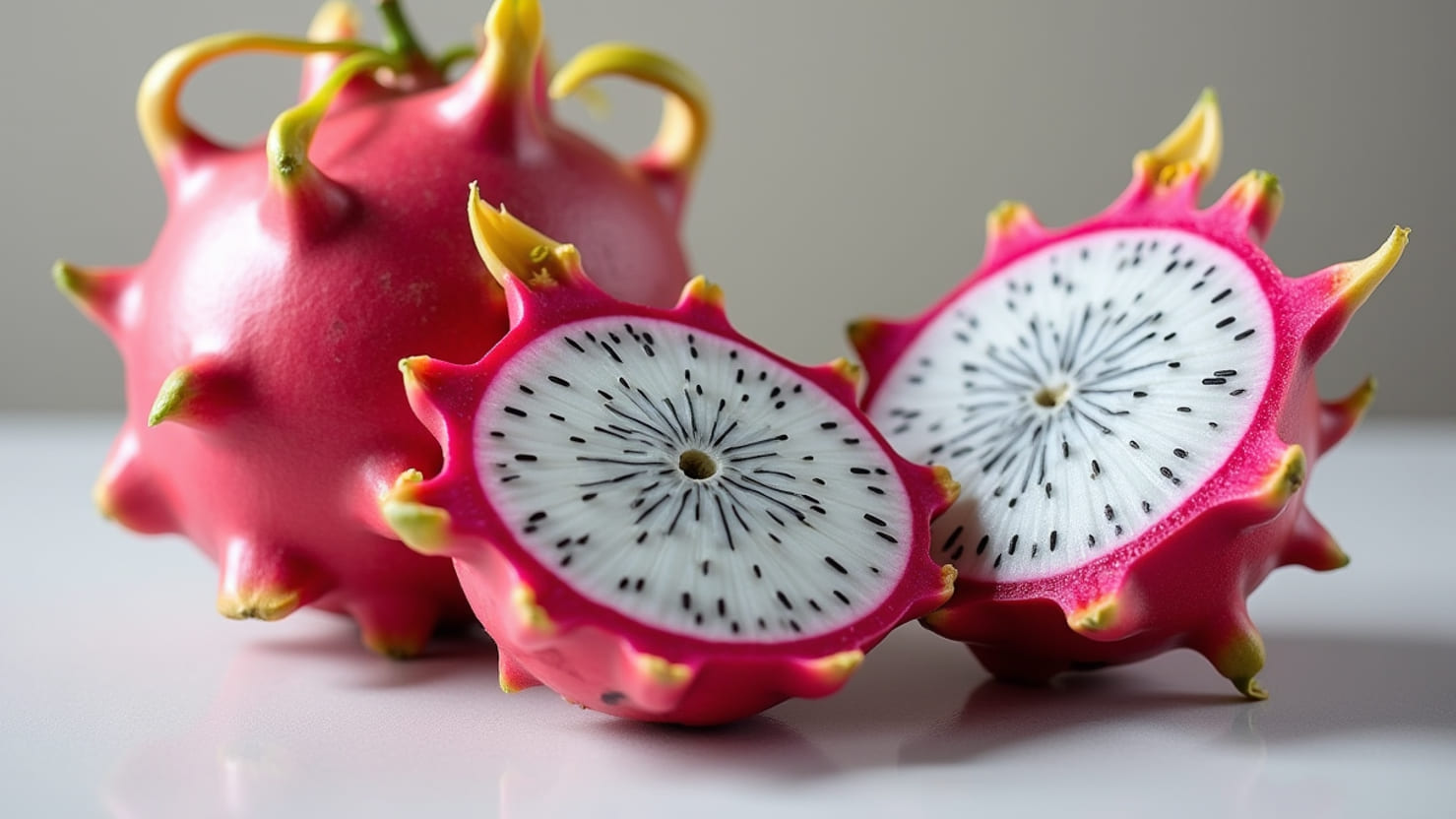
Grow Desert King dragon fruit if you want exceptional winter harvests and can manage a self-sterile, slow-growing plant. Skip it if you need high yields or cannot provide a compatible pollinator. This Israeli-bred selection 4126 is a megalanthus x red-flesh hybrid complex known for spiny, early-yellow fruit. Flesh color varies by report, often described as pink or white. It fills the off-season gap left by summer varieties but demands specific conditions to succeed.
Here is how it compares to a standard commercial pitaya:
| Trait | Desert King | Typical Commercial Pitaya |
|---|---|---|
| Harvest Window | December to April | June to December |
| Fruit Appearance | Spiny, early yellowing | Less spiny, red or pink |
| Flesh Color | Pale to pink | White or deep red |
| Sweetness | 15-17 Brix | 12-18 Brix |
| Fertility | Mostly self-sterile | Often self-fertile |
| Yield | Low, slow | Faster to production |
The name problem: DK 16 and 4126
Dragon fruit naming is messy. Desert King is a grower name applied loosely in trade, not a formal variety release with registration paperwork behind it. In the trade press, it appears as selection 4126, an Israeli-bred clone developed for commercial winter harvests.[1] Because there is no single, standardized registry entry, the name "Desert King" can refer to slightly different plants depending on who is selling them.
Do not confuse Desert King with CFA DK 16. These are two distinct clones. CFA DK 16 is a separate named variety that used Desert King as its pollen parent.[1] If you buy a cutting labeled DK 16, you are buying the offspring, not the parent. They share lineage, but they are not the same plant.
Then there is the number 4126. This is the selection code for the original Israeli material. Some nurseries sell "Desert King," others sell "4126," and some sell both, implying they are identical. While they likely refer to the same genetic line, the lack of a unified name means you cannot rely on the label alone to tell you what you are getting.
Buy by description, not just name. Ask the seller for photos of the fruit, details on the growth habit, and information on pollination requirements. If they cannot confirm whether the plant is self-sterile or what the flesh color is, walk away. A name is a marketing label; the plant’s behavior is the reality.
Parentage records also disagree. One database lists it as S. megalanthus x S. costaricensis/polyrhizus, while another says S. polyrhizus x megalanthus. A third calls it Selenicereus undatus.[4] This confusion stems from the 2017 merger of the Hylocereus and Selenicereus genera, which left many older variety descriptions using outdated names.[5] The safest way to identify the plant is by its diagnostic traits: spiny fruit that yellows early, a thick rind, and an autumn-to-winter ripening habit.[3]
Where it came from, and why it fruits in winter
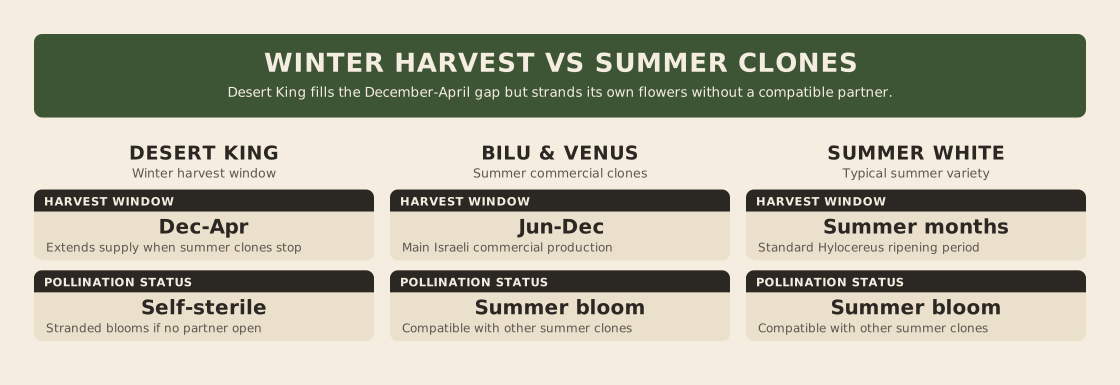
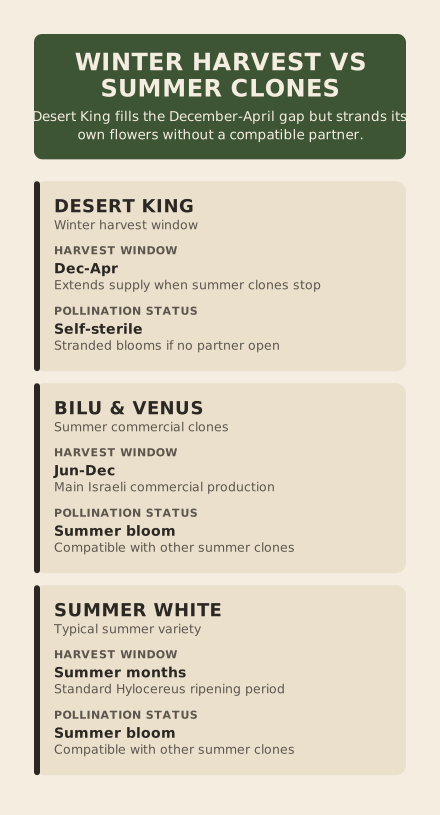
Desert King is not a random garden discovery. It is selection 4126, a clone developed within Israel’s intensive pitaya program to solve a specific commercial problem: how to keep fruit on the shelf when the main summer varieties stop bearing. The Israeli industry operates on a tight schedule. The two primary commercial clones, Bilu and Venus, are harvested from June through the end of the year. That leaves a gap in the supply chain. Desert King fills it. In Israel, it is harvested from the end of December until April, providing a steady stream of fruit during the winter months when competitors are idle.[2]
This timing is the result of deliberate breeding strategy, not luck. The program utilizes three distinct genetic groups to cover the calendar. Hylocereus inter-clonal and interspecific hybrids ripen in summer. Intergeneric hybrids ripen from autumn to the end of winter. True yellow pitaya (*S. megalanthus*) ripens from the end of winter into late spring. By mixing these groups, growers can deliver fruit from July to May, with only June missing.[3] Desert King sits in the middle of this spectrum. It is a triploid hybrid derived from crosses between tetraploid *S. megalanthus* and diploid *Hylocereus* species. These triploids combine good taste and long shelf life with a ripening window from late autumn to the end of winter. Unlike pure *S. megalanthus*, which is notoriously spiny, these hybrids produce fruit that is far less spiny, making them more practical for commercial handling.[3]
The economic engine behind this work is significant. Israeli pitaya production covers about 50 hectares across five major producers, yielding around 2,000 tonnes annually. Most of this is exported, primarily to UK supermarkets that had previously relied on bland, white-fleshed Vietnamese fruit. Desert King-line material was bred specifically to extend supply into the off-season, offering a premium, flavored alternative that travels well due to its thick rind.[3] The winter harvest also offers a biological advantage. Fruit rot caused by *Bipolaris cactivora* is most severe between 75-91°F under humid conditions and hits mature fruit hardest. By ripening in cooler, drier winter months, Desert King faces significantly less disease pressure than summer-ripening varieties.[11]
Despite its commercial success, Desert King lacks formal registration paperwork. It appears in trade press as selection 4126 rather than in a formal variety release description. This absence of a standardized registry entry means that every trait attributed to it relies on grower observation and breeder notes rather than a single authoritative source. The genus classification has also shifted. In 2017, *Hylocereus* and *Selenicereus* were merged into *Selenicereus*. Consequently, older descriptions using *Hylocereus* names now refer to *S. undatus*, *S. megalanthus*, and *S. polyrhizus*. This taxonomic change explains some of the confusion in parentage records, but the plant’s behavior remains consistent: it is a winter-ripening, self-sterile hybrid designed for the off-season market.
What the fruit tastes like
Desert King is grown for flavor, not volume. Israeli breeders selected this winter-ripening hybrid specifically for taste and shelf life, accepting smaller fruit and slower development as the trade-off.[3] The result is a fruit that sits in the mid-to-upper range for the crop. Measured sweetness sits at 15-17 Brix, where pitaya generally spans 12-18 Brix.[4]
The flavor profile is complex. Growers describe notes of pineapple, raspberry, and cherry on a tangy-to-sweet base.[6] One San Diego County grower who fruits the variety in Southern California reports a distinct longan-like taste, alongside peach-colored skin and pink flesh.[6] This complexity is why the variety earns a perfect 5 out of 5 for taste in our internal ratings, even though it scores only a 1 out of 5 for yield.[7]
The physical structure of the fruit supports its commercial niche. It features a thick rind and exceptional shelf life, traits that allow it to travel and store better than thin-skinned summer whites.[3] The trade-off is size. The fruit is small-to-medium, a direct consequence of the S. megalanthus parentage and the breeding focus on quality over bulk.[3]
Flavor vs. Effort: Desert King is a high-effort, high-reward plant. You get exceptional fruit, but you must manage a self-sterile, slow-growing vine that demands a compatible pollinator to set anything at all. If you are looking for a "plant it and forget it" producer, this is not it. If you want the best-tasting winter pitaya you can grow, it is worth the work.
Pollination: why Desert King sets so little fruit
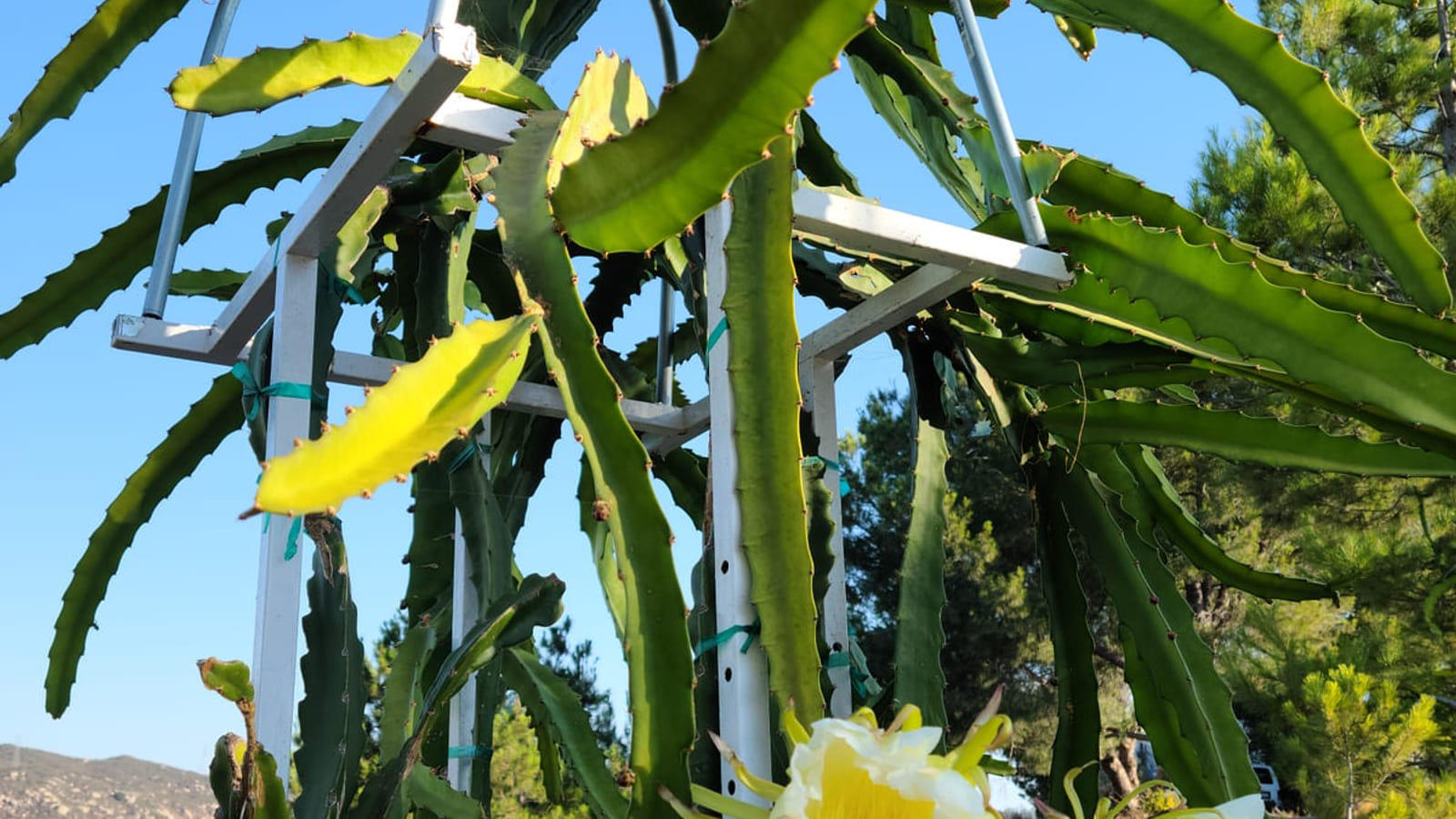
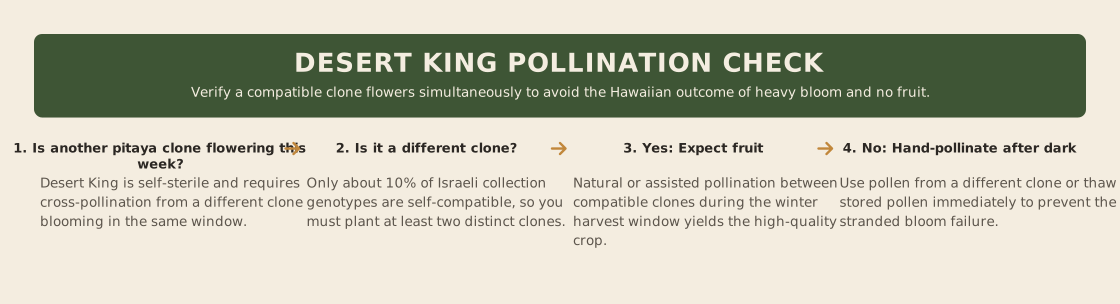
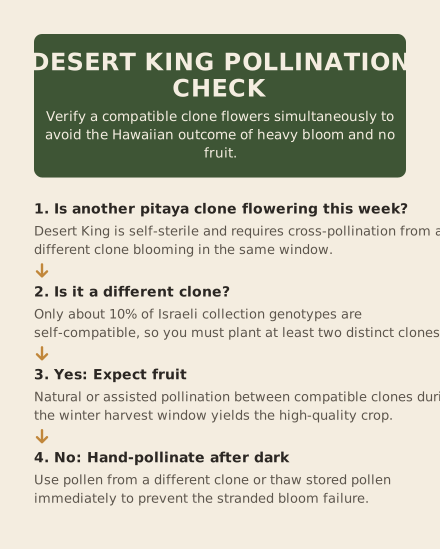
Desert King is self-sterile and requires a partner clone flowering at the exact same time to set fruit. This is the norm for the crop. Only about 10% of the genotypes in the Israeli collection are self-compatible, meaning the vast majority need cross-pollination to produce a crop.[3] If you plant a single Desert King, you are planting a decorative vine that will bloom and then drop its flowers.
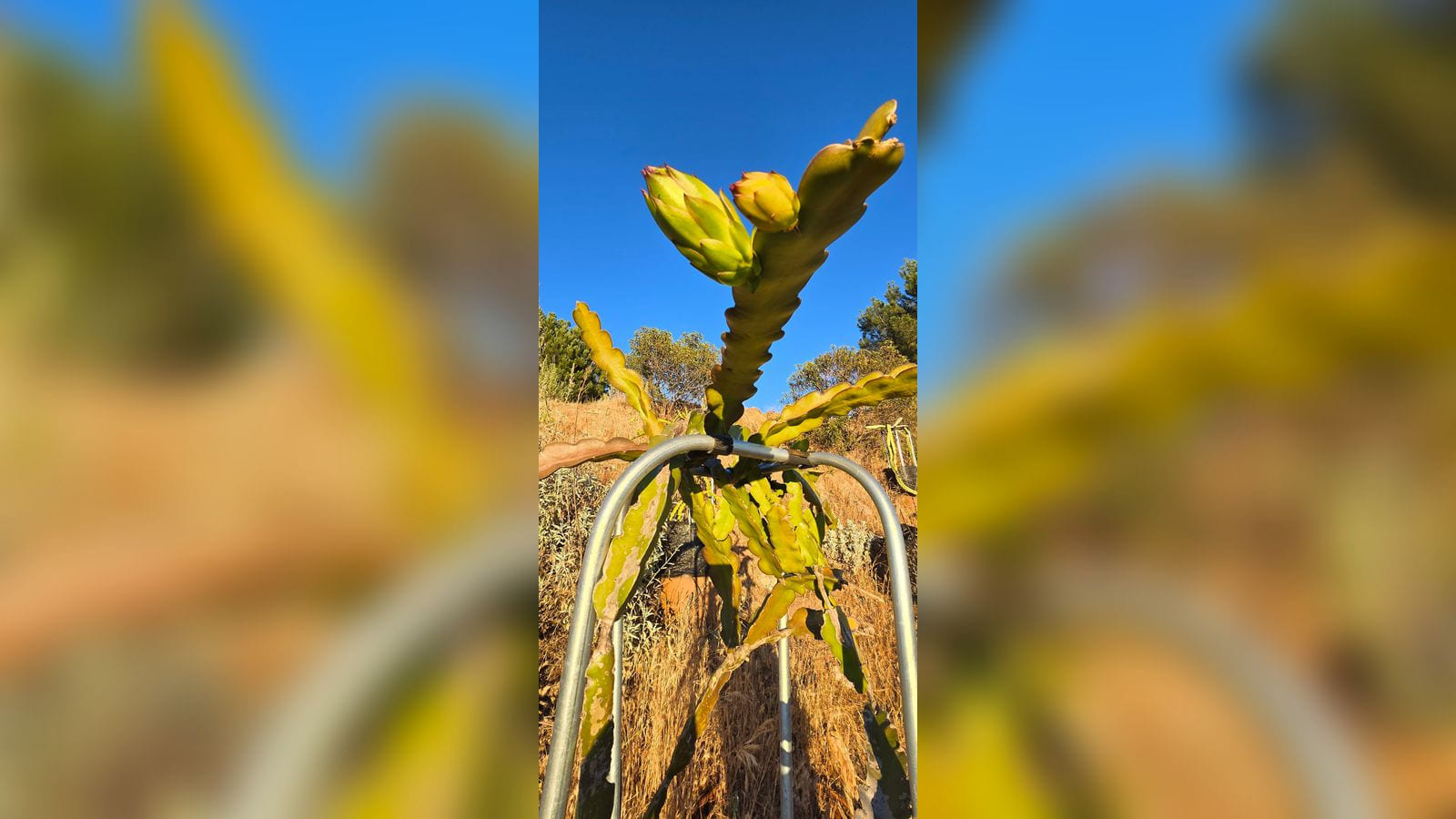
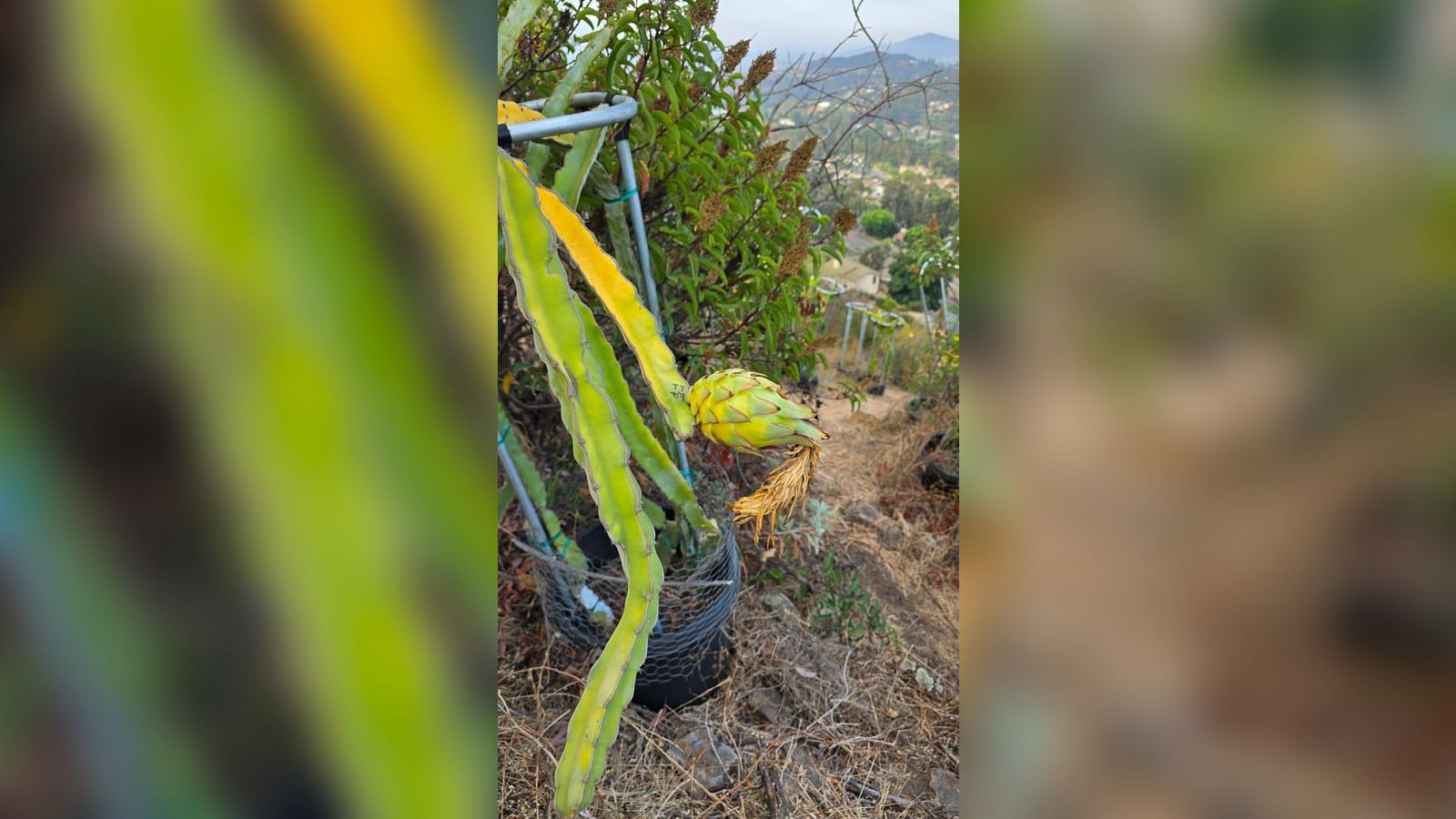
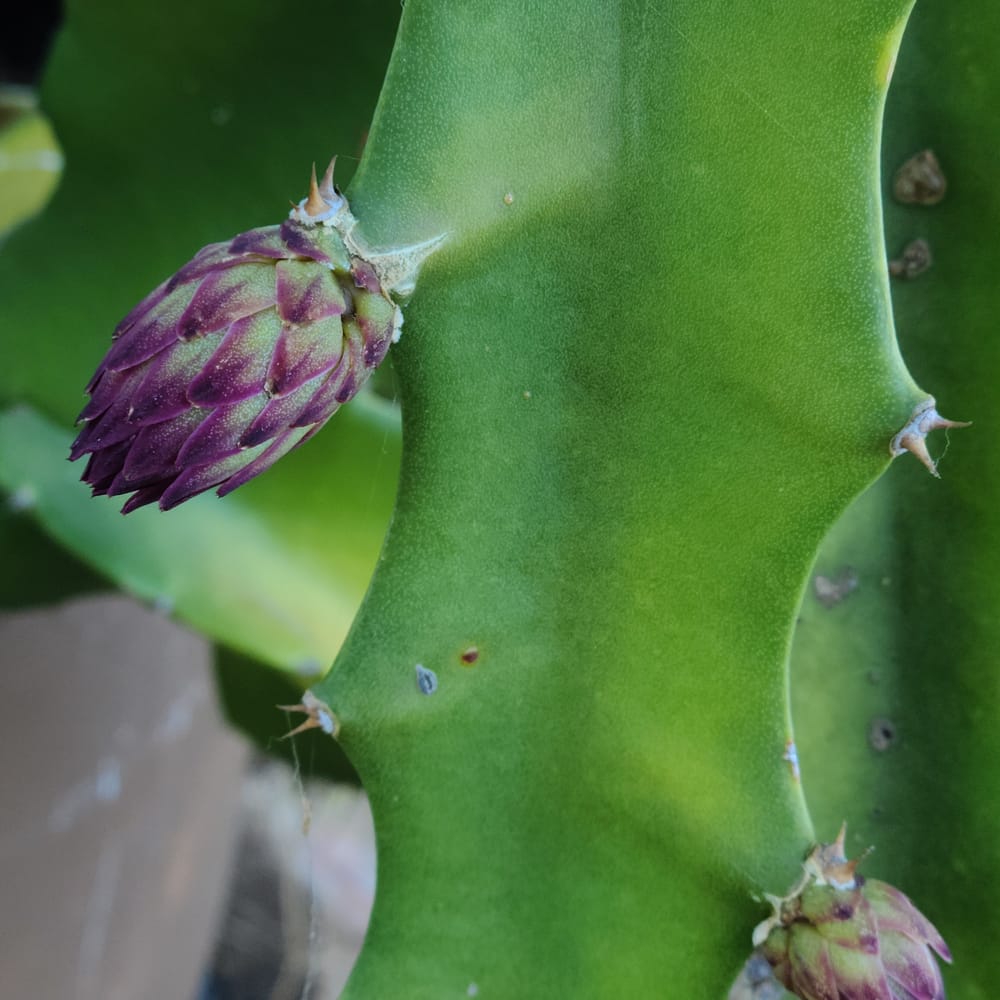
Timing is the main challenge. Desert King blooms at the edges of the season, often in late summer or autumn, when most other varieties have already finished their main flush. A trial at Hawaiian Ocean View demonstrated this failure mode clearly. The Desert King vines produced masses of blossoms in October, but set almost no fruit because no other variety was open to serve as a pollinator.[8] The failure was a stranded bloom window, not low fertility. Without a compatible partner open at the same moment, the flowers are wasted.
Some growers claim Desert King pollen is a "universal donor," suggesting it can pollinate any other variety. This reputation is unverified. Do not rely on it. Assume you need a specific, compatible partner for your Desert King, and that your partner needs a compatible partner for itself. If you are unsure which varieties overlap in bloom time, check our guide on which dragon fruit varieties are self-fertile and which need a partner.
How to fix the pollination gap
You have three practical options, starting with planting. Pair Desert King with a self-fertile variety or another clone that has a confirmed bloom overlap. Planting them side-by-side ensures that when the Desert King flowers, a compatible stigma is nearby. This is the most reliable method for home growers who want to avoid nightly maintenance.
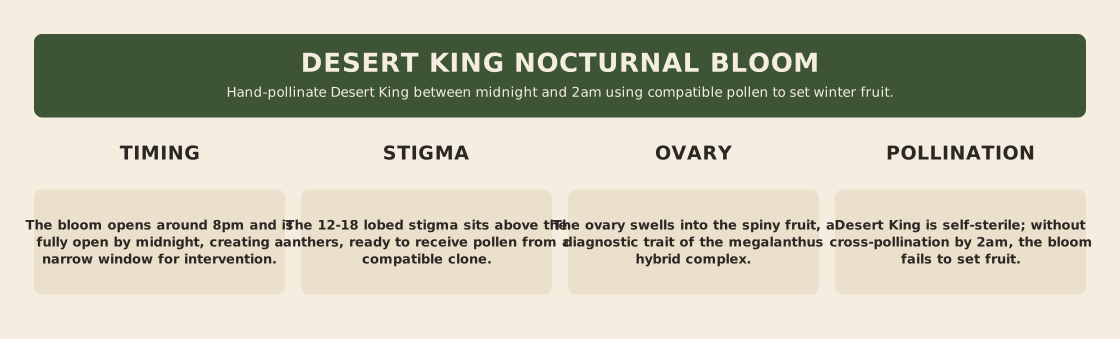
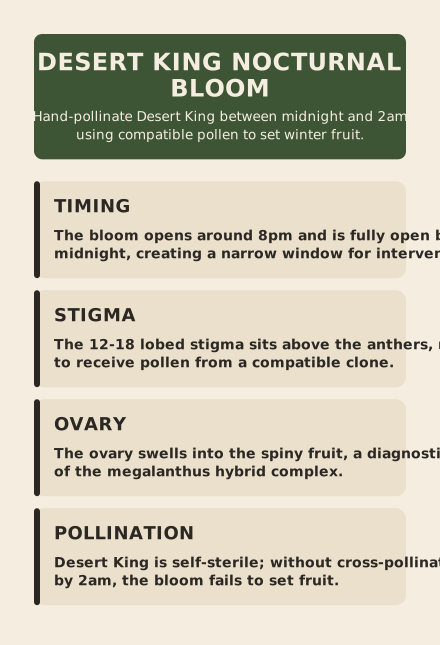
Second, hand-pollinate. Dragon fruit flowers open at night. In summer, they begin opening around 8pm; in autumn, closer to 7:30pm. They are fully open by midnight and the window closes by roughly 2am.[9] You must work after dark. Pinch the bulging base of the flower to open it and expose the stigma. Transfer pollen from a different clone or variety. Two flowers' worth of pollen is sufficient for one fruit.[9] Manual cross-pollination is standard practice across the industry because it raises fruit set, size, and quality.[9]
Third, use stored pollen if bloom windows mismatch. If your partner variety flowers in June and your Desert King flowers in October, you can bridge the gap with stored pollen. Israeli growers use a proven technique: desiccate pollen under vacuum to 5-10% humidity and store it at -20 C. This pollen remains viable for more than 18 months.[3] You can collect pollen during your partner's bloom, freeze it, and use it to hand-pollinate your Desert King months later.
Do not assume self-compatibility. A lone Desert King in a home garden will set nothing without a partner clone or a night with a brush. The "universal donor" claim is unverified; do not count on it.
Flowering and harvest timing, by climate
If you look at the data on Desert King, the bloom windows seem to contradict each other. Israeli export logs show harvests from December through April, while a Hawaiian trial recorded blooming from July to October. Community growers often log peak bloom in July. It is the result of how dragon fruit biology interacts with local weather.
The core mechanism is photoperiodism. Red pitaya flower buds are induced by long days and repressed by short days under phytochrome control.[10] This explains why an off-season clone like Desert King behaves differently from a standard summer variety. In Israel, the goal is winter harvest. As days shorten and temperatures fall, the interval between flowering waves lengthens. This causes ripening to slide from November into April.[3] The first fruits of the season are often about half the size of later ones because early winter temperatures are less suitable for fruit development.[3]
In warmer, tropical-like climates such as Hawaii, the plant responds to the long days of midsummer. The Hawaiian trial noted rapid vegetative growth and high canker resistance, with bloom occurring from July to October.[8] This aligns with community logs that place peak bloom in July.[4] The disagreement in timing is simply a reflection of latitude and season. The plant is doing what its genetics dictate: blooming when the light and temperature cues are right for bud induction.
Once a flower opens, the clock starts. Community tracking of Desert King, though based on a tiny sample of three plants, logged an average of 25.8 days from bud to flower and 30 to 35 days from flower to harvest.[4] This 30 to 35 day window is normal for the species. Most red and white cultivars begin harvest 30 to 35 days after anthesis.[9] However, cool weather stretches this timeline. Ohana Express, a Desert King seedling, took 60 days from flower to harvest in Louisiana’s cooler climate.[1]
Temperature plays a critical role in both induction and development. Pitaya thrives at 18 to 27 C (64 to 81 F). For floral bud induction, the crop prefers a day temperature of 29 to 32 C with nights of 19 to 22 C under long days.[9] Temperatures above 39 C (102 F) are unsuitable.[9] Shade is required to prevent sunburn and stress in inland areas with extreme summer heat.
The table below summarizes how these biological drivers translate to different climates. Note that "Bloom" refers to when flowers open, and "Harvest" refers to when fruit is ready to pick.
| Region | Bloom Window | Harvest Window | Key Driver |
|---|---|---|---|
| Israel (Winter Program) | Nov to Jan | Dec to Apr | Breeding targets winter supply; bloom occurs at season edges.[3] |
| Hawaii (Tropical) | Jul to Oct | Aug to Nov (Estimated) | Warm conditions favor standard development. |
| Inland SoCal (Hot Summer) | May to Sep | Jun to Oct (Estimated) | Shade required to prevent sunburn; high heat causes stress.[3] |
| Coastal SoCal (Mild) | May to Sep | Jun to Oct (Estimated) | Moderate temps favor growth; less risk of sunburn. |
Timing Tip: If you are growing Desert King in a region with distinct seasons, expect the first fruits of the season to be smaller. Later fruits, which develop during more stable temperatures, will be larger and sweeter.
For growers in Southern California, the bloom window often overlaps with other varieties, which is critical for pollination. Since Desert King is self-sterile, you need a partner plant flowering at the same time. If your Desert King blooms in July, ensure your pollinator is also ready then. If you are in Israel or a similar Mediterranean climate, you are targeting a winter bloom, which requires a pollinator that can also flower in the cool season. Understanding this timing is essential for successful fruit set. For more on matching bloom times, see our guide on which dragon fruit varieties are self-fertile and which need a partner.
Growing Desert King in Southern California
Coastal San Diego County sits comfortably within the 64-81 F optimum range for pitaya, making it a forgiving environment for this variety. Move inland, however, and the challenges shift from frost to radiation and water stress. Grower logs claim tolerance to 115 F, but that tolerance does not prevent tissue damage when the plant is stressed. Inland growers, such as those in Ramona, often see sunburn on vines grown in nearly full sun, a problem severe enough that neighboring commercial farms run shade cloth to protect their crops.[6]
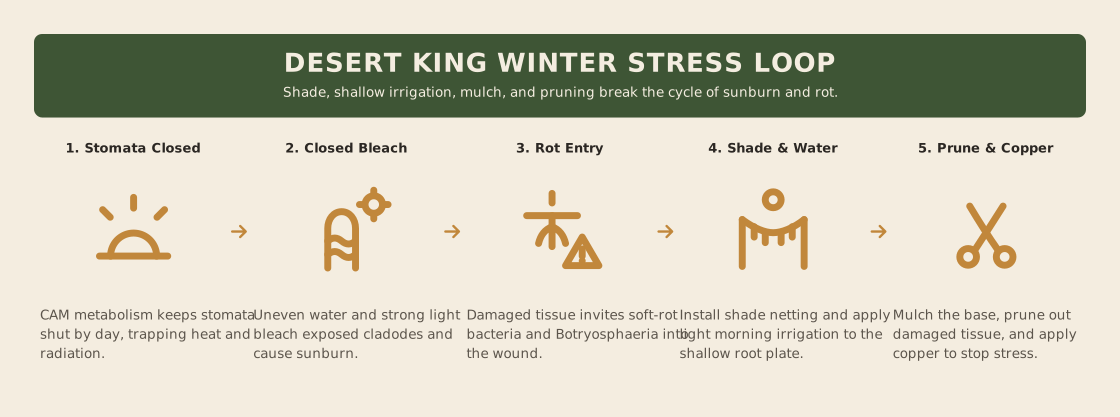
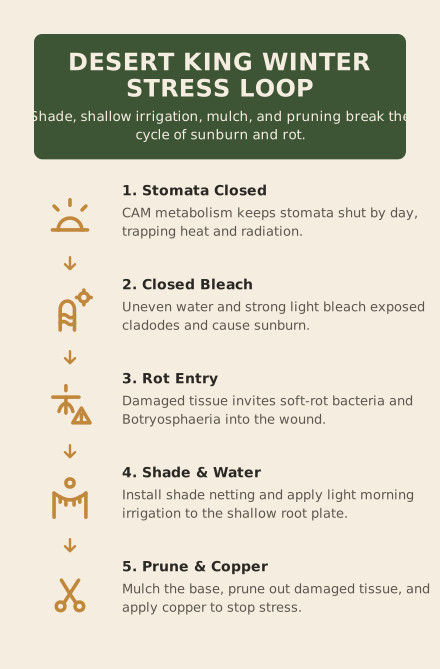
Like all pitayas, Desert King keeps its stomata closed during the day to conserve water, using roughly 10% of the water that C3 crops like citrus or avocado require in the same climate.[3] If a plant is drought-stressed or suffering from root rot, it cannot transpire to cool itself, leading to sunburn. That damaged tissue becomes the entry point for stem soft rots, which is the primary failure mode for inland Southern California plantings.[11]
Radiation is a more binding constraint than heat alone. In Israel, where summer radiation levels are high, pitayas are grown under shade nets providing 20% shade on the coast and up to 60% inland.[3] The need for shade varies by clone and the amount of wax on the stems, but for yellow-skinned types like Desert King, protection is recommended to prevent scorching. While the plant can survive light frosts, it prefers to avoid temperatures in the 30s entirely; nights in the upper 20s can cause temporary yellowing, though significant damage is rare.[6]
Water management requires precision because the root plate is shallow, extending no deeper than 40 cm.[3] Heavy irrigation pushes moisture below the roots where it is useless and can trigger rot. Instead, irrigate lightly and frequently. Pitaya needs the equivalent of 25-50 inches of annual rainfall, typically delivered twice weekly, to prevent fruit splitting from uneven moisture or root rot from over-watering.[9]
Desert King’s yellow-skinned lineage brings specific vulnerabilities. As a hybrid involving S. megalanthus, it inherits sensitivity to root-knot nematodes (Meloidogyne incognita and M. javanica).[3] In sandy soils, this can be a serious issue. The fix is grafting onto resistant pitaya rootstock, which is easy to do and results in plants reaching production about a year later than own-rooted vines.[3]
California’s dry climate offers a structural advantage: you can grow pitaya without fungicides. Tropical producers must spray, but here, the main threats are soft-rot bacteria entering through sunburn and root-rot fungi from over-watering.[11] Since there are no fungicides labeled for pitahaya in California or Florida, culture and sanitation are your entire toolkit.[11] Prune out dying stems, clean clippers with 10% bleach or a torch, and irrigate in the morning so canopy wetness ends quickly.[11] Desert King’s canker resistance is rated high, so coastal and near-coastal plantings rarely need intervention beyond removing oozing stems and applying a copper drench.[8]
| Factor | Coastal SD | Inland SD |
|---|---|---|
| Temperature | Ideal (64-81 F) | High heat; shade needed |
| Water | Light, frequent | Light, frequent; watch for stress |
| Shade | Often unnecessary | 20-60% shade net recommended |
| Disease | Low pressure | Sunburn leads to soft rot |
| Nematodes | Check soil type | Graft if sandy |
Trellis, planting and feed
Although slow-growing and thin-stemmed, Desert King demands a heavy-duty support structure. You need a post-and-cap or pole trellis capable of carrying several hundred pounds of stem weight over time. Do not use bare wire, which cuts into the succulent stems and invites rot. Set your plants 15-25 feet away from trees, buildings, and power lines to ensure adequate airflow and light access. For the first 3-4 months after planting, provide about 30% shade. This protects the young, sensitive tissue from sunburn while the root system establishes itself. Start with cured cuttings rather than seed. Seedlings are genetically variable and can take up to seven years to bear fruit, whereas a 6-15 inch cutting that has been cured properly can fruit within six to nine months. Desert King’s yellow-pitaya inheritance pushes it toward the slower end of that range, but it is still far faster than starting from seed. Feeding begins about a month after planting or as soon as you see new growth. In the first year, apply 0.25 lb of fertilizer per plant every two months. Use a 6-6-6, 8-3-9, or 8-4-12 palm-type formula, supplemented with 4 lb of well-decomposed manure. As the plant matures, increase the dosage. From year four onward, apply 0.50-0.75 lb per plant three or four times a year. This steady, measured approach supports the plant’s compact habit without overwhelming its shallow root zone.
Why shade matters: Young pitaya tissue is sensitive to sunburn. The initial shade cloth prevents scorching, which is the primary entry point for soft-rot bacteria in arid climates.
Should you buy a Desert King cutting?
If you want a prolific red vine that fills a basket every summer, Desert King is the wrong plant. It is a niche selection bred for a specific commercial window, not a volume producer. The Sky Botanicals grower ratings tell the story plainly: taste scores 5/5, growth rate 4/5, but fruit yield sits at 1/5.[7] You are buying exceptional flavor and winter timing, not abundance.
Expect a slow start. Yellow-pitaya-line clones generally take three years to reach production, compared to about one year for standard Hylocereus reds.[8] While a cured cutting can technically fruit within 6 to 9 months, Desert King’s inheritance pushes it toward the slower end of that spectrum.[12] In the only variety trial that tracked this clone, the observed yield was zero.[8] A well-pollinated, mature pitaya planting can produce around 220 lb per plant per year.[12] Desert King’s shortfall is a pollination and clone-vigor issue, not a ceiling on the species itself.[12]
Buy it if you have a warm, dry site with some shade available and you are willing to manage a self-sterile plant. You need a bloom-overlapping partner or the discipline to hand-pollinate. If you cannot get a second clone open in the same week, you will get flowers and no fruit. The Israeli workaround for this is real: viable pollen can be desiccated and stored at -20 C for more than 18 months, allowing you to pollinate with frozen pollen from another season.[3] For most home growers, planting beside a self-fertile variety that flowers at the same time is the simpler path. See which dragon fruit varieties are self-fertile and which need a partner before you commit.
Skip it if you need volume or cannot guarantee a pollinator. The plant is slow, light-cropping, and demands specific conditions. It thrives in arid climates with minimal water, but its yellow-skinned lineage makes it the most cold-sensitive of the crop.[3] It also carries a sensitivity to root-knot nematodes in sandy soils.[3] If you are in a region with wet summers or heavy clay, the risk of root rot and nematode damage outweighs the reward of a few high-quality winter fruits.
Reality check: A lone Desert King in a home garden will likely set nothing without a partner clone or a night with a brush. Judge it as a flavored niche block, not a volume planting.[8]
Key takeaways
Desert King is a niche block, not a volume crop. It delivers exceptional winter fruit from December through April, filling a gap left by summer varieties, but it demands a compatible pollinator to set anything at all. If you are new to cross-pollination, read our guide on which dragon fruit varieties are self-fertile and which need a partner before you plant.
Expect slow growth and low yields. This clone is rated 1 out of 5 for fruit production by the nursery that sells it, yet it scores 5 out of 5 for taste. You are buying flavor and off-season timing, not a heavy harvest.
Ready to try it? Sky Botanicals sells rooted Desert King cuttings (SKU DK) for $20 (small) and $25 (large). These are verified clones, not seedlings, so you get the exact winter-ripening genetics described here.
References
- Ohana Express: a self-fertile seedling of Desert King, H. polyrhizus x S. megalanthus, with Desert King described as Israeli commercial selection 4126; 60 days flower to harvest, 19 Brix, pick 1-3 or 10-12 days after blush, Spicy Exotics (commercial nursery, first-hand Louisiana and Hawaii observations) (2019).
- Here be dragons: Israel breathes fire into exotics (Desert King harvested end of December to April; Bilu and Venus June to end of year; about 50 ha and 2,000 t/yr across five major producers; breeding attributed to Prof. Yosef Mizrahi at the University of the Negev), Fruitnet / Eurofruit (trade press reporting Israeli export growers) (2014).
- Thirty-one years of research and development in the vine cacti pitaya in Israel (ripening groups by hybrid type and the July-to-May calendar with only June missing; two triploid commercial clones ripening late autumn to end of winter with spiny fruit; S. megalanthus tetraploid with small-medium fruit, low seed number, long shelf life and autumn flowering, all clones sensitive to Meloidogyne incognita and M. javanica in sandy soils, grafting onto resistant rootstocks productive within a year; about 10% self-compatible collection genotypes; CAM water use about 10% of C3 fruit crops; shade nets from 20% coastal to 60% inland at 2,200 micromol photons; roots no deeper than 40 cm with 60-250 mm annual irrigation; vacuum-dried pollen stored at -20 C for over 18 months; winter ripening November to April with first fruits 50% of later size), Improving Pitaya Production and Marketing symposium proceedings, ISHS / Food and Fertilizer Technology Center; Mizrahi, Dept. of Life Sciences, Ben-Gurion University of the Negev (2015).
- Desert King cultivar record: white flesh, 15-17 Brix, needs cross-pollination, flowering May-September with peak bloom in July, bud to flower 25.8 days from 3 logged buds, harvest 30-35 days after flowering, 8 buds / 4 blooms / 1 harvest across 3 tracked plants, arid tolerance and heat to 115 F; with the Dragon Fruit Plants record listing S. megalanthus x S. costaricensis/polyrhizus and Desert King as parent of Desert Weed and DK 16, The Dragon Fruit Directory (Tendra grower community logs) and Dragon Fruit Plants cultivar database (2026).
- Taxonomic revision of the vine cacti: Hylocereus, Selenicereus and related genera merged into Selenicereus, Phytotaxa 327(1):1-40 (Korotkova, Borsch, Arias) (2017).
- Growing dragon fruit in Southern California (Desert King fruit described as peach skin, pink flesh, longan-like; some Israeli and yellow types not suited to the region and very spiny; Ramona, San Diego County: nearly full sun with sunburn on some vines and a neighbouring farm under shade cloth; plants take a light frost but prefer no temperatures in the 30s, upper-20s nights caused temporary yellowing; UC specialist's heat-and-cold-tolerant variety list; non-self-fertile varieties need night hand pollination), Southern Cal Weekend Gardener (Greg Alder), first-hand Southern California plantings (2022).
- Desert King Dragon Fruit Cutting product page: variety ratings taste 5/5, growth rate 4/5, fruit yield 1/5, combined 10/15; tasting notes pineapple, raspberry, cherry, tangy to sweet; SKU DK, $20 small / $25 large, Sky Botanicals (own variety ratings and listing) (2026).
- Desert King varietal data sheet: S. polyrhizus x megalanthus, self-sterile, 15-17 Brix, rapidly growing, high canker resistance, bloom July-October at Moana Experimental Farm, Hawaiian Ocean View, Kona district; many blossoms with no fruit and no pollinator in bloom during a heavy October bloom; reported off-season fruiting and relatively high cold tolerance, Sustainable Bioresources LLC (Hawaiian observational varietal trial) (2026).
- Pitaya Nutrition, Biology, and Biotechnology: A Review (fruit 220-840 g, pH 4.6-5.5, 12-18 Brix, 30-50 d pollination to ripening, harvest 30-35 d after anthesis; floral buds 13 d plus anthesis 16-17 d; flowers open 8pm summer / 7:30pm autumn, fully open by midnight, pollination complete about 2am; manual pollination 11pm to morning, two flowers' pollen per fruit, pinching the bulge exposes the stigma; 12-18 stigma lobes; thrives 18-27 C, 39 C unsuitable; bud induction 29-32 C day and 19-22 C night under long days; 25-50 in annual rainfall or twice-weekly irrigation, uneven moisture splits fruit; manual cross-pollination improves fruit set, size and development), International Journal of Molecular Sciences 24(18):13986, PMC10530492, South China Agricultural University (2023).
- The photoperiod-regulated flower bud formation of red pitaya (Hylocereus sp.): long days induce and short days repress floral buds, under phytochrome control, HortScience 47(8):1063-1067 (Jiang, Liao, Lin, Lee, Yen, Yang) (2012).
- Pitahaya Diseases (California's dry climate allows production without fungicides while tropical producers spray; sunburn-damaged tissue as entry point for soft-rot bacteria and infection starting from injured areas; Botryosphaeria dothidea brown stem spot isolated in Ventura County; Bipolaris cactivora fruit rot most severe 75-91 F and humid, worst on mature ripe fruit; no fungicides labeled for pitahaya in California or Florida; morning irrigation to limit canopy wetness, 10% bleach or torch tool hygiene, prune and remove diseased material; CAM stomata closed by day so drought-stressed or root-rotted plants sunburn), UC Agriculture and Natural Resources / UC Cooperative Extension Ventura and San Diego Counties (Downer, adapted from Bender) (2016).
- Pitaya (Dragonfruit) Growing in the Florida Home Landscape (trellis carrying several hundred pounds of stem, no bare wire, plant 15-25 ft from trees and structures, about 30% shade for the first 3-4 months; 6-15 in cuttings cured 7-8 days, fruiting 6-9 months, seed up to 7 years; fertilize from a month after planting, 0.25 lb per plant every 2 months in year one plus 4 lb manure, 0.50-0.75 lb 3-4 applications from year four; 3-4 year old plants about 220 lb per plant per year, planting life about 20 years; damage below 31 F of long duration with rapid recovery from light freezing; optimum 65-77 F, injury above 100 F; self-incompatibility documented in several nursery cultivars and 2-3 different genetic types recommended), UF/IFAS Extension (Crane and Balerdi), HS1499 (2023).