Yellow Dragon Fruit (Ecuador Palora): Complete Variety Spotlight

Yellow dragon fruit (Selenicereus megalanthus), commonly sold as the Ecuador Palora variety, is the sweetest dragon fruit in existence — with a Brix reading of 20 to 24, it roughly doubles the sugar content of common red or white dragon fruits (typically 11-14 Brix). It has bright yellow, spined skin, translucent white flesh, and a flavor reminiscent of lychee, pear, and kiwi. Fruits weigh 1 to 1.5 pounds, the plant is self-fertile, and it produces from September through May — the longest fruiting season of any dragon fruit variety. At Sky Botanicals in Escondido, CA (USDA zone 10a), we grow Ecuador Palora as our premium specialty variety.
Overview & Identification
Yellow dragon fruit belongs to a different species than the red- and pink-skinned dragon fruits most consumers know. While red and white dragon fruits are Selenicereus undatus (white flesh) or Selenicereus costaricensis (red flesh), yellow dragon fruit is Selenicereus megalanthus — a distinct species native to the Andean regions of Ecuador, Colombia, and northern Peru.
You can identify Yellow Ecuador Palora by several distinctive traits:
- Skin color: bright, saturated yellow at ripeness
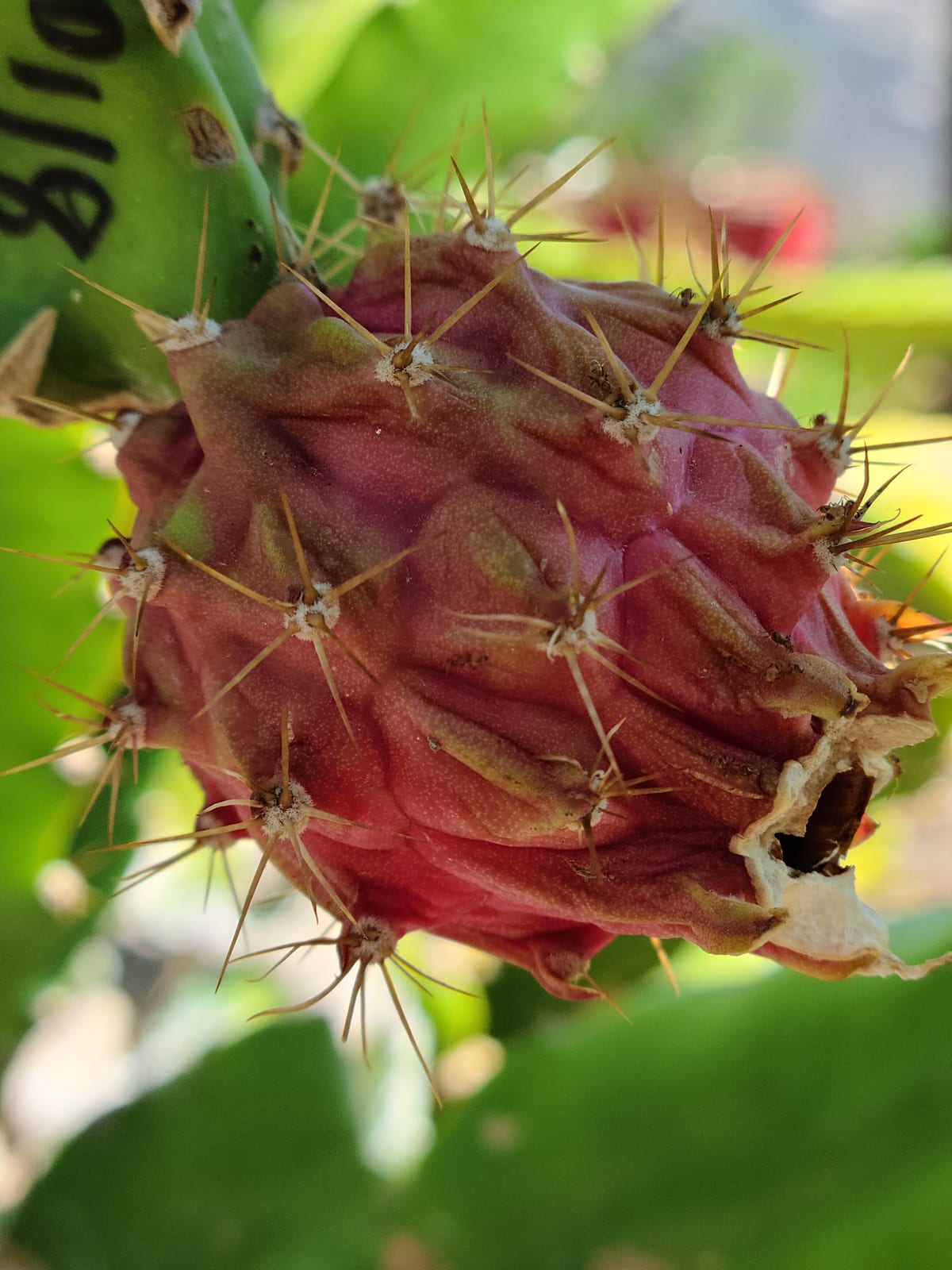
- Surface texture: covered with small spines that naturally fall off as the fruit fully ripens (unlike the fleshy green "flaps" or bracts of red/white varieties)
- Shape: oblong to oval, slightly more elongated than round red varieties
- Size: 1 to 1.5 pounds per fruit — smaller than commercial reds but dense
- Flesh: translucent white with small black edible seeds
- Stems: thinner, more angular, and lighter green than S. undatus; the plant has a more delicate, vining habit
Ecuador Palora specifically refers to the premium commercial selection from the Palora region of Ecuador's Morona-Santiago province, where the microclimate and elevation produce the benchmark-quality yellow pitahaya exported worldwide.
Flavor & Sweetness: Why It's the Sweetest
Brix is the measure of dissolved sugars in fruit juice (1 degree Brix = 1 gram of sucrose per 100 grams of solution). For dragon fruit context:
- Red/white commercial dragon fruit: 11-14 Brix
- Premium red varieties (e.g., American Beauty, Vietnamese Jaina): 15-18 Brix
- Yellow Ecuador Palora: 20-24 Brix
For reference, a ripe mango is typically 14-17 Brix, and a Honeycrisp apple lands around 13-15. At 20-24, yellow dragon fruit is in the same sugar range as ripe lychee, cherimoya, and premium honey mangoes.
The flavor profile is complex and tropical:
- Lychee: the dominant note — perfumed, floral sweetness
- Pear: clean, juicy, slightly vegetal
- Kiwi: a bright acidic finish balances the sugar
- Light citrus/honey: finishing undertones
Unlike red dragon fruit, which many first-timers describe as "mild" or "watery," yellow dragon fruit needs no explanation — customers regularly describe their first bite as life-changing.
Growing Requirements
Yellow dragon fruit is more demanding than red/white varieties, which is why it commands premium pricing. In Escondido (zone 10a), we find it performs beautifully with the right setup.
Climate
- USDA zones: 10a-11 outdoors; zones 9 and colder need winter protection
- Temperature range: 65-90°F optimal; damaged below 32°F, stressed above 100°F
- Humidity: tolerates the dry Southern California climate better than many assume, but prefers moderate humidity
- Elevation native range: 3,000-5,500 ft in Ecuador, so it tolerates cool nights well
Sun & Shade
Yellow dragon fruit prefers bright filtered light or morning sun with afternoon shade — more shade-tolerant than red/white, which thrive in full sun. Unshaded midday sun in inland Southern California can scorch the thinner stems. 30-40% shade cloth is ideal.
Soil & Watering
- Well-draining soil — amended sandy loam or cactus mix
- Slightly acidic to neutral pH (6.0-7.0)
- Watering: deep, infrequent soakings. Let the top 2-3 inches dry between waterings. Overwatering is the #1 killer.
- Drip irrigation preferred over overhead
Support
Like all Selenicereus, yellow dragon fruit is an epiphytic climbing cactus. It needs a sturdy trellis or post — we use 6-foot cement posts with a rebar or wooden cross-arm at the top. The plant climbs up, then cascades down from the cross-arm, where flowers and fruit form.
Fertilizing
Lighter feeders than red varieties. A balanced low-nitrogen cactus fertilizer (e.g., 5-10-10) applied monthly during the growing season is sufficient. Too much nitrogen produces leafy green growth at the expense of fruit.
For a broader dive into dragon fruit horticulture, see our complete dragon fruit care guide.
Pollination: Self-Fertile, but Bigger with Help
Unlike most red-fleshed varieties (which are self-sterile and require cross-pollination), yellow Ecuador Palora is self-fertile — a single plant will set fruit on its own. This is a major advantage for home growers with limited space.
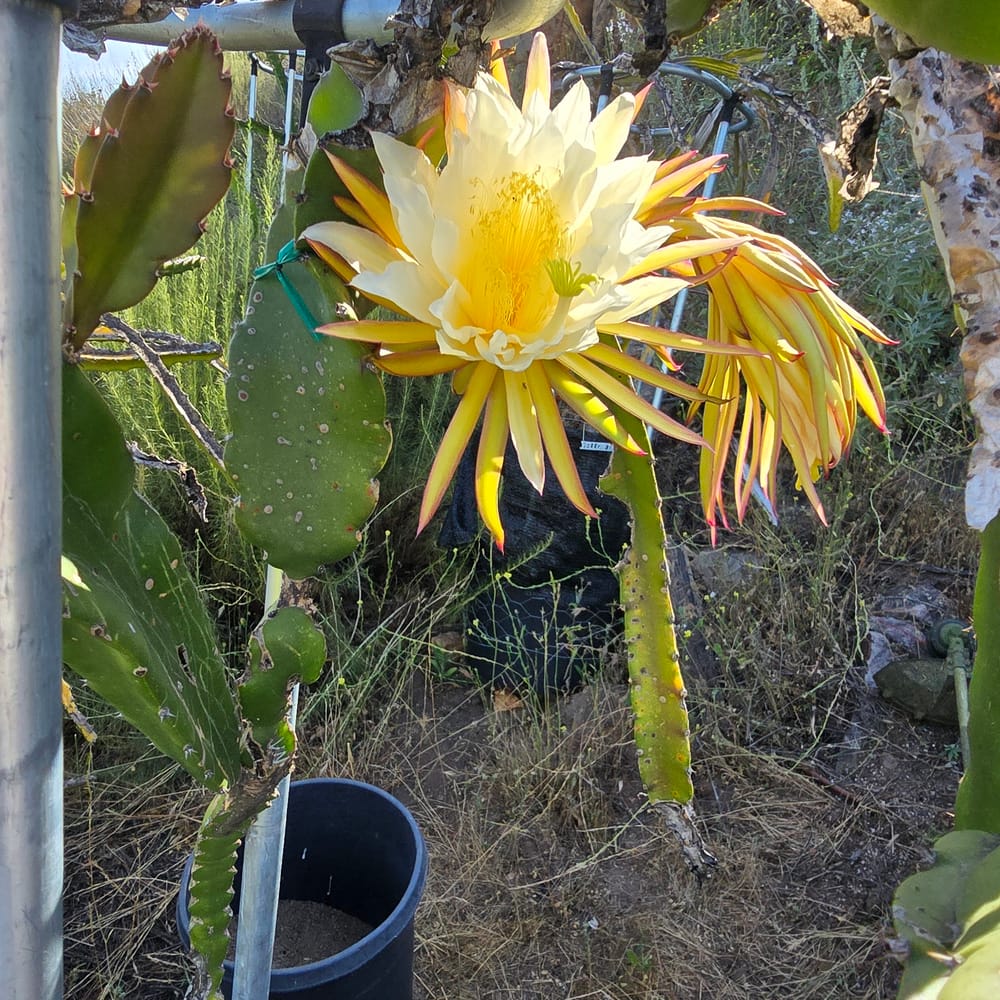
However, hand-pollination or a second genetically distinct plant will noticeably increase fruit size and set rate. Flowers open at night (like all Selenicereus) and are pollinated naturally by moths and bats in their native range. In California gardens, hawkmoths do the work, but many growers use a small paintbrush to transfer pollen between flowers that open the same night for reliably larger fruit.
Bloom-to-harvest timeline: approximately 120-150 days from pollination to ripe fruit — longer than red varieties (which ripen in 30-50 days). This is one reason yellow dragon fruit is more expensive commercially.
Harvest & Season: The Longest of Any Variety
Yellow dragon fruit has the longest fruiting season of any dragon fruit variety: September through May — roughly 9 months. Red and white varieties produce in concentrated summer flushes (typically June-October), while yellow dragon fruit produces continuously through the cool season when other pitahayas are dormant.
Harvest indicators:
- Skin transitions from green to fully saturated bright yellow
- Small spines naturally loosen and fall off or brush away easily
- Slight give when gently squeezed (like a ripe avocado)
- Fruit detaches with a gentle twist
Shelf life: 1-2 weeks refrigerated. Yellow dragon fruit holds better than red varieties due to the thicker, protective skin.
This counter-seasonal production is a commercial advantage: Ecuador Palora fills the gap when red/white varieties are out of season, which is why yellow pitahaya from Ecuador commands premium prices in winter markets.
How It Compares: Yellow vs Red vs White
| Trait | Yellow (Ecuador Palora) | Red-Fleshed | White-Fleshed |
|---|---|---|---|
| Species | Selenicereus megalanthus | S. costaricensis | S. undatus |
| Skin | Yellow with small spines | Pink/red with green flaps | Pink/red with green flaps |
| Flesh | White, translucent | Deep magenta/red | White |
| Brix (sugar) | 20-24 | 13-18 | 11-14 |
| Fruit size | 1-1.5 lbs | 0.75-2 lbs | 0.75-2 lbs |
| Self-fertile | Yes | Usually no | Varies by cultivar |
| Fruiting season | Sept-May (9 months) | June-Oct | June-Oct |
| Days bloom to harvest | 120-150 | 30-50 | 30-50 |
| Growth rate | Slower | Fast | Fast |
| Flavor | Lychee, pear, kiwi — intense | Berry, beet, mildly sweet | Mild, melon-like |
For a full comparison of all the major varieties we grow, see our dragon fruit varieties guide.
Why It's a Premium Variety
Yellow dragon fruit costs 2-4x more than red or white at retail, and there are real reasons for that:
- Slower growing plant: takes 2-4 years to first fruit vs 1-2 years for red varieties
- Longer fruit maturation: 4-5 months vs 1-2 months on the plant
- Lower yield per plant: 15-25 lbs annually vs 40-80 lbs for established red plants
- More climate-sensitive: narrower temperature tolerance
- Harder to propagate: cuttings root more slowly than S. undatus
- Higher sugar = more perishable on the tree: must be harvested at the right window
The upside is obvious: there is nothing else in the fruit world that tastes quite like it, and customers who try it once become buyers for life.
Frequently Asked Questions
Is yellow dragon fruit really the sweetest dragon fruit?
Yes. At 20-24 Brix, yellow Selenicereus megalanthus is measurably and noticeably the sweetest dragon fruit species. Red varieties typically test 13-18 Brix and white varieties 11-14 Brix.
Why is yellow dragon fruit so expensive?
It grows slower, takes longer to mature on the plant (120-150 days from flower), yields less per plant, and is more climate-sensitive than red or white dragon fruit. Commercial yellow pitahaya is largely imported from Ecuador and Colombia, adding airfreight cost.
Do I need two plants to get fruit?
No. Ecuador Palora is self-fertile, so a single plant will produce fruit. However, hand-pollination or a second genetically distinct plant will produce larger, more numerous fruits.
Can I grow yellow dragon fruit in Southern California?
Yes — USDA zones 10a and warmer support outdoor year-round growing. In Escondido at Sky Botanicals, it thrives with morning sun, afternoon shade, a sturdy trellis, and careful watering. Zones 9 and colder can grow it in containers brought indoors in winter.
When does yellow dragon fruit fruit?
September through May in Southern California — roughly 9 months, the longest season of any dragon fruit variety. This is the opposite of red and white dragon fruit, which fruit mainly June-October.
What does yellow dragon fruit taste like?
Sweet and floral, with dominant lychee notes and accents of pear, kiwi, and honey. The flesh is translucent white with crunchy edible seeds, texturally similar to kiwi.
How do I know when it's ripe?
Skin is fully bright yellow (no green remaining), the small spines loosen and fall off or brush away easily, the fruit gives slightly to gentle pressure, and it detaches from the plant with a gentle twist.
Is yellow dragon fruit the same as yellow pitahaya or yellow pitaya?
Yes. "Pitahaya" and "pitaya" are the Spanish and Latin American names for dragon fruit. Yellow pitahaya, yellow pitaya, and yellow dragon fruit all refer to Selenicereus megalanthus, most often the Ecuador Palora commercial strain.
For more questions about dragon fruit varieties, growing, and harvesting, check our complete dragon fruit FAQ.
Sky Botanicals grows specialty dragon fruit varieties including yellow Ecuador Palora in Escondido, California (USDA zone 10a). Cuttings and plants available seasonally.