Edgar's Baby Dragon Fruit: Sweet & Compact
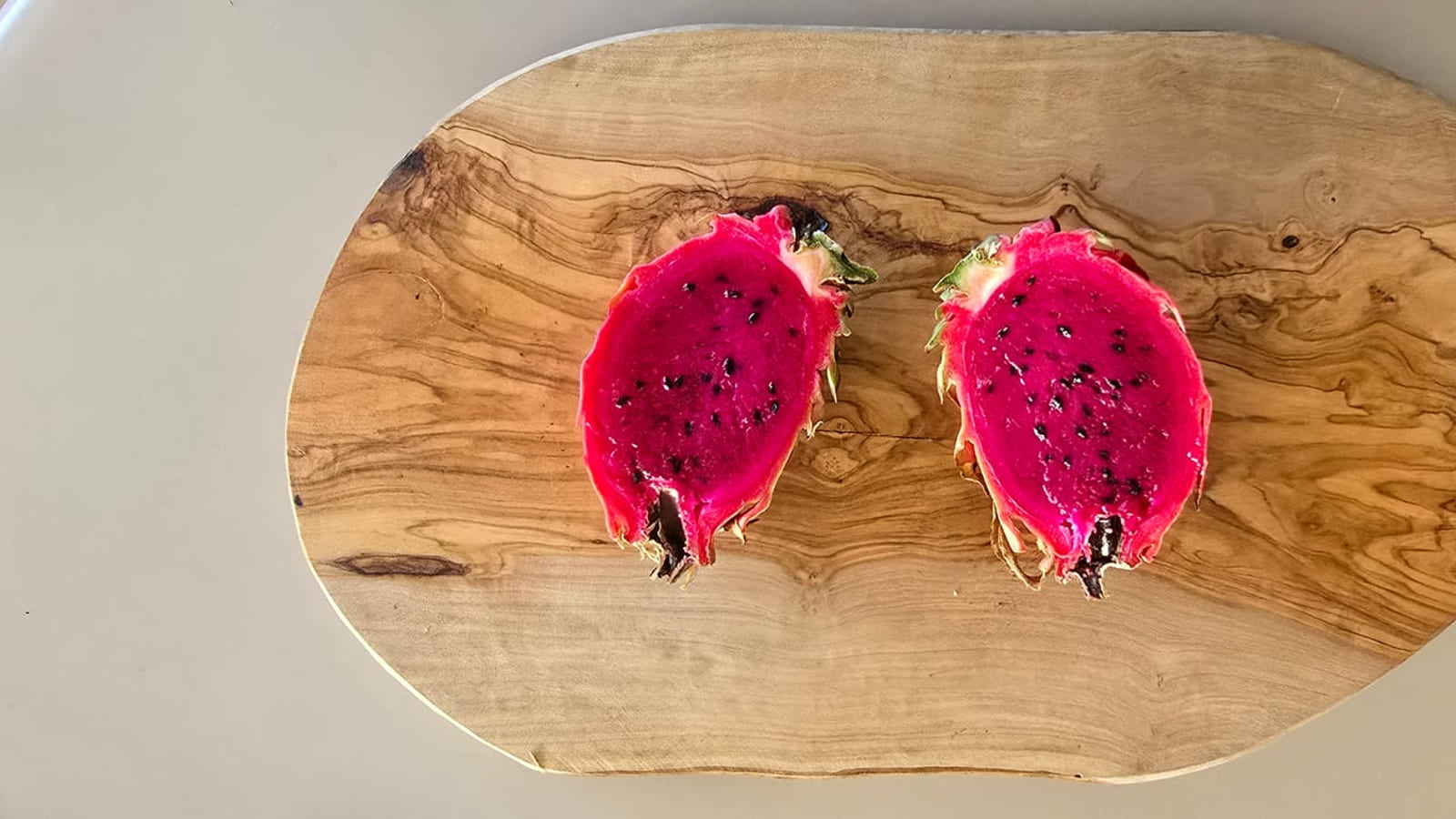
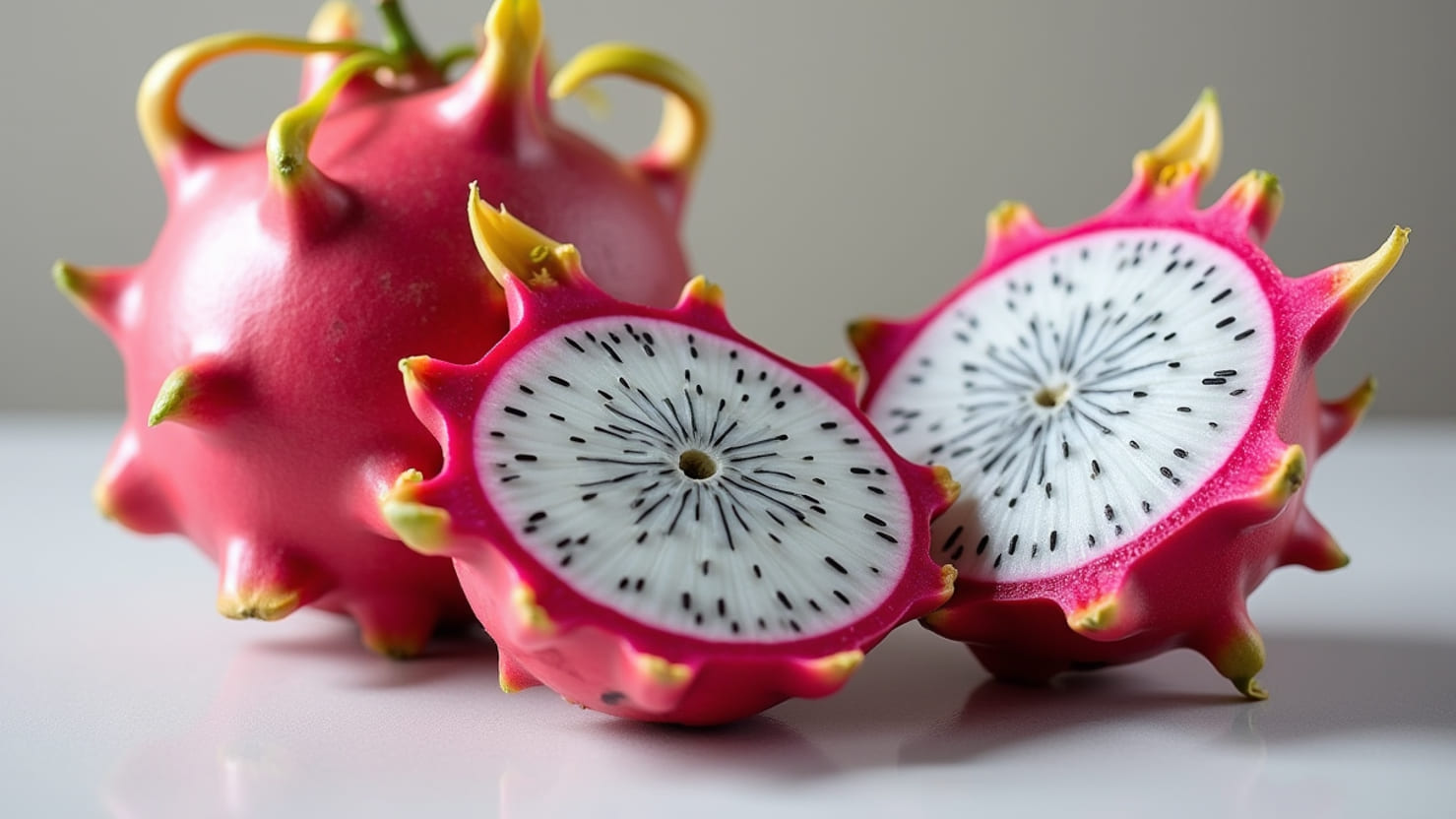
Edgar’s Baby is a compact dragon fruit hybrid that delivers exceptionally sweet, magenta-fleshed fruit in small packages. Bred by California hybridizer Edgar Valdivia as part of the Asunta series, this Selenicereus stenopterus and S. guatemalensis cross (with S. undatus in the background) produces green-skinned fruit. You can expect clean berry and mild floral notes. The plant is ideal for containers and small spaces. If you want high sugar content in a manageable footprint, this variety fits the bill.
Where It Came From: The Valdivia Asunta Line
Edgar’s Baby did not appear overnight in a commercial catalog. It is a seedling from the Asunta series, specifically raised from an Asunta 1/2/3/4 line crossed with the Condor variety[4]. This lineage places it firmly within the work of California hybridizer Edgar Valdivia, a member of the California Rare Fruit Growers who has been refining these small-fruited, red-fleshed hybrids in Southern California[8]. The Asunta series was not released as a single, static cross but was improved over many selection generations, meaning Valdivia spent years selecting for specific traits like sweetness and compact habit[8].
The variety reached the broader grower community through distribution out of a Florida tropical nursery, which helped connect Valdivia’s work to home gardeners across the country[4]. While the genetic background includes Selenicereus undatus, the primary parentage of S. stenopterus and S. guatemalensis gives the plant its distinct characteristics[4].
Collector’s Item vs. Commercial Crop
Modern dragon fruit breeding programs typically target self-compatibility and high soluble solids, aiming for commercial-type hybrids around 18 Brix that can be grown in large-scale orchards without complex pollination management[7]. Edgar’s Baby ignores this trend. Its small fruit size, while perfect for a single serving, limits its wholesale appeal, preventing it from becoming a boxed fruit commodity[5]. Instead, this commercial weakness is exactly what makes it charming for hobbyists. It circulates as a novelty and collector’s cutting, prized for its exceptional flavor and manageable size rather than its shipping durability[5].
Flavour: High Sugar in Small Fruit
Small fruit often means small flavour, but Edgar’s Baby proves otherwise. While the fruit is compact, the sugar content is exceptional. Spicy Exotics records an average of 19 Brix on mature, second-year fruit, while the Dragon Fruit Directory lists a range of 17 to 19 Brix[4]. This variety delivers a very sweet profile with clean berry notes and a mild floral finish that lingers[4].
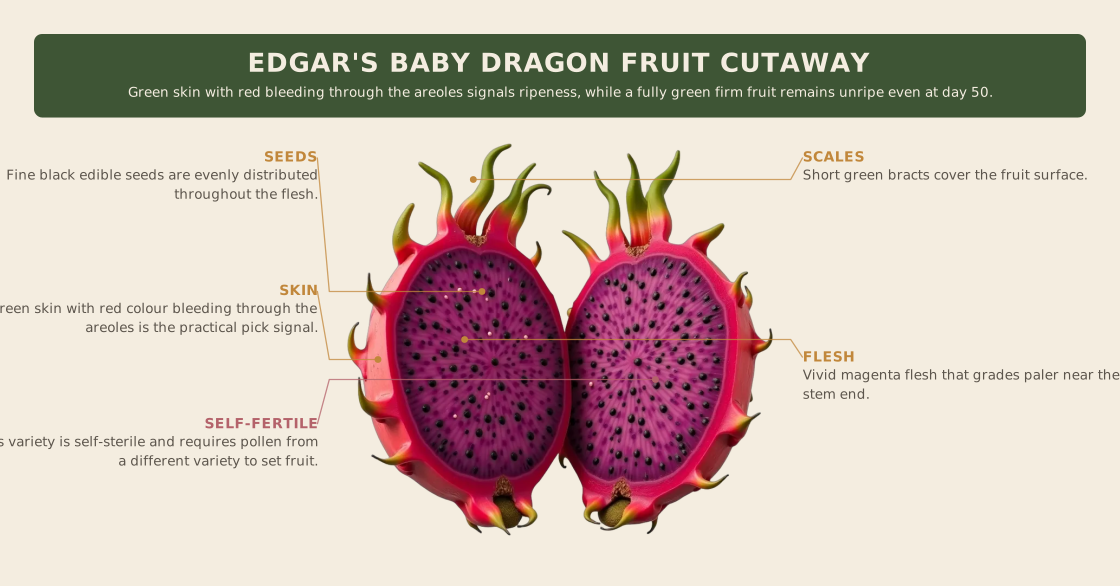
The texture is just as important as the sugar. The flesh is juicy, not mealy, and the seeds are fine enough that you barely notice them as you eat. This makes the fruit ideal for fresh eating rather than processing. The magenta colour is not just for show; it signals a high concentration of betalain pigments, specifically betacyanins[6]. Red-fleshed dragon fruit like this one shows measurably higher total phenolics and antioxidant activity compared to white-fleshed types, meaning the intense colour correlates with higher nutritional value[6].
Patience pays off. First-year fruit on Edgar’s Baby can be smaller and less sweet. The 19 Brix average is recorded on mature, second-year fruit, which tends to be larger and more consistent in quality[4]. If your first harvest is underwhelming, give the plant another season to establish its root system and support structure.
| Attribute | Edgar’s Baby | Typical Commercial White |
|---|---|---|
| Sweetness (Brix) | 17 to 19 (avg 19 on mature fruit) | Lower |
| Flavour Profile | Clean berry, mild floral | Mild, sometimes bland |
| Flesh Colour | Magenta (high betacyanins) | White (lower than red-fleshed) |
| Seed Texture | Fine, edible | Fine, edible |
The Catch: Edgar's Baby Will Not Pollinate Itself
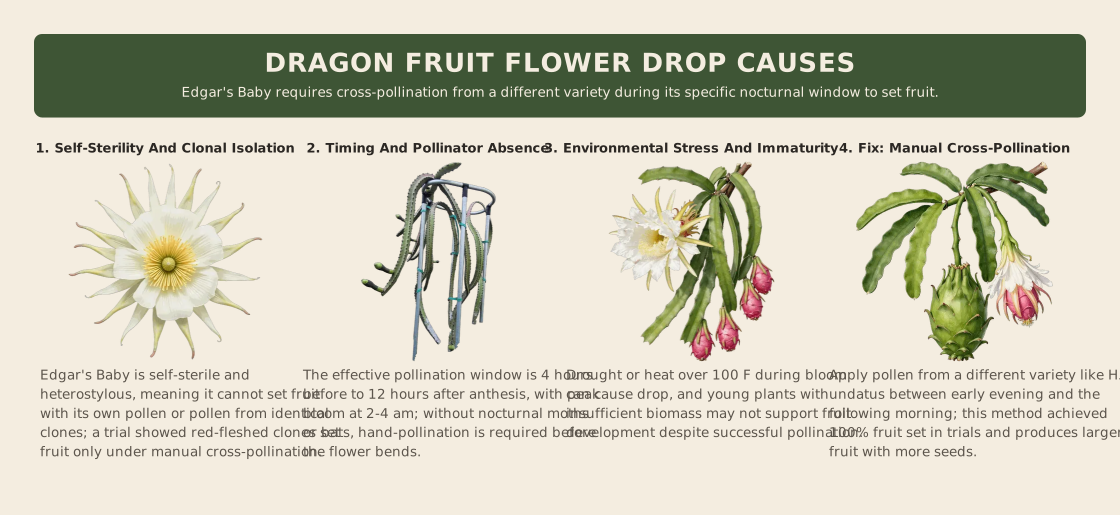
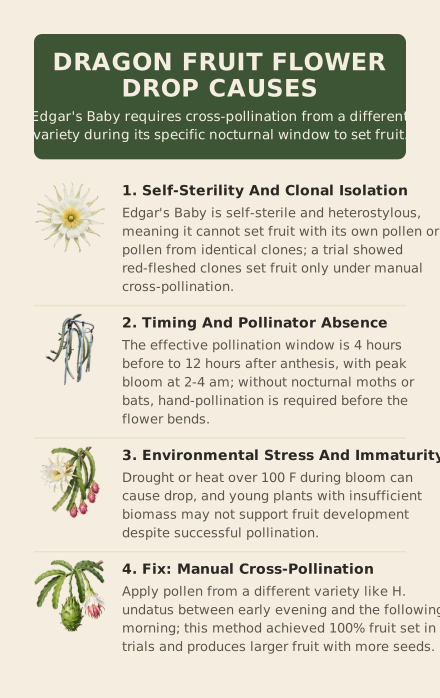
Edgar’s Baby is self-sterile, a trait shared by most cultivated dragon fruit species. This biological barrier stems from heterostyly, a floral structure where the stigma and anthers sit at different heights. This spatial separation naturally pushes pollen between plants rather than allowing self-fertilization. In a two-year trial, red-fleshed clones set fruit only under manual cross-pollination. Bagged flowers and those self-pollinated by hand produced nothing, confirming that the plant cannot reproduce alone[1].
Proper pollination does more than just trigger fruit set; it determines size and quality. Fruit development in dragon fruit tracks the number of ovules fertilized. In the same trial, manual cross-pollination of a self-compatible white-fleshed variety produced an average fruit weight of 588 g. Manual self-pollination yielded 377 g, while open pollination resulted in just 208 g. The difference comes down to seed count. Cross-pollinated fruit carried about 1,300 seeds, compared to 582 seeds in open-pollinated fruit. More seeds mean more hormonal signals to expand the fruit. Inadequate pollination leads to small, underdeveloped fruit even when the flower initially sets[1].
Because Edgar’s Baby cannot pollinate itself, you must plant a genetically distinct partner nearby. A second cutting of Edgar’s Baby will not work. Clones share the same genetic makeup, so their pollen is recognized as "self" and rejected. You need a different variety to provide compatible pollen. Plain Selenicereus undatus types are documented as effective pollinators for this specific cultivar. These white-fleshed varieties are widely available, vigorous, and often self-compatible, making them ideal partners. They provide the necessary genetic difference to trigger full fruit set and maximize size.
Timing is critical. The effective pollination window runs from about 4 hours before the flower opens to 12 hours after. Pollen applied outside this window results in significantly smaller fruit. Since natural nocturnal pollinators like moths and bats may be scarce in home gardens, hand pollination is often required to avoid pollen deficit. For detailed instructions on how to manage this process, see our ecom__dragon fruit pollination guide self fertile vs cross pollinating varieties.
Why a second Edgar’s Baby fails:
Clones are genetically identical. Self-incompatibility systems reject pollen from the same genotype. You need a different variety, such as a standard white-fleshed S. undatus, to provide compatible pollen.
How to Hand-Pollinate It the Night the Flower Opens
Edgar’s Baby is self-sterile, so you cannot rely on a single plant to produce fruit. You must move pollen from a genetically distinct variety onto the stigma of an open flower. While natural pollinators like moths, bats, and beetles do this work in the wild, they are often scarce in home gardens. Hand pollination is the surest way to guarantee a set[1]. The process is simple, but timing is critical because the effective pollination window is narrow and strictly nocturnal.
Watch your buds closely in the evening. They typically begin to unfurl between 6 and 8 pm. Full anthesis, the stage where the flower is fully open and receptive, starts near 8 pm and lasts until about 6 am. Peak bloom occurs between 2 and 4 am. This is the ideal time to work. If you wait too long, the flower will begin to bend or curl after about 12 hours. This bending is your signal that the receptive phase is over and it is too late to pollinate effectively[1].
Use a small, soft brush to collect pollen from the anthers of your partner variety. Gently dab this pollen onto the stigma lobes of the Edgar’s Baby flower. The effective window runs from about 4 hours before anthesis to 12 hours after. Pollination performed from early evening through the following morning results in near-total fruit set and normal fruit size. If you apply pollen 18 to 30 hours after anthesis, you may still get fruit, but it will be significantly smaller. Fruit size in dragon fruit tracks the number of ovules fertilized, so missing the peak window leads to underdeveloped fruit[1].
Pro Tip: Do not rely on clones. Extension guidance recommends planting at least two genetically distinct varieties to ensure compatibility. Plain Selenicereus undatus types are documented as effective pollinators for Edgar’s Baby[4].
Troubleshooting Poor Fruit Set
If you are seeing flowers drop or small fruit, the issue is almost always timing or pollen source. Use this table to diagnose the problem.
| Symptom | Likely Cause | Fix |
|---|---|---|
| Flower drops with no fruit | No pollination occurred; natural pollinators absent | Hand-pollinate between 8 pm and 6 am |
| Small, lopsided fruit | Incomplete pollination or late timing | Ensure full coverage of stigma lobes during peak bloom (2-4 am) |
| Fruit sets but stalls | Pollen applied outside the 4-hour pre-anthesis to 12-hour post-anthesis window | Try again next flush; do not wait for the flower to bend |
Bloom to Harvest: The Edgar's Baby Calendar
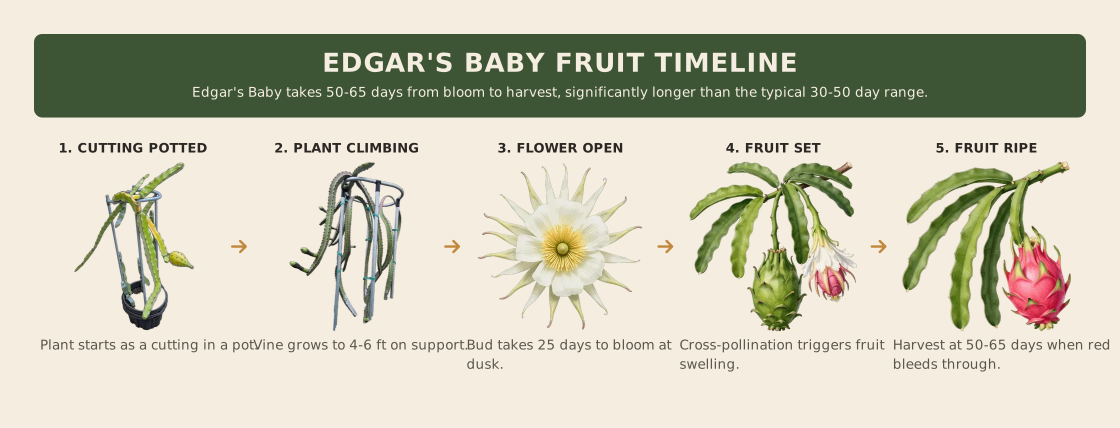
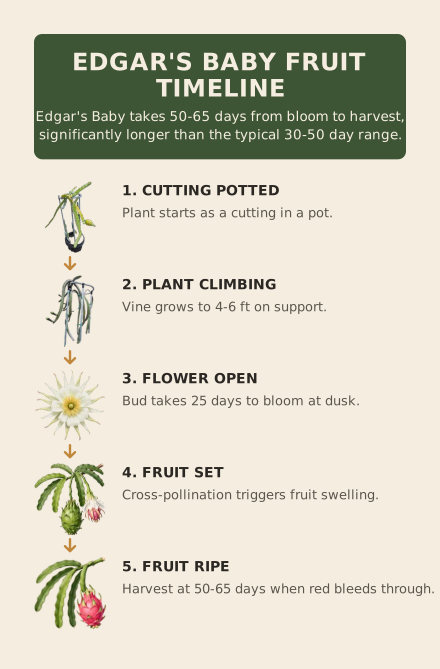
Patience is the primary skill required here, as Edgar’s Baby operates on a slower clock than standard commercial varieties. The directory logs approximately 25 days from bud initiation to flower opening[1]. This is slightly longer than the 16 to 22 days observed in white-fleshed phenology trials[1]. Once the flower opens, the wait extends significantly. You are looking at 50 to 65 days from anthesis to harvest[4]. Compare this to the 29 to 34 days from anthesis to maturity measured in white-fleshed types, which results in a total bud-to-harvest benchmark of roughly 48 to 54 days[1]. Edgar’s Baby adds a substantial delay to the ripening phase, requiring you to manage expectations for a longer season.
Flowering is driven by photoperiod. Dragon fruit is a long-day plant, which explains why natural bloom flushes in the Northern Hemisphere occur from May through September[3]. In subtropical climates like Florida, this can extend harvest windows into November, with multiple flushes per season[3]. Commercial growers often use supplemental lighting to trick the plants into flowering out of season, extending the day length to trigger additional cycles[3]. For home growers, this means your main crop arrives in summer, but you can potentially stretch the season with a simple timer and a bright light source.
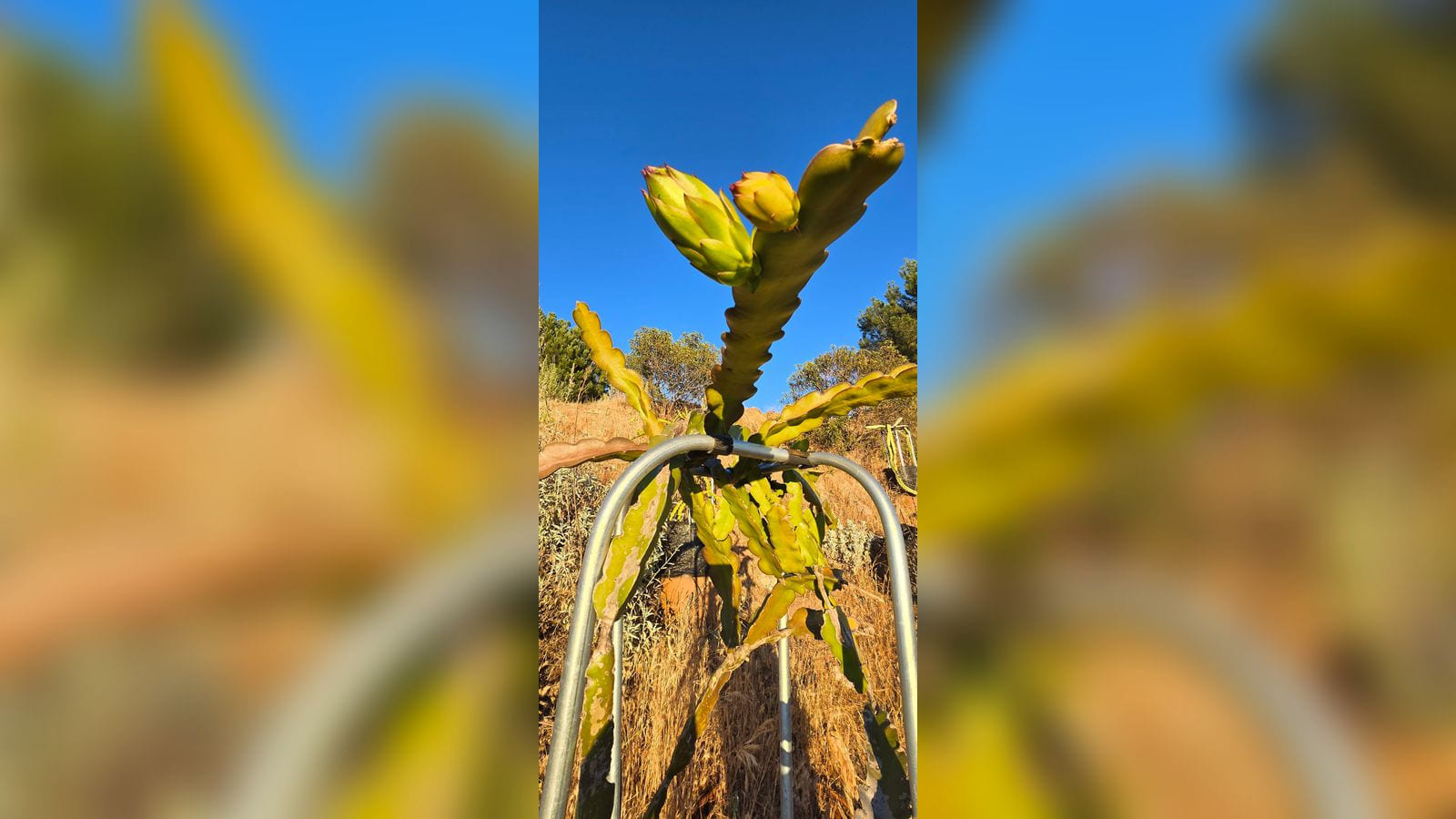
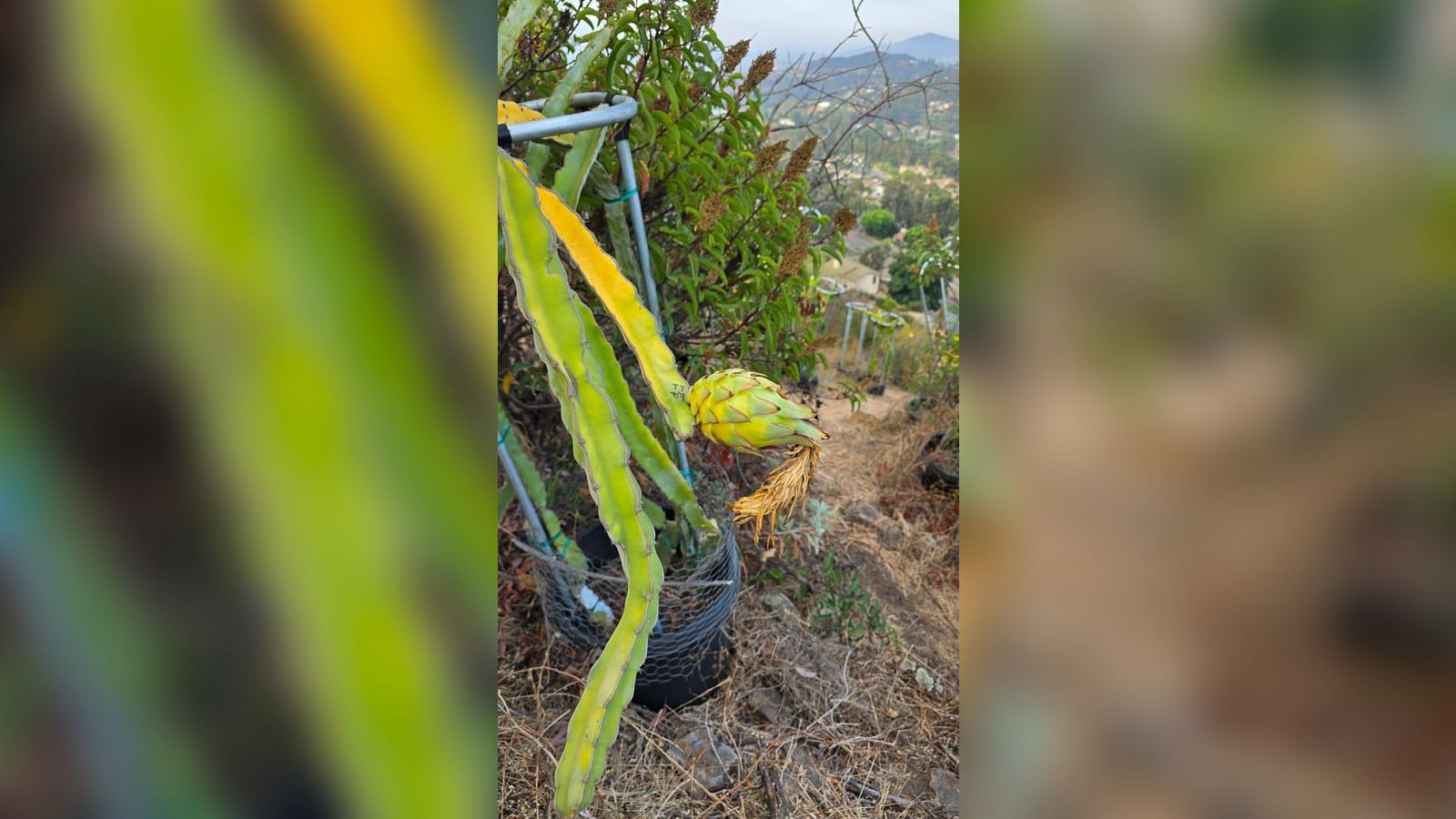
The flowers themselves are medium-sized, featuring white inner petals and outer petals that blend white, yellow, and green[4]. In Gulf-coast climates, these blooms open at dusk and close by sunrise, offering a shorter show than some other varieties[4]. The bud resembles an Asunta bud but remains solid green until it opens[4]. Once pollinated, the fruit swells over the next two months. The skin remains green for most of this period, hiding the ripeness inside.
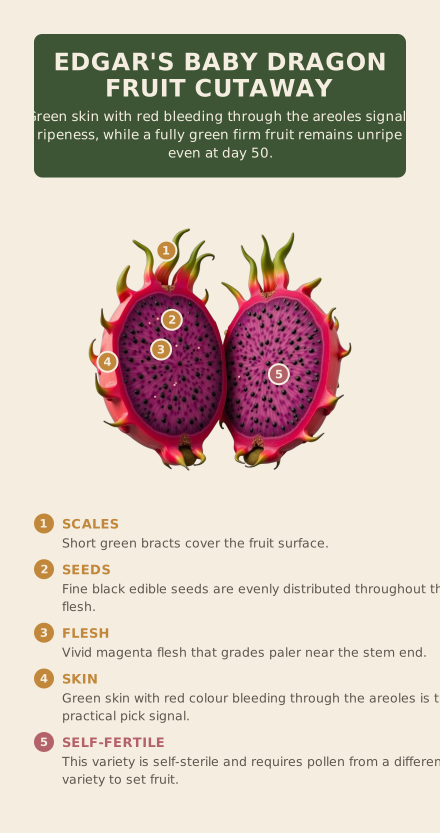
The 50-Day Rule: Date the night the flower opens. Count 50 days forward. Then, inspect the fruit daily. Do not pick based on size alone. The practical signal for Edgar’s Baby is red bleeding through the green skin[4]. The flesh is magenta to pink-red, and the bracts are short and green[4]. Waiting for that color shift ensures the sugars have fully developed.
Because the ripening time is long, 50 to 65 days, you must protect the developing fruit from pests and weather for a longer window than with standard varieties[4]. The extension sources note a 30 to 50 day ripening range for common types, but Edgar’s Baby consistently sits at the upper end of that spectrum or beyond it[4]. This delay is a trade-off for the high brix content. The extra time on the vine allows the berry and floral notes to concentrate. If you pick too early, waiting for the red bleed, you will get a bland, firm fruit that lacks the signature sweetness. Trust the calendar, but verify with the color.
Growing Edgar's Baby
Edgar’s Baby behaves like a standard dragon fruit in the garden but with a more manageable footprint. The plant produces three-sided, bright green stems covered in small spines, closely resembling the growth habit of common white-fleshed varieties[4]. It is a compact climber, typically reaching only 4 to 6 feet on support, which makes it an excellent candidate for smaller trellises or single posts[4]. Unlike many hybrids with Selenicereus stenopterus in their background, established Edgar’s Baby plants show strong tolerance to full sun, even in the humid heat of a Louisiana summer[4].
While the plant handles heat well, it is a CAM cactus with specific temperature limits. Pitaya thrives in tropical and subtropical climates where frost is rare, with optimal growth occurring between 65 and 77 degrees Fahrenheit[2]. It can tolerate temperatures up to 100 degrees Fahrenheit, but extended exposure to 31 degrees Fahrenheit will damage stems[2]. The good news is that plants recover rapidly from light freezing injury, though they are far more sensitive to cold than they are to drought[2]. For this reason, it is best suited to USDA zones 10 and 11 outdoors, or grown in containers that can be moved under cover in cooler climates[9].
Young Plant Care: Provide about 30% shade for the first 3 to 4 months after planting to prevent sunburn on new growth[2]. Once established, move the plant to full sun, as too much shade will reduce both yield and fruit quality[2].
Watering and feeding should mimic the plant’s natural environment. Use a sharply drained sandy mix or cactus soil to prevent root rot, and water deeply but infrequently, allowing the top layer to dry out between drinks[9]. Feed with a balanced fertilizer or a cactus-specific formula during the active growing season to support the heavy energy demands of flowering and fruiting[9].
| Care Factor | Recommendation |
|---|---|
| Light | Full sun once established; 30% shade for first 3-4 months[2] |
| Water | Deep but infrequent; allow dry-down between waterings[9] |
| Soil | Sharply drained sandy mix or cactus soil[9] |
| Temperature | Optimum 65-77°F; damage at 31°F; avoid >100°F[2] |
| Feeding | Balanced or cactus fertilizer during growth[9] |
| Support | Sturdy post or trellis; reaches 4-6 ft[9] |
| Container | Large enough for root spread; well-draining |
| Winter | Protect from frost; move indoors if below 31°F[2] |
Edgar's Baby vs the Other Small Red-Fleshed Varieties
Choosing between red-fleshed varieties often comes down to what you want to do with the fruit, not just how sweet it tastes. Edgar’s Baby sits in a unique niche among the small-fruited hybrids we stock. It shares its lineage with Asunta 3 and Condor, but its behavior in the garden and its harvest profile differ in ways that matter for your daily routine.
The most immediate difference is visual. Edgar’s Baby has green skin that stays green until the very end. You look for red bleeding through the bracts and skin to know it is ready. Asunta 3 and Condor often show color changes earlier or have different skin tones that make ripeness easier to spot from a distance. This makes Edgar’s Baby slightly harder to judge if you are new to reading pitaya ripeness.
Edgar’s Baby is small, typically 0.5 to 1 lb, which is great for a single serving but limits its use in canning or bulk gifting. If you want to make jam or sell fruit at a market, larger varieties like standard white-fleshed types may be more practical. Edgar’s Baby is a treat for the grower, not a commercial crop.
Pollination needs are similar across these red-fleshed varieties. Most are self-sterile or have low self-compatibility. You will need a partner for Edgar’s Baby, Asunta 3, and Condor. The difference lies in which partners work best. Edgar’s Baby responds well to plain Selenicereus undatus pollen, which is easy to source. Other varieties may have different preferences.
Here is how they compare side by side:
| Variety | Flesh Color | Typical Size | Sweetness | Pollination | Best For |
|---|---|---|---|---|---|
| Edgar's Baby | Magenta | Small (0.5-1 lb) | Very High (17-19 Brix) | Self-sterile | Container growing, single serving |
| Asunta 3 | Red/Pink | Small-Medium | High | Self-sterile | Collector interest, similar habit |
| Condor | Red | Medium | High | Self-sterile | Parent stock, reliable producer |
Because Edgar’s Baby has green skin, do not rely on color change alone. Look for the red bleed appearing through the green skin and the bracts drying out slightly. The fruit should detach with a gentle twist. If it resists, it is not ready.
Why pick one over the other? Choose Edgar’s Baby if you have limited space and want the highest sugar content possible in a small package. Its compact habit fits on a balcony or in a large pot. Choose Asunta 3 or Condor if you want to maintain the genetic line or experiment with breeding. All of them require a pollinator partner, so plan for at least two varieties in your collection.
Which Varieties We Stock to Pair With It
Since Edgar’s Baby is self-sterile, you cannot rely on a single plant to produce fruit. You need a genetically distinct partner to provide viable pollen. Extension guidance for guaranteed set is to plant at least two different varieties rather than clones[3]. If you buy two cuttings of Edgar’s Baby, you have bought two copies of the same genetic code. They will bloom, but they will not set fruit. You need a different variety to bridge the gap.
Our nursery stocks several varieties that serve as reliable pollinator partners. We recommend Vietnamese White or Condor-line for this role. These white-fleshed varieties are vigorous, easy to grow, and provide the pollen compatibility Edgar’s Baby requires. They also offer a practical benefit: if you forget to hand-pollinate one night, you still get a crop of white-fleshed fruit from the partner plant.
If you prefer a red-fleshed partner to keep the theme consistent, consider Asunta 3. These are siblings within the same breeding line but are genetically distinct enough to cross-pollinate. American Beauty is another strong candidate. It is a self-compatible red-fleshed variety that can act as a universal donor. Its pollen is compatible with many red-fleshed hybrids, including those in the Asunta group. Bahamut is a newer addition to our list. It is a vigorous grower with large fruit that can support the pollination needs of smaller, self-sterile varieties like Edgar’s Baby.
The Clone Trap: Never buy two cuttings of the same variety expecting them to pollinate each other. Self-sterility means the plant rejects its own pollen. You must introduce genetic diversity. One Edgar’s Baby plus one Vietnamese White is a functional pair. Two Edgar’s Babies are just two plants that will never fruit.
For growers who want to skip the pollination chore entirely, we offer alternatives. If the nightly hand-pollination routine feels like too much work, consider starting with a self-compatible variety. Asunta 3 is self-compatible. It sets fruit without a partner. You get the same magenta flesh and high sugar content without the timing stress. Bahamut is also self-compatible. These varieties are ideal for beginners or for growers who want a low-maintenance red-fleshed crop.
If you are not ready to commit to a cutting, you can taste the fruit first. We sell fresh dragon fruit from Box of Fresh. This allows you to verify the flavor profile before investing in plants. You can try Edgar’s Baby alongside our other red-fleshed varieties to see which one fits your palate. Once you know which flavor you prefer, you can buy the cutting that matches. This approach saves you from growing a plant you do not enjoy eating.
| Variety | Role | Why It Works |
|---|---|---|
| Vietnamese White | Pollinator Partner | Documented compatibility; vigorous growth; dual-purpose fruit. |
| Condor-line | Pollinator Partner | White-fleshed undatus type; reliable pollen source. |
| American Beauty | Pollinator Partner | Self-compatible red-fleshed; universal pollen donor. |
| Asunta 3 | Alternative or Partner | Self-compatible; same flavor profile; no partner needed. |
| Bahamut | Alternative or Partner | Self-compatible; large fruit; vigorous support. |
Frequently Asked Questions
Growers often ask if they can skip the hand-pollination step. The answer is no. Spicy Exotics has successfully set fruit on this variety using plain Selenicereus undatus pollen, so a common white-fleshed pitaya makes a reliable companion[4]. Avoid using other stenopterus-derived hybrids as pollinators, as they may share the same incompatibility barriers.
Expect a long wait for your first harvest. From a rooted cutting on a supported trellis, the plant is earlier-fruiting than many hybrids. Once the night-blooming flowers open, patience is still required. The fruit takes 50 to 65 days to ripen, which is significantly longer than the 30 to 50 days common for standard white-fleshed types[4]. This slow development allows the sugars to concentrate, resulting in the high Brix levels this variety is known for.
| Question | Answer |
|---|---|
| How sweet is it? | 17 to 19 Brix, with clean berry and floral notes[4]. |
| How big is the fruit? | 0.5 to 1 lb. Second-year plants may produce fruit slightly over a pound[4]. |
| Can I grow it in a pot? | Yes. It thrives in containers in zones 10 to 11, or can be overwintered indoors in cooler climates[9]. |
| How do I know it is ripe? | Do not rely on skin color alone. The skin remains green. Look for red bleeding through the green and count 50 to 65 days from bloom[4]. |
Identifying ripeness requires a shift in expectation. Unlike commercial white-fleshed varieties that turn bright pink or red, Edgar’s Baby keeps a green skin even when fully mature. The flesh inside is magenta to pink-red. The most reliable sign of readiness is a subtle red bleed showing through the green skin, combined with the correct day count from pollination. If you pick too early, the fruit will not sweeten further, as dragon fruit does not ripen off the vine.
Tip: Keep a simple garden log. Mark the date you hand-pollinated each flower. Since the ripening window is fixed at 50 to 65 days, a calendar entry is more accurate than guessing by appearance.
References
- Floral and pollination biology of dragon fruit reveals strategies for enhancing productivity through pollination management and reproductive window extension, Scientific Reports (Nature Portfolio), doi:10.1038/s41598-025-21168-2 (2025).
- HS1068/HS303: Pitaya (Dragonfruit) Growing in the Florida Home Landscape, UF/IFAS Extension (Crane & Balerdi) (2016).
- Suncoast Grown and Gathered: August Dragonfruit, UF/IFAS Extension Sarasota County (2025).
- Edgars Baby - H. stenopterus X H. guatemalensis, Spicy Exotics (2026).
- Edgar's Baby Cultivar - The Dragon Fruit Directory, The Dragon Fruit Directory (Tendra) (2026).
- Nutritional Value and Therapeutic Benefits of Dragon Fruit: A Comprehensive Review with Implications for Establishing Australian Industry Standards, Molecules (MDPI) (2024).
- Breeding and Varieties, in: Dragon Fruit (CABI Series), CABI (2024).
- Ax Dragon Fruit Information and Facts (Asunta series lineage, Edgar Valdivia), Specialty Produce (2025).
- Growing Guide: Edgar's Baby Dragon Fruit, Sow Exotic (2026).