Godzilla Dragon Fruit: What You Need to Know
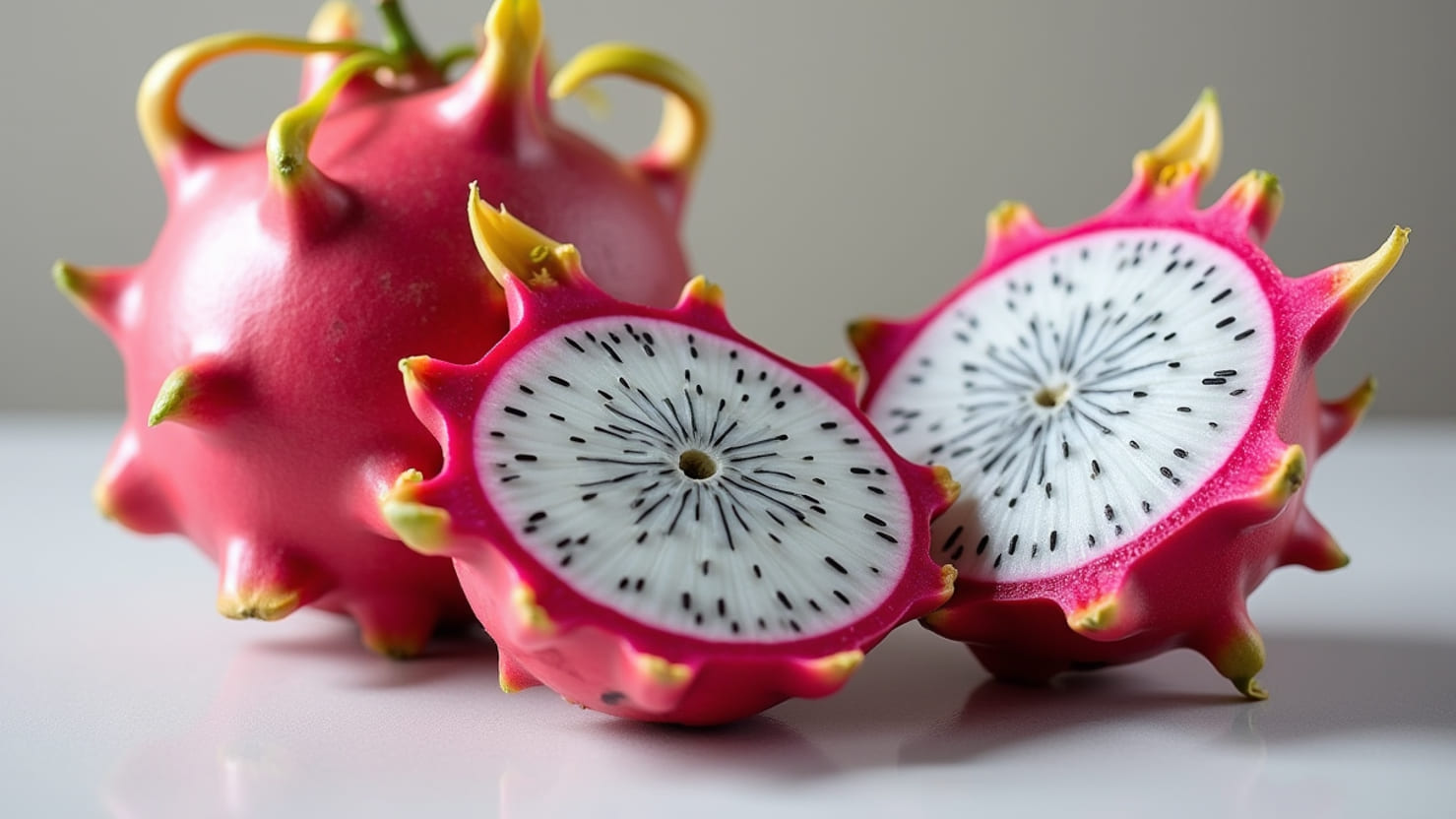
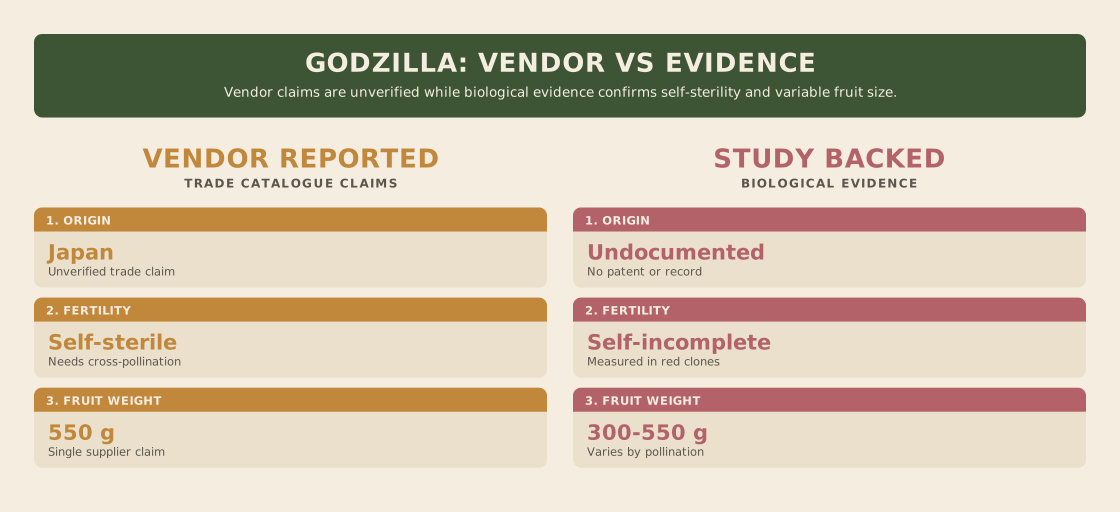
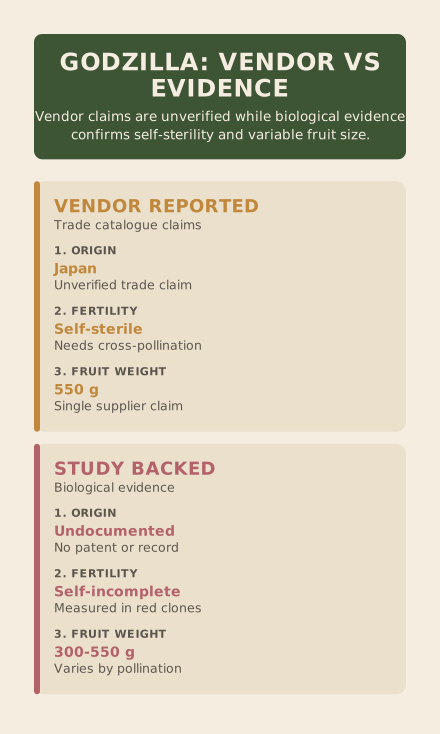
Godzilla dragon fruit, sold as Japanese Godzilla, is a vigorous, red-fleshed variety with thick stems and round, finned fruit. Before buying a cutting, understand that it is self-sterile, requiring hand-pollination with a compatible variety on the night the flower opens. Without this, the flower falls off. The payoff is worth the labor: growers report sweet, substantial fruit with a berry-and-pear flavor. Note that specific metrics are vendor-reported, not from controlled trials. The self-sterile status aligns with published studies on red-fleshed clones, which show strict self-incompatibility. If you lack a pollinator, check our pollination guide to plan your cross-pollination strategy before planting.
What Godzilla Is
Godzilla is not a new species. It is a cultivar selection within the genus Selenicereus, formerly classified under Hylocereus. Like all traded pitayas, it is a climbing cactus in the family Cactaceae. The name change from Hylocereus to Selenicereus reflects modern phylogenetic sorting, but the plant’s biology remains that of a robust, epiphytic cactus. You will see both names in older literature and current nursery catalogs, but they refer to the same group of plants.[1]
The provenance of Godzilla is murkier than its taxonomy. The trade consistently cites Japan as the origin, yet there is no plant patent, variety registration, or published breeding record to support this claim. The origin story is vendor-reported, not documented. This lack of formal registration means the name "Godzilla" functions as a trade label rather than a scientifically defined cultivar.[1]
Because the name is not legally protected or genetically standardized, it likely covers more than one red-fleshed selection. Supplier descriptions vary enough to suggest that different nurseries are selling distinct plants under the same banner. One description might emphasize a large fruit with high sugar potential, while another describes a smaller fruit with dark purple pulp. Both are called Godzilla. The physical traits generally agreed upon are thick, stiff, green-grey branches and round, finned fruit, but the specific performance metrics are inconsistent.[5]
When a variety lacks a patent or registration, the name is a marketing term, not a guarantee of genetic identity. If you buy a cutting labeled "Godzilla," you are buying a red-fleshed pitaya with round fruit and vigorous growth, but you cannot be certain it is the exact clone described by a different supplier. Always verify the self-sterile status with your specific seller, as this trait is critical for fruit set.
Variety Sheet: Vendor Claims vs Published Science
When you buy a cutting labeled Godzilla, you are buying a set of expectations. The table below separates what suppliers promise from what botanical science and commercial growing data actually support. Dragon fruit is a long-lived crop. A cutting planted today is a decade-plus decision, and knowing which traits are genetically fixed versus which are environmental helps you plan your trellis and pollination strategy correctly.
| Trait | What suppliers report | What the science supports |
|---|---|---|
| Origin | Japan; no registration | Not documented; reached Western collections via growers, not breeding programs[5] |
| Growth | Very vigorous, thick green-grey waxy stems | Consistent with CAM climbing cactus ecology; sunburn is a documented problem in the crop[5] |
| Fruit shape | Round | Consistent across suppliers[5] |
| Fruit weight | 300-550 g | Grower-reported; no trial data[5] |
| Flesh | Pink to deep purple | Betalain-basis explained in the next section |
| Sweetness | About 18 Brix | Grower-reported[5] |
| Pollination | Self-sterile, needs cross | Supported; red-fleshed clones show strict self-incompatibility[1] |
| Flowering season | From November in the Southern Hemisphere | Long-day plant, environmentally induced, mirrored by hemisphere[1] |
| Trellis | Post and strong support | UF/IFAS: several hundred pounds of stem weight, 15-25 ft clearance[2] |
Why the waxy stem matters: Suppliers describe the green-grey, waxy look of Godzilla stems as a natural sunscreen. This is a real and useful trait. Cultivated dragon fruit is a CAM photosynthesising climbing cactus with water-retaining cladodes and a shallow, dense root system. This biology allows it to perform on drought-prone, high-temperature, marginal ground. Sunburn is listed among the documented problems that cost commercial growers fruit. A waxy stem covering is the plant's own answer to that problem. [8][10][11]
The Pollination Problem Is the Whole Story
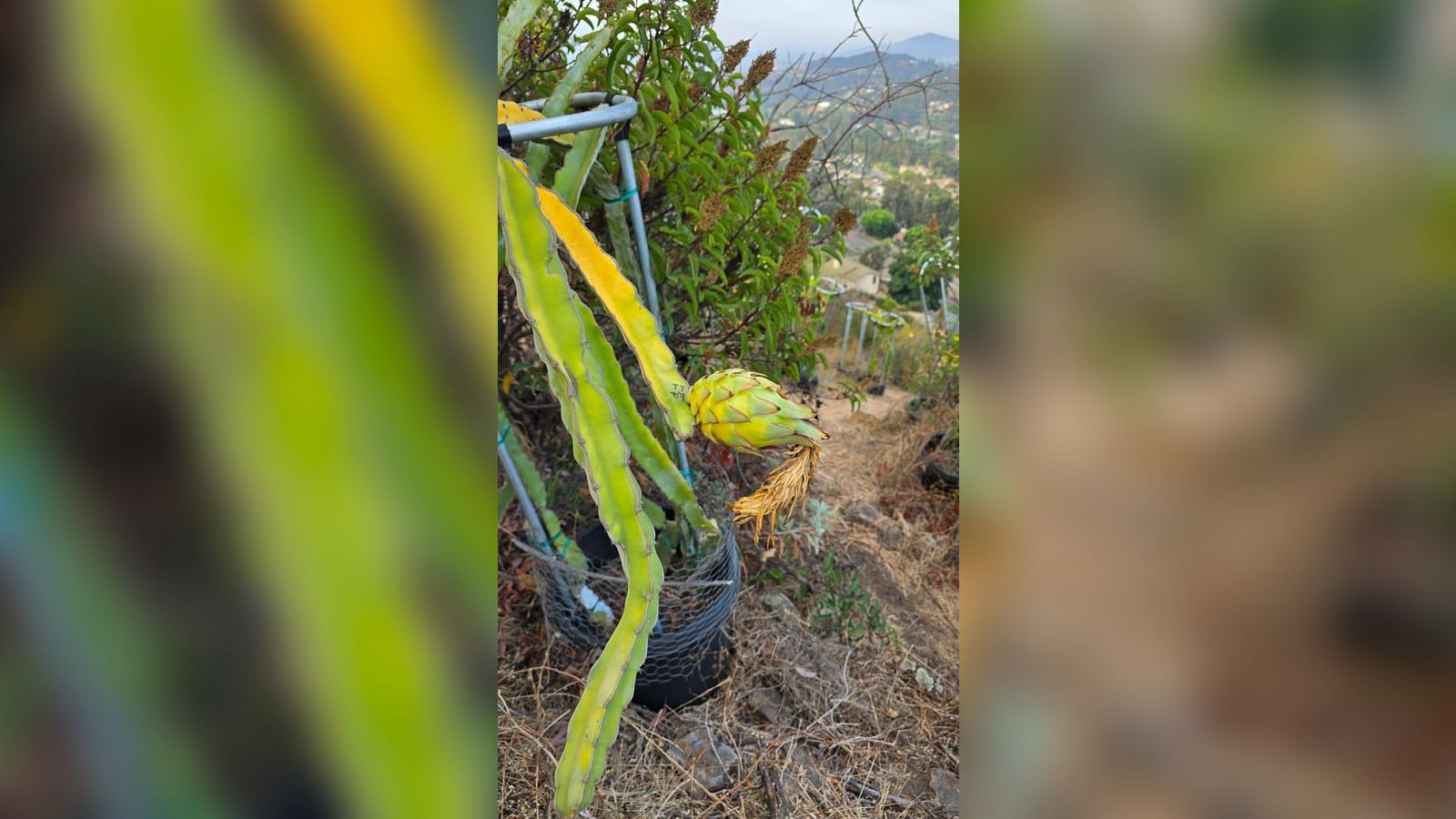
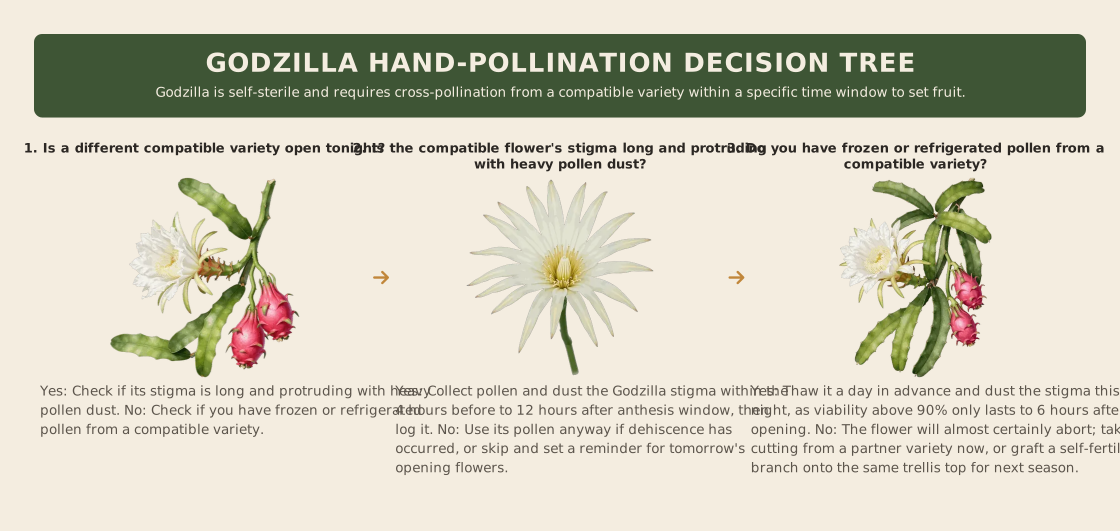
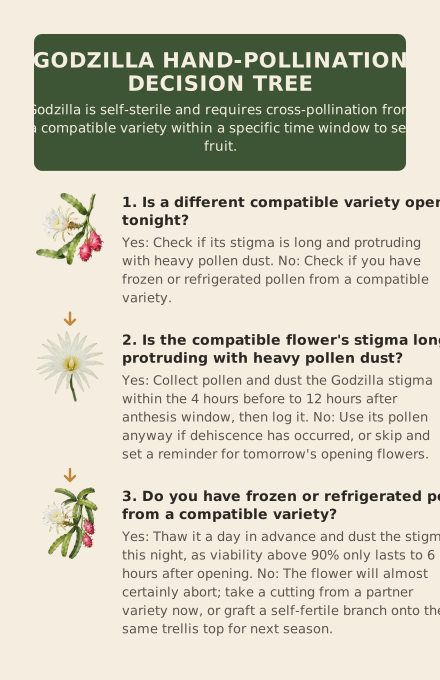
Most gardeners treat pollination as a minor chore, but for Godzilla, it is the entire agricultural challenge. The plant’s biology dictates the outcome. If you do not understand the mechanism, you will lose every flower. The core issue is heterostyly, a physical separation of reproductive parts that prevents self-fertilization. In self-pollinating varieties, the stigma sits low, nestled inside the anthers, so the flower dusts itself as it opens. In self-sterile types like Godzilla, the stigma protrudes well clear of the anthers, often appearing as a large, star-shaped structure held high above the pollen-covered center. This visual tell confirms the plant cannot fertilize itself. You must act as the vector for pollen transfer.[6]
Suppliers disagree on Godzilla’s fertility, which adds confusion. While most catalogs list it as self-sterile, one claims it is self-pollinating. That outlier description often matches a different red selection, so assume Godzilla is self-sterile and plan for hand-pollination. If you skip this step, the flower falls off. If you do it correctly, you get fruit. The difference between a half-pollinated flower and a fully pollinated one is stark: fruit size tracks the number of ovules fertilized. A flower that receives pollen on only half its stigma will produce a fruit that is roughly half the size. You are not just setting fruit; you are determining its weight.[5]
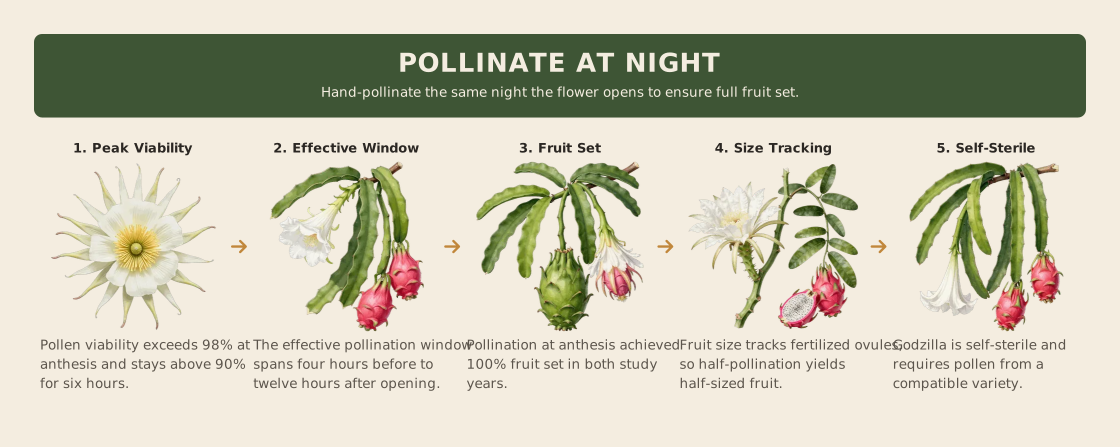
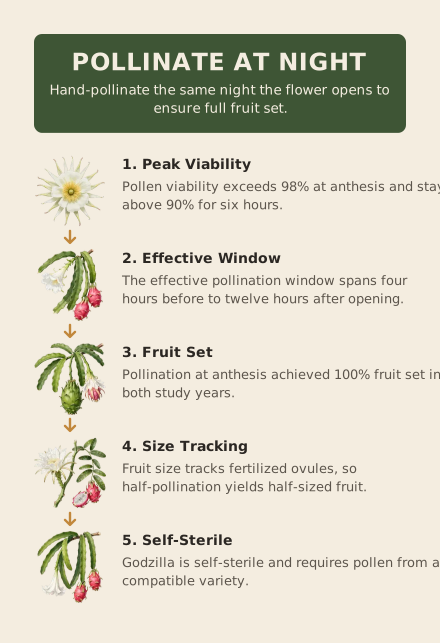
Timing is critical because pollen viability drops rapidly after the flower opens. The effective window is narrow, so missing it wastes the bloom. Note that anthesis is the moment the flower fully opens.[1]
| Time Relative to Anthesis | Pollen Viability | Outcome |
|---|---|---|
| -6 hours to +6 hours | > 90% | High success rate |
| At anthesis (0 hours) | > 98% | Can achieve 100% fruit set in trials |
| +12 hours | ~80% | Reduced viability |
| +24 hours | ~45% | Low success rate |
The effective pollination window runs from four hours before anthesis to twelve hours after. Pollinating at the moment of opening yields high success rates in controlled studies. Waiting until the next morning is risky, and waiting two days is futile. The practical instruction is simple: pollinate the same night the flower opens, either in early evening or the following morning. Do not rely on natural vectors like bats or moths if you want guaranteed fruit. Use the same-night hand pollination technique that turns a self-sterile Godzilla flower into a fruit to ensure every ovule is hit.[1]
Staggered Bloom Strategy
What if your Godzilla blooms on a different night than your pollinator? You can harvest pollen from the pollinator variety and store it. Dragon fruit pollen keeps for about two weeks when refrigerated and up to 30 days when frozen. This allows you to bridge the gap between bloom dates. Collect pollen from the anthers of the compatible variety, store it in a sealed container, and apply it to the Godzilla stigma when the flower opens. This method turns a timing mismatch into a manageable logistical task rather than a lost harvest.[1]
Why the Flesh Stains: Betalains, Not Betalins-and-Colouring
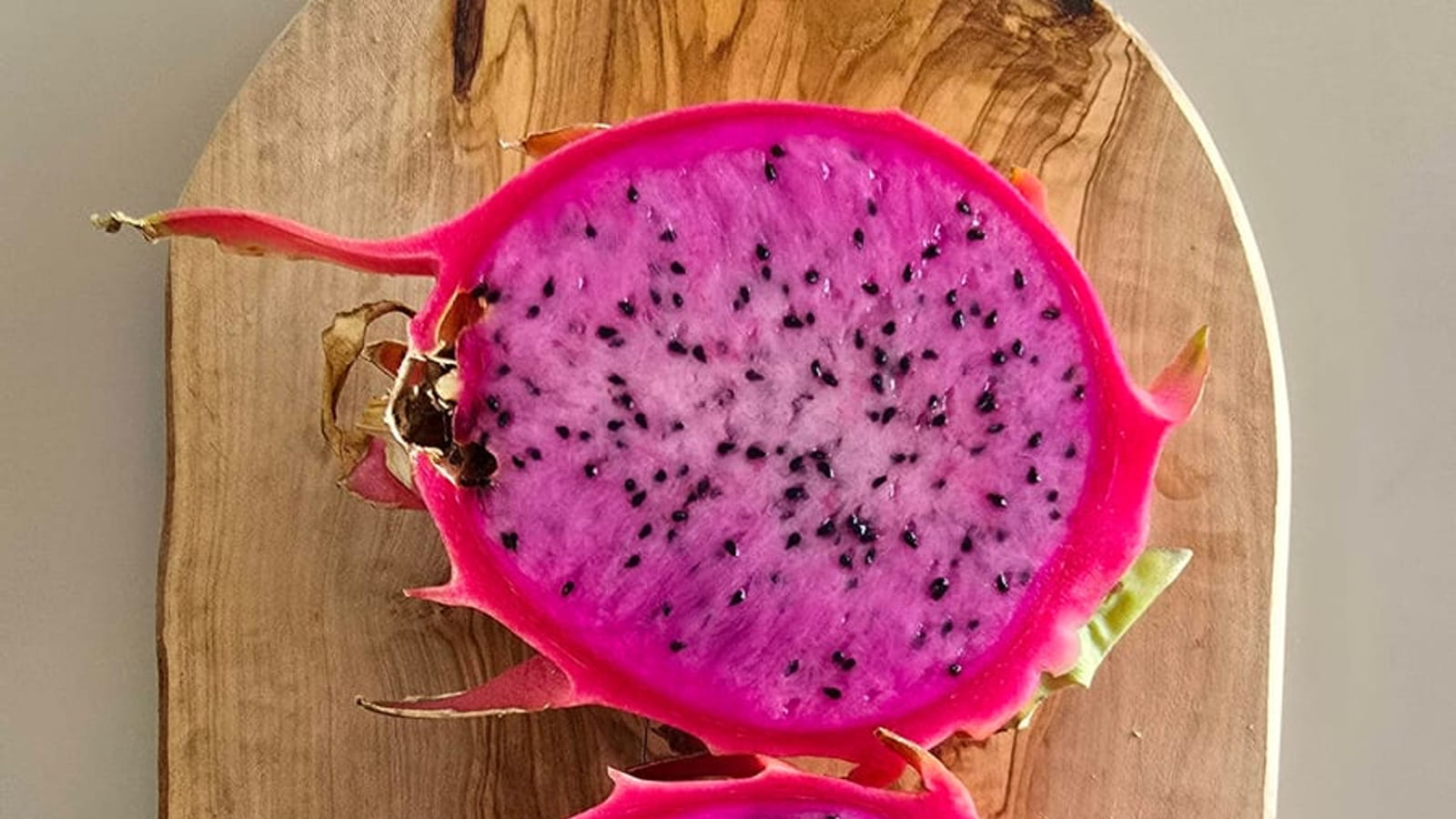
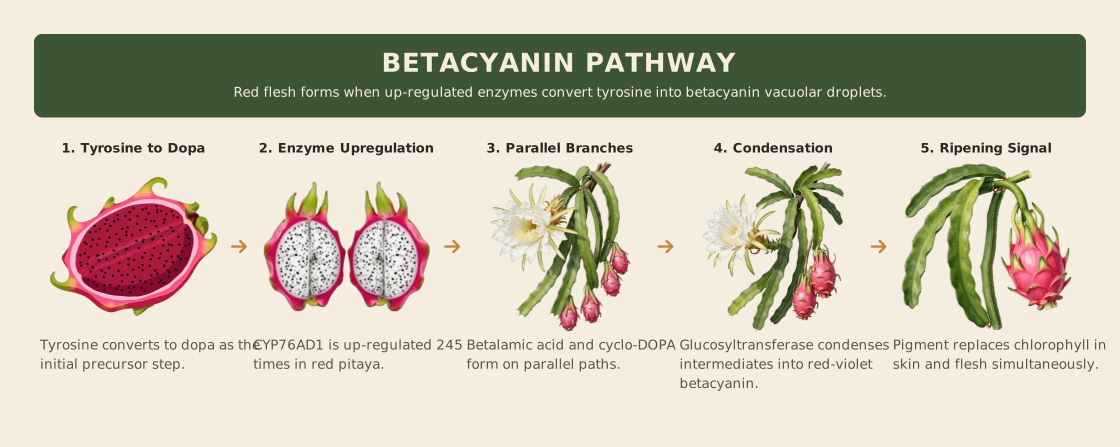
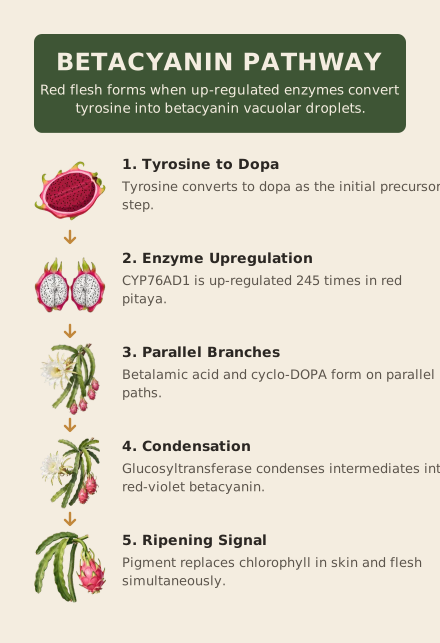
The deep purple pulp that makes Godzilla worth the hand-pollination effort is not a dye added by nature, nor is it related to the anthocyanins found in blueberries or red cabbage. It is a betalain pigment, specifically a class called betacyanins. These molecules are built from two parts: betalamic acid and cyclo-DOPA. When these two components condense, they form the vivid red-to-purple chromophores that stain your fingers and turn a smoothie into a work of art. This chemistry is distinct from the pigments in most other red fruits, which is why pitaya is valued as a natural red colorant in the food industry.
The production of this pigment is driven by specific genes. Research on red pitaya transcriptomes identified the gene CYP76AD1 as being up-regulated approximately 245-fold in colored tissue compared to non-colored tissue. This gene works in tandem with another enzyme, DODA, to initiate the pathway. When scientists expressed the genes HmoCYP76AD1, HmoDODA-alpha-1, and cyclo-DOPA-5-O-glucosyltransferase together in tobacco plants and yeast, the result was abundant red betalain pigments. This confirms that the intense coloration in Godzilla is a direct result of high enzymatic activity in the flesh.
For the grower, this genetic machinery has practical implications. The color deepens as the fruit matures because the biosynthetic pathway becomes more active during the final stages of development. This makes flesh color a reliable indicator of ripeness. Unlike some fruits that continue to sweeten after picking, dragon fruit does not ripen off the vine. The betalain concentration peaks at full maturity, so a pale or streaky interior suggests the fruit was harvested too early. Waiting for the flesh to turn a uniform, deep purple ensures you are eating the fruit at its peak sugar and pigment content.
This pigment profile also affects how you use the fruit in the kitchen. Betalains are water-soluble and sensitive to heat and pH. In a smoothie, the color remains vibrant because the fruit is raw and the pH is relatively neutral. However, if you make jam or bake with Godzilla pulp, the high heat and potential acidity can degrade the betalains, causing the color to shift toward brown or dull red. If you want to preserve the striking purple hue in cooked preparations, minimize heating time and avoid adding acidic ingredients like lemon juice until the end. The staining power of the flesh is a direct reflection of the high concentration of these stable, bioactive pigments.
Growing Godzilla: Site, Structure, Water, Canker
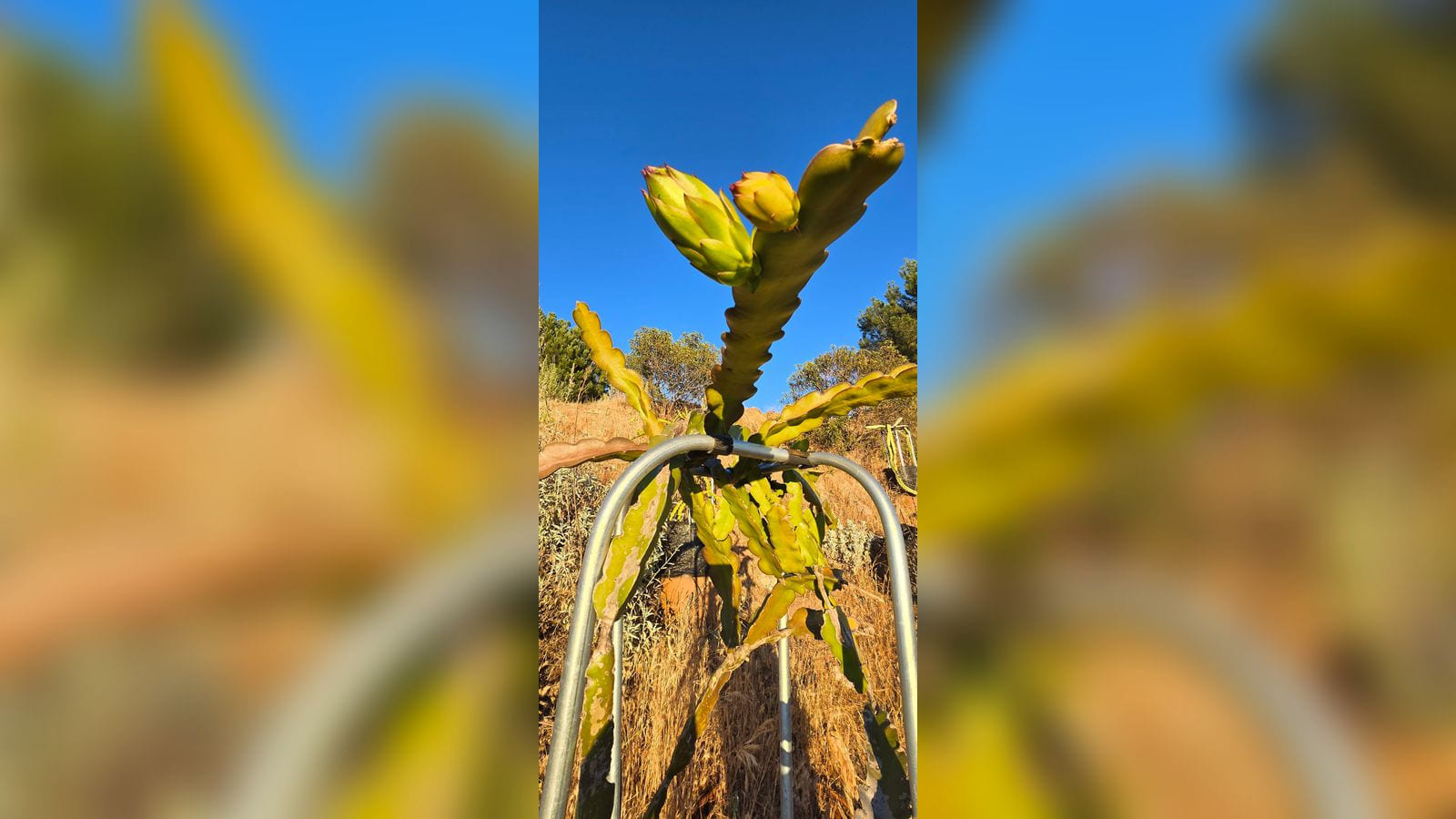
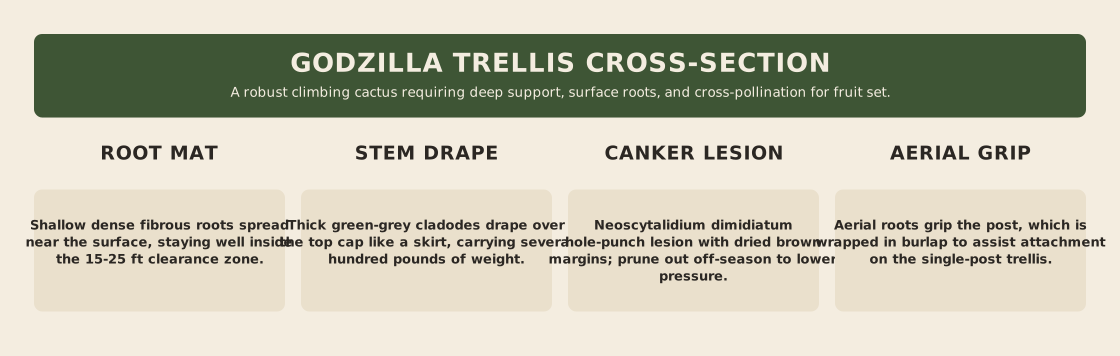
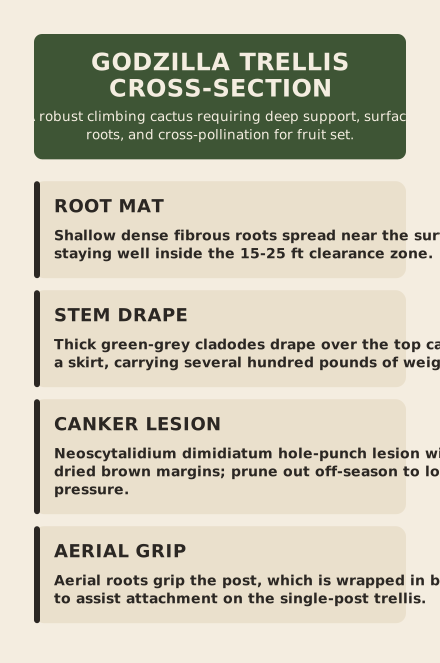
Godzilla is a heavy vine. It produces thick, stiff stems that pile up quickly, and a mature plant can carry several hundred pounds of biomass. You cannot treat it like a lightweight houseplant or a casual garden climber. The structure must be built for load, and the site must be chosen to keep the canopy dry enough to avoid fungal issues. If you skip the heavy-duty prep, the vine will eventually pull its support system down or rot out from the inside.
The table below covers the non-negotiable specs for getting a Godzilla vine established and keeping it healthy through its first few seasons. These numbers come from UF/IFAS home-landscape guidance and grower references for vigorous red-fleshed clones.
| Task | Specification | Why It Matters |
|---|---|---|
| Support Structure | Post top 5-8 ft high; must hold several hundred lbs. Wrap metal or treated wood in burlap. | Aerial roots will not grip smooth metal or pressure-treated lumber. Burlap gives them something to bite into.[2] |
| Site Clearance | 15-25 ft away from trees, structures, and electrical lines. | Prevents the vine from invading neighboring property or tangling with utility lines as it sprawls. |
| Spacing | Approximately 8 ft between plants. | Allows air circulation to reduce humidity around the stems, which helps prevent disease. |
| Planting Depth | 2-3 cm deep in free-draining mix; growth arrow pointing up. | Planting too deep invites rot at the base. The arrow indicates the natural upward growth direction.[5] |
| Watering | Water only when the mix has dried out. Do not overwater. | Pitaya roots are shallow and dense. Soggy soil suffocates them quickly. |
| Fertilizer | Regular feeding throughout the growing season. | Supports the vigorous vegetative growth needed to reach the trellis top and set fruit. |
| Pruning | Heavy prune ~1 month before expected flush. | Stimulates flowering and, per UF/IFAS, cuts canker pressure by removing infected or weak tissue.[3] |
The Canker Threat: The primary killer of vigorous Godzilla vines in humid or coastal summers is dragon fruit canker, caused by Neoscytalidium dimidiatum. Look for hole-punch lesions on the stems with dry, brown margins. On fruit, it appears as holes or blemishes with similar or yellowish edges. UF/IFAS plant pathology work confirms that off-season pruning reduces this pressure. This aligns perfectly with the pre-flower prune that boosts bloom count, so one task solves two problems.
Once the vine is established on the post, watch for sunburn. While Godzilla’s waxy, green-grey stems offer some natural protection, intense exposure can still damage the cladodes, especially if the canopy is thin. Keep the vine fed and watered correctly to maintain a dense, healthy canopy that shades its own stems. Remember that fruit does not ripen off the plant. You must pick it fully colored, which typically happens 30 to 35 days after a successful pollination for red-fleshed varieties, though 45 days is a general average for the crop.[5]
When Godzilla Flowers and How to Force It
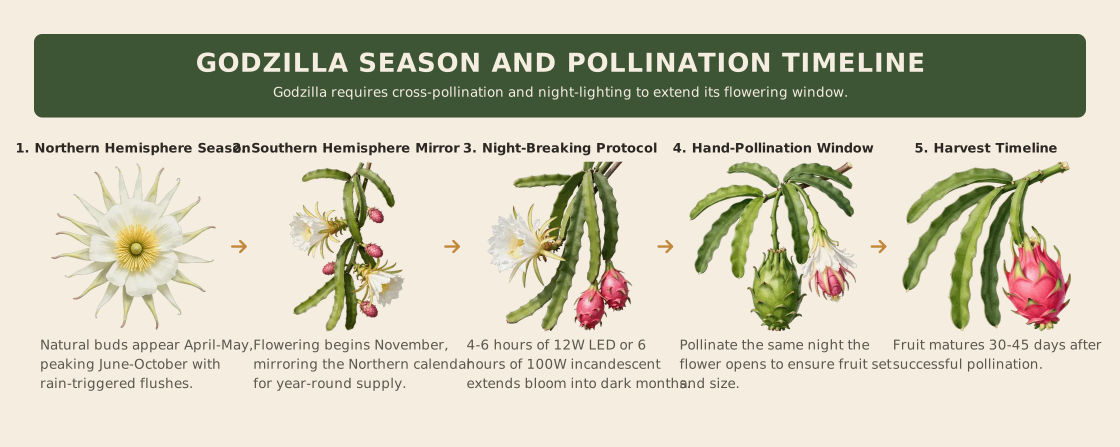
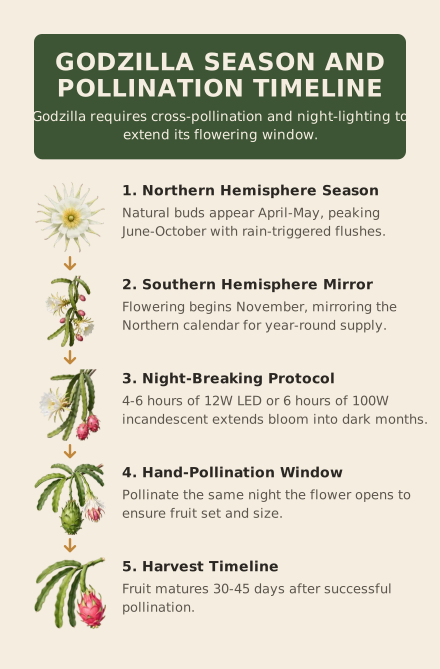
Dragon fruit does not follow an internal clock. It blooms when the environment tells it to. As a long-day plant, Godzilla’s natural season in the Northern Hemisphere runs from April or May through autumn, with harvests peaking mid-year into October or November.[1] This explains why an Australian supplier notes flowering starting in November (their spring) while a Southern California grower sees buds in May. The variety is identical; the seasons are simply mirrored.[8]
You can trigger a flush without waiting for the calendar. Rainfall events act as floral inducers, so a heavy sprinkler pass or a fogger run can simulate that trigger and push the plant into bloom.[1] For off-season production, artificial night-breaking is the most reliable tool. Trials show that duration matters: 4 to 6 hours of light is significantly better than just 2 hours.[1]
Backyard Rule: In dull months, run a couple of hours of light over the vines. This buys you flowers when your pollinator variety is also more likely to be forced, solving the timing mismatch that often causes fruit set failure.
Lighting Specs That Work
Commercial trials provide clear benchmarks for home growers. In a tropical Java trial, a 12-watt LED treatment produced the best off-season results.[1] A separate field trial found that 6 hours of night-breaking with a 100-watt incandescent bulb was optimal.[1] You do not need industrial power. A modest LED setup that mimics these durations is sufficient to extend your season and align Godzilla’s bloom with its compatible pollinator.
Two Plants, One Trellis: The Layout That Actually Sets Fruit
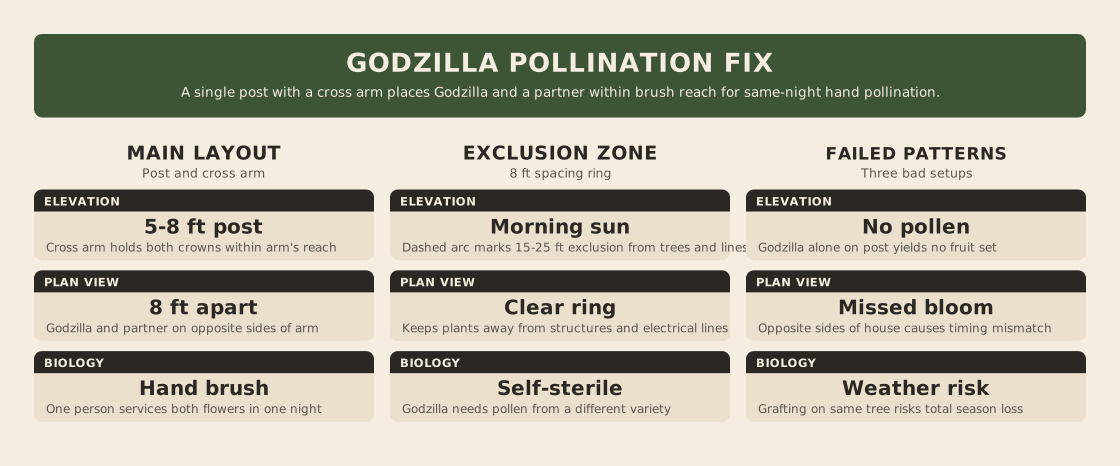
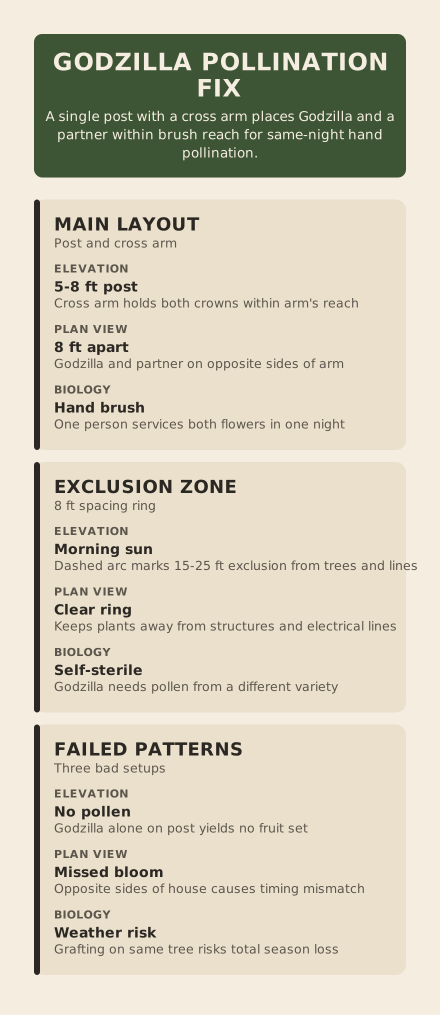
Buying a Godzilla cutting is only half the transaction. Because this variety is self-sterile, a single vine is a decorative plant that drops its flowers. You need a partner. The most efficient layout places a Godzilla vine and a compatible pollen parent on the same trellis structure, within arm’s reach of each other. This proximity solves the logistical headache of hand-pollination. You do not need to run around the garden with a brush and a jar of collected pollen. You can pollinate Godzilla flowers with fresh pollen from the neighbor vine on the same night they open.
Choosing the right partner requires specific criteria. You are looking for a variety that blooms in the same window. Dragon fruit flowering is triggered by environmental cues like day length and rainfall, so two plants on the same trellis will likely flower together, but not always. A reliable partner is one known to flower heavily and consistently in your region. More importantly, the partner must produce heavy, viable pollen. Some varieties are prolific bloomers but poor pollen donors. Ask your supplier for compatibility data. The best partners are those with a known track record of setting fruit on red-fleshed types like Godzilla. White-fleshed varieties are often used as pollen parents because they are frequently self-fertile or have high pollen viability, but you must verify that they are compatible with your specific Godzilla clone.
| Partner Trait | Why It Matters |
|---|---|
| Overlapping Bloom Window | Pollen must be fresh. If the partner flowers a week later, you need stored pollen. |
| High Pollen Viability | Some varieties bloom but produce sterile or low-quality pollen. |
| Known Compatibility | Red-fleshed clones are strictly self-incompatible. The partner must be a different compatible genotype. |
| Proven Set on Red Flesh | Some white-fleshed varieties set fruit poorly on red-fleshed mothers. Ask for grower reports. |
Even if you choose a partner that is self-fertile, keep it nearby. Research shows that manual cross-pollination increases fruit weight in self-compatible varieties, and incomplete natural pollination leads to small, misshapen fruit because size tracks the number of ovules fertilized[1]. For Godzilla, which is self-sterile, the stakes are higher. No cross-pollination means no fruit. A well-pollinated flower means a heavy, sweet fruit. The presence of a second vine on the same trellis ensures you have access to fresh pollen at the moment of anthesis, when viability is highest[1].
Pro Tip: If your partner variety flowers on a different night, you can bridge the gap. Harvest pollen from the partner when its flowers open, store it refrigerated for about two weeks, or frozen for up to 30 days, and apply it to your Godzilla flowers when they open[7][8]. This requires a bit more planning, but it allows you to pair Godzilla with a variety that blooms reliably, even if the timing isn't perfect.
Planting two vines on one trellis also helps with structure. Godzilla is a vigorous grower with thick, stiff branches. A single vine may not cover the trellis top evenly, leaving gaps where air circulation is poor or sun exposure is uneven. Two vines interlace, creating a denser canopy that supports better fruit development and reduces the risk of sunburn on the stems. Just ensure you space the plants correctly. UF/IFAS guidance suggests planting 15 to 25 feet away from structures, but on a trellis, you want the plants close enough to share the support structure but far enough apart to allow airflow. A spacing of about 8 feet between plants on a trellis is a common working number for vigorous growers[8].
Remember that the goal is not just to set fruit, but to set large, high-quality fruit. The size of the fruit is directly linked to the number of ovules fertilized during pollination[1]. A single, half-hearted brushstroke is not enough. You need to transfer pollen from the partner’s anthers to the Godzilla stigma thoroughly. Having the partner vine within arm’s reach makes this process faster and more effective. You can move from flower to flower, ensuring each one gets a generous dose of fresh pollen. This is the practical reality of growing a self-sterile variety: the layout of your garden determines the success of your harvest.
Should You Grow Godzilla
Godzilla is not a beginner plant. It demands a commitment to specific gardening labor. If you are looking for a "plant it and forget it" experience, or if this is the only dragon fruit you intend to grow, skip it. You will likely end up with a vigorous, beautiful, fruitless vine that frustrates you every summer. The self-sterile nature of this variety means that without a compatible pollinator and your own hand at 9:00 PM with a brush, the flowers drop. That is not a flaw in the plant; it is its biology. But if you are willing to work with that biology, the payoff is exceptional.
You should buy Godzilla if you already have, or are willing to buy, a second variety that flowers on the same nights. You need a strong trellis. We are not talking about a flimsy garden stake or a decorative arch. We are talking about a structure that can hold several hundred pounds of stem weight over a lifespan of 20 to 30 years[1]. A cutting planted today is a decade-plus decision. If you cannot commit to heavy-duty support now, you will be replacing your structure in a few years when the vine loads it down. If you have the space, the structure, and the pollinator, Godzilla is worth the trouble.
The reward for that effort is a red-fleshed fruit with high sugar potential and a distinct, round shape that stands out in the garden. Growers report sweetness levels around 18 Brix, with a berry-and-pear flavor profile that justifies the extra work[5]. The flesh is rich in betalains, which stain fingers and smoothies a deep purple-red, a trait that is both visually striking and chemically interesting[5]. The plant itself is robust, with thick, stiff, green-grey branches that handle heat well thanks to their waxy coating[5]. It is a tough, vigorous grower that thrives on marginal ground and high temperatures, making it a resilient choice for hot climates if you can manage the pollination.
Buy from a source that knows their plant. Because "Godzilla" is a trade name without formal registration, descriptions vary. Some suppliers claim it is self-pollinating; most state it is self-sterile. Do not rely on the name alone. Ask your seller specifically about the set behavior of their mother plant. If they cannot tell you whether their own Godzilla sets fruit without a cross, buy from someone who can.
There is a middle ground for those hesitant to dive in. If you want the red flesh but not the nightly chore, start with a known self-fertile red variety. Let that plant establish and teach you the basics of pruning and watering. Once you have a trellis that is proven strong and a routine for managing the vines, add Godzilla as your second plant. This way, you have a pollinator ready and a support structure that is already tested. You are not gambling on a single plant’s success. You are building a system where Godzilla can shine.
Godzilla is for the grower who enjoys the process as much as the harvest. It demands attention during the flowering window. It requires a plan for cross-pollination. It needs a home that can support its weight for decades. If those conditions sound like a challenge you want to meet, then yes, grow it. The fruit is heavy, sweet, and uniquely shaped. The vine is tough and long-lived. But if you want fruit the first season with minimum fuss, or if you cannot guarantee a compatible partner plant, look elsewhere. Save Godzilla for when you are ready to be a hands-on pollinator.
Frequently Asked Questions
Quick note: The answers below assume you have read the pollination and growing sections above. They are designed to clarify specific decisions, not to re-teach the basics.
Is Godzilla dragon fruit self-pollinating?
No. You should assume it requires cross-pollination. While one supplier claims self-pollination, the vast majority of descriptions and the biological profile of red-fleshed clones point to strict self-sterility. If you buy a single cutting, you must have a second, compatible variety flowering on the same night to set fruit. Without a pollinator, the flowers will drop. [1]
How big do the fruits get?
Reported weights range from 300 to 550 grams. However, pollination quality is a bigger lever on size than genetics alone. A poorly pollinated flower will produce a small, misshapen fruit regardless of the variety’s potential. A well-pollinated flower, with thorough dusting of the stigma, maximizes the number of fertilized ovules, leading to the larger end of that weight range. [1]
What does Godzilla taste like?
Growers report a sweetness level around 18 Brix, with distinct notes of berry and pear. The flesh is firm, not mushy, and contains small, crunchy seeds. The texture holds up well in smoothies or fresh slices, and the red pigment stains fingers and clothing readily.
What can I use to pollinate Godzilla?
You need pollen from a different, compatible variety. Ideally, use a heavy-pollen, self-fertile selection that flowers on the same night. The pollen must be applied to the Godzilla stigma within the effective window, which is roughly 4 hours before to 12 hours after the flower opens. Late pollination results in poor fruit set or small fruit. [4]
Can I save pollen for later use?
Yes. Harvested dragon fruit pollen can be stored for about two weeks in the refrigerator or up to 30 days in the freezer. This allows you to bridge the gap if your pollinator variety flowers on a different night than your Godzilla. Ensure the pollen is dry before freezing to prevent clumping.
Why did my Godzilla flowers fall off?
The most common cause is self-sterility combined with a lack of cross-pollination. If the flower was not hand-pollinated with compatible pollen, it will drop. Secondary causes include late pollination, canker infection, or overwatering. Check for hole-punch lesions on the stems or blemishes on the remaining fruit to rule out disease. [3]
References
- Floral and pollination biology of dragon fruit reveals strategies for enhancing productivity through pollination management and reproductive window extension, Scientific Reports (Nature Portfolio), doi 10.1038/s41598-025-21168-2; two-year field study of Selenicereus undatus and a red-fleshed clone under subtropical conditions (2025).
- Pitaya (Dragonfruit) Growing in the Florida Home Landscape, HS303, UF/IFAS Extension, University of Florida, Crane and Balerdi, EDIS (2023).
- Off-Season Pruning Effectively Reduces Dragon Fruit Canker: PP390, UF/IFAS Extension, University of Florida; Zhang, Dutra, Gazis, Crane, Wasielewski; EDIS plant pathology (2026).
- Manipulating Light Duration and Intensity Using LEDs to Enhance Off-Season Yield of Hylocereus polyrhizus in a Tropical Area of Banyuwangi, East Java, Indonesia (4-6 h better than 2 h; 12 W LED the best treatment), OnLine Journal of Biological Sciences 26(3):054, doi 10.3844/ojbsci.2026.26.03.054, Prapti et al. (2026).
- Godzilla Dragon Fruit - Japanese Variety (origin Japan, not self-pollinating, white flowers, flowering from November, green-grey waxy stems, round pink-red skin with green-tipped fins, pink flesh, about 550 g, Brix 18, Bundaberg source, 20 cm cuttings, plant 2-3 cm deep), Rare Dragon Fruit, Bundaberg, Australia; full product page read this run (2026).
- Godzilla Cutting (self-sterile, pink outer colour, purple flesh, round, hand pollinated, fruit around 300 g), Lees Dragon Fruit, Australia (2025).
- Pollination and Harvest (self-sterile varieties usually carry a long protruding stigma; coloured-flower varieties usually self-sterile; hand pollination needed even on self-fertile types for large fruit), Dragon Fruit Obsession, grower reference (2025).
- Pitaya Presentation, grower notes (trellis generally 5-8 ft high, plants about 8 ft apart, aerial roots will not grip metal or treated wood, heavy pruning about a month before flowering, average about 45 days for fruit development, pollen kept up to 2 weeks refrigerated and 30 days frozen), California Rare Fruit Growers International (2018).