Colombiana Yellow: Sweetest Dragon Fruit
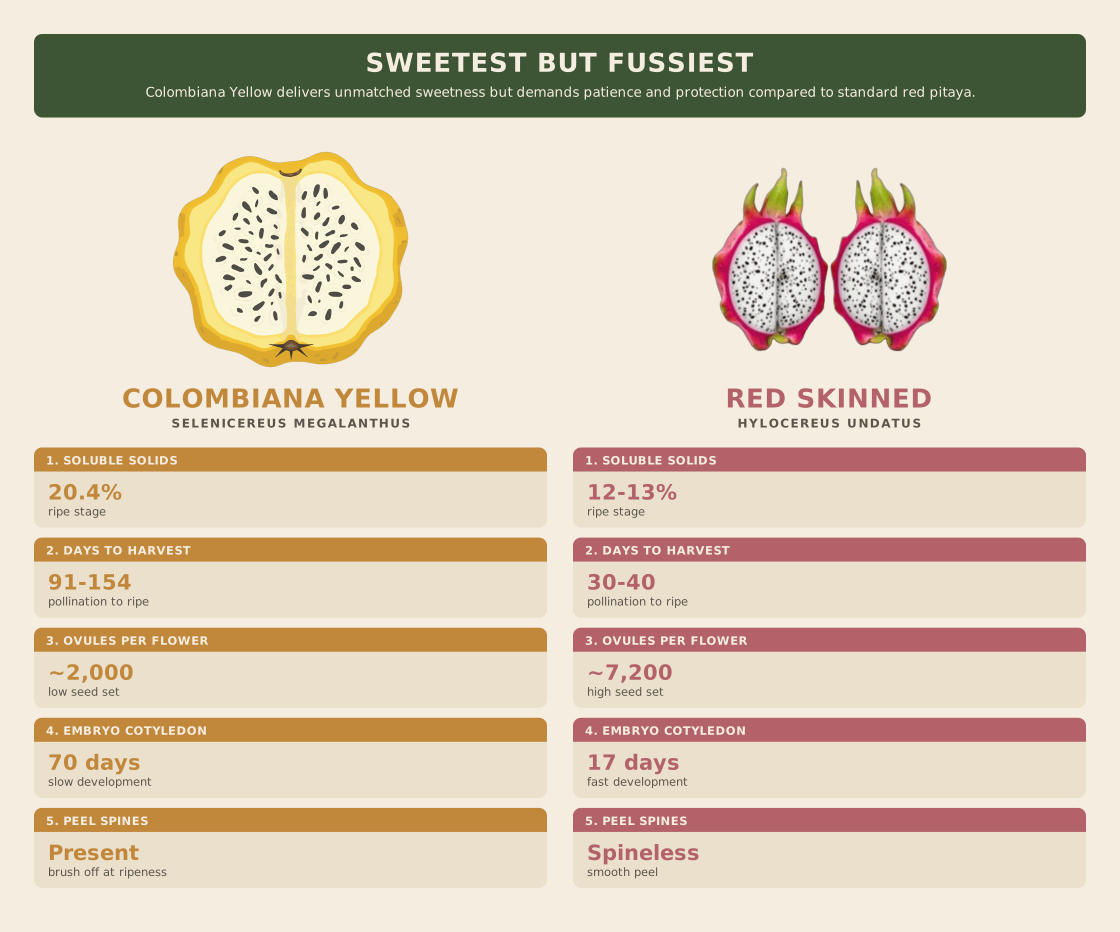
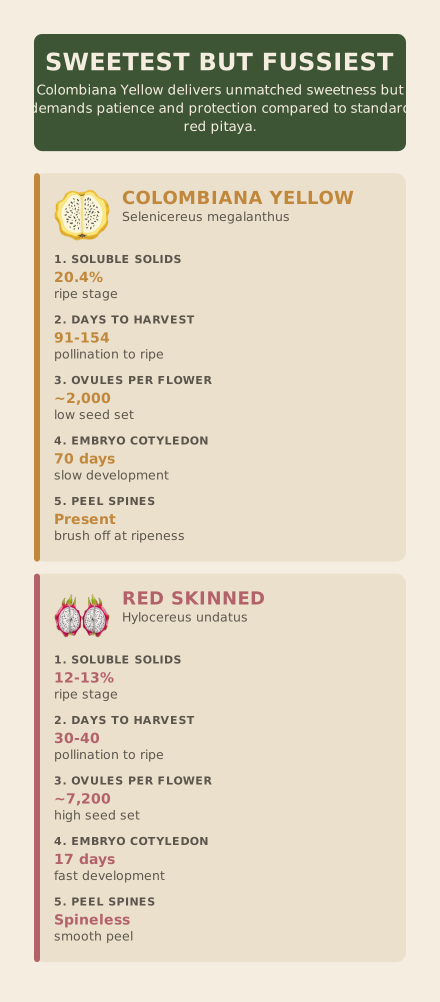
Colombiana Yellow is the sweetest dragon fruit you can grow, but it is also the slowest, most cold-tender, and hardest to handle. This is not a red-skinned Hylocereus variety. It is Selenicereus megalanthus, a distinct species with a spiny yellow peel that accounts for 76.4% of commercial plantings in Colombia. The name reflects that dominance. Lab tests show ripe fruit hitting 20.4% soluble solids, a honey-like sweetness that beats red-fleshed types. But the trade-off is real. The plant is tetraploid with low pollen viability, so you must hand-pollinate for marketable fruit. It grows slowly, often requiring grafting onto vigorous rootstock to establish. It is also highly sensitive to freezing temperatures, unlike its red cousins.
Handling requires care. The peel carries large spines that brush off only when fully ripe. If you want the flavor without the headache, start with grafted stock. We stock grafted Colombiana Yellow cuttings ready for your trellis. See our grafted yellow varieties to skip the slow establishment phase.
Name and taxonomy
Colombiana Yellow, Colombian Yellow, Yellow Colombiana, and thorny yellow are all trade names for the same species: Selenicereus megalanthus. This places it in a different genus from every red and white variety in our catalogue, which belong to Hylocereus. The split is not just a label change. It reflects deep genetic and physiological differences that dictate how the plant grows, flowers, and sets fruit.
The key distinction lies in the chromosomes. S. megalanthus is tetraploid, with a chromosome count of 2n = 4x = 44. It is the only cultivated pitaya species that is not diploid. This extra set of chromosomes is linked to chromosomal aberrations that reduce pollen viability and limit seed set, which explains why hand-pollination is often necessary for marketable yields.[3]
Because of this genetic distance, S. megalanthus cannot be cross-pollinated with Hylocereus undatus or other red-skinned varieties. They are biologically incompatible. When you grow Colombiana Yellow, you are growing a plant that shares a family name with dragon fruit but behaves like a distinct botanical entity. The spiny peel, the slow growth, and the cold sensitivity are all tied to this separate lineage.
The fruit
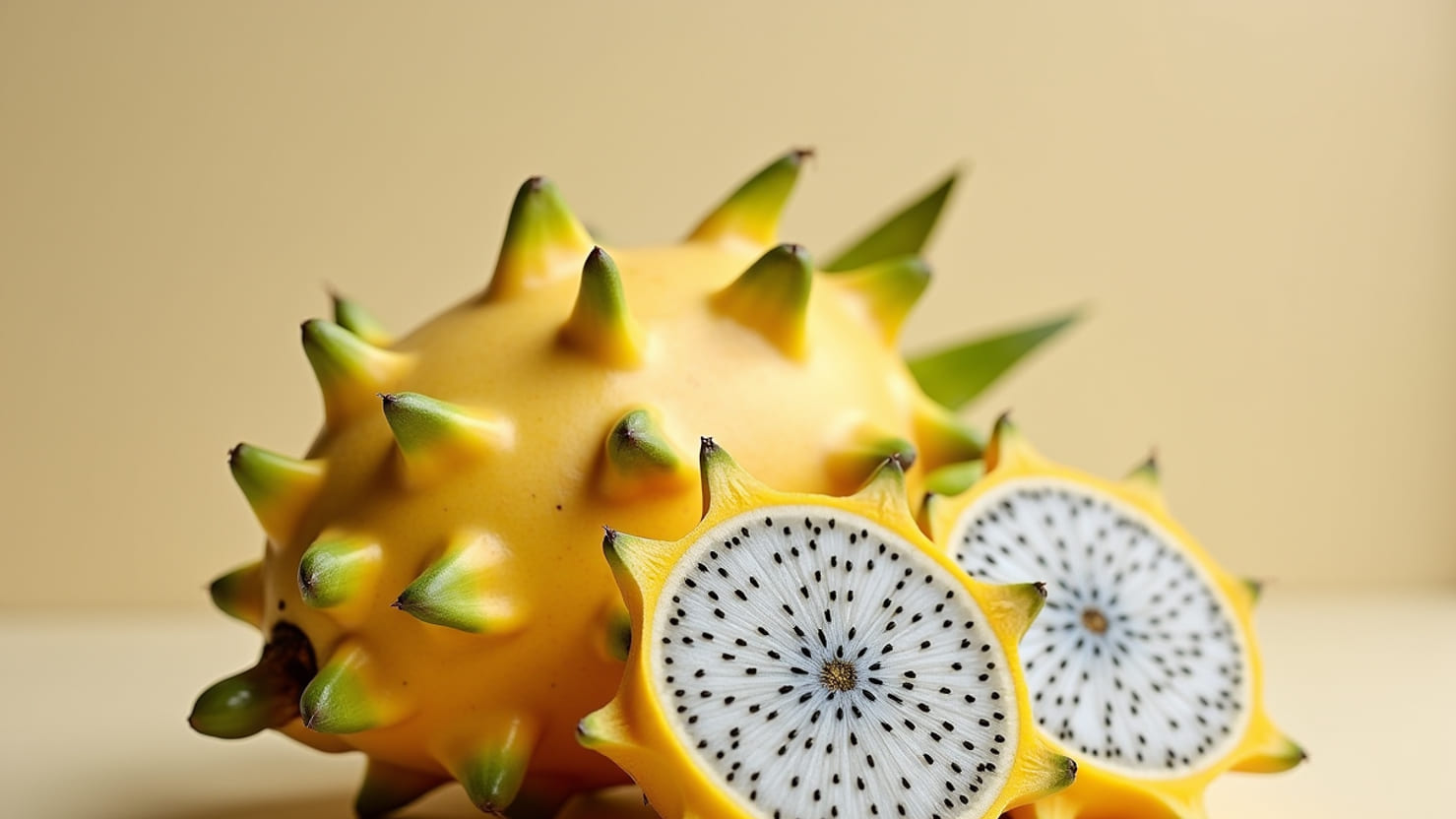
You are harvesting a heavy, dense berry. Depending on the specific cultivar and how well you managed the vine, ripe Colombiana Yellow fruit typically weighs between 300 and 800 grams.[1] The peel is the first thing you notice. It is covered in large, prominent spines that make the fruit look dangerous to touch. These spines are not permanent fixtures. Once the fruit reaches full ripeness, they loosen and brush off with a gentle swipe of your thumb, leaving a smooth, bright yellow surface underneath.
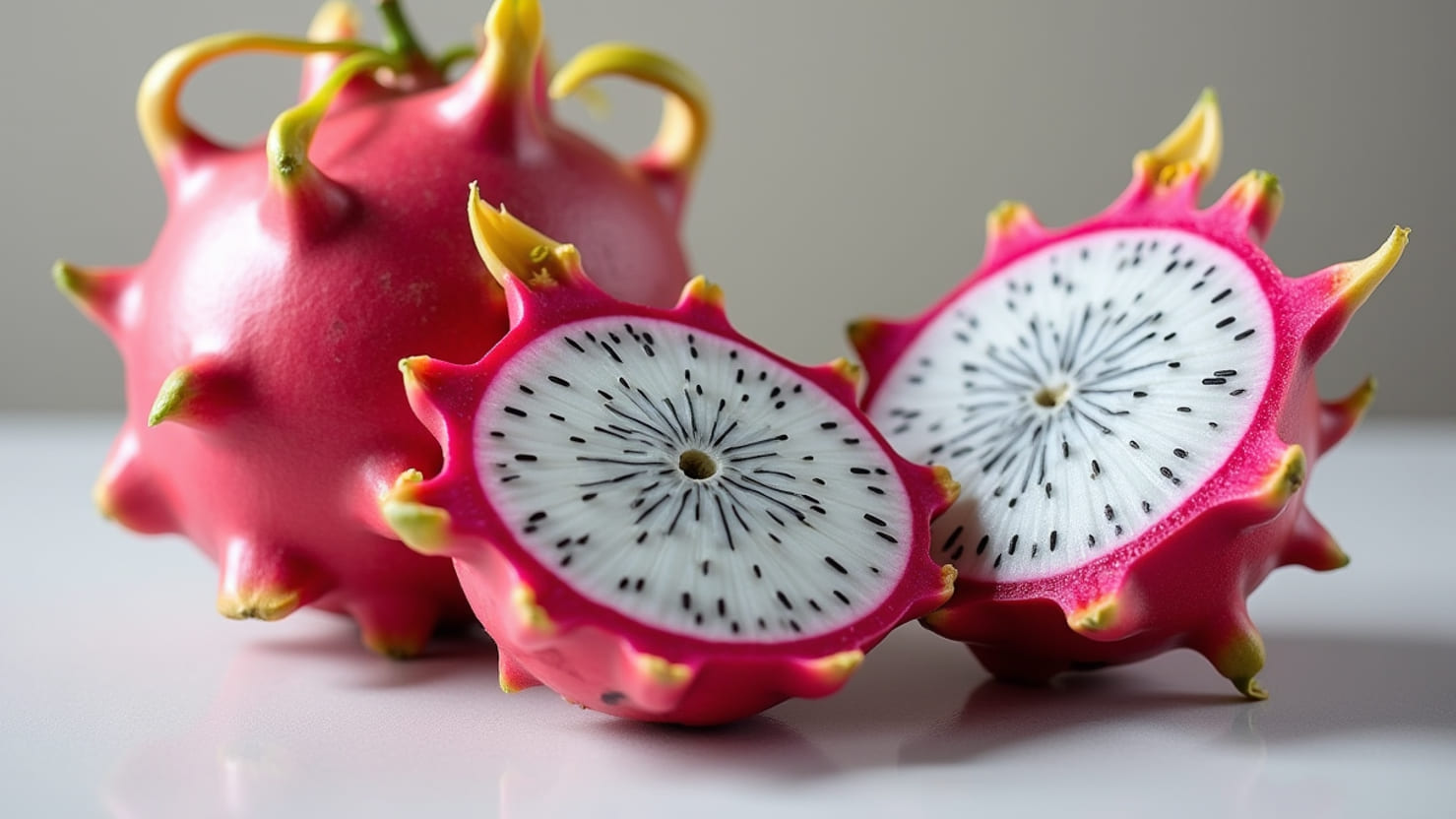
Inside, the flesh is stark white, contrasting sharply with the yellow skin. It is packed with small, black seeds that are edible and add a subtle crunch. These seeds are not just filler; they carry fiber and omega-3 fatty acids, while the surrounding pulp is close to 80% water and provides magnesium, potassium, calcium, phosphorus, and vitamin C.[9] The texture is juicy and crisp, often described as honey-like rather than the berry-like notes found in red-fleshed varieties.
The sweetness is the headline feature, but it is a chemical journey, not a sudden switch. A 2025 development study tracked the fruit through five distinct stages of maturity, showing how the flavor profile shifts dramatically as the fruit fills out. The sugar content climbs steadily while acidity drops, creating that signature high-brix profile.
| Stage | Soluble Solids (%) | Titratable Acidity (%) | Sugar-Acid Ratio |
|---|---|---|---|
| S1 (Immature) | 6.34 | 0.83 | 7.6 |
| S5 (Ripe) | 20.4 | 0.28 | 72.9 |
As you can see, the jump from stage S1 to S5 is massive. The sugar-to-acid ratio skyrockets from a tart 7.6 to a sweet 72.9.[2] This places ripe yellow pitaya well above red-fleshed types, which typically hover between 10.21% and 13.3% soluble solids.[2] The difference is not just in the numbers; it is in the palate. The low acidity at stage S5 means the sweetness is clean and direct, without the sharp tang that can mask flavor in other varieties.
Harvest timing matters. Yellow pitaya is non-climacteric, meaning it does not continue to ripen or gain sugar after you cut it from the plant. You must wait for stage S5, characterized by a uniform yellow peel, high soluble solids, and reduced firmness.[2] If you pick it early, it stays early. If you wait, the fruit can remain on the vine and continue gaining weight for up to 50 days, giving you a wide window to harvest at peak quality.
How the fruit fills
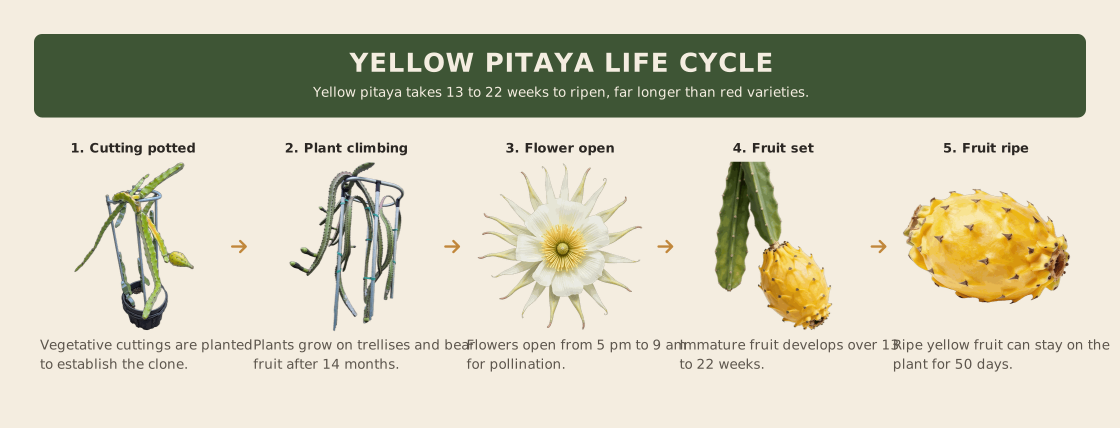
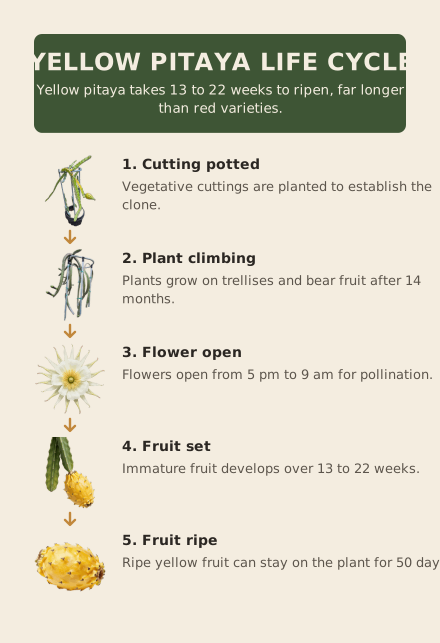
Patience is the primary requirement for a successful harvest. While red and white Hylocereus varieties rush to maturity in 30 to 40 days, Colombiana Yellow moves at a glacial pace. Summer heat accelerates development, but even then, you are looking at a 13 to 14 week wait from pollination to ripe fruit. In cooler winter months, that timeline stretches to 20 to 22 weeks.[1] This lag is not a sign of poor health; it is the biological reality of Selenicereus megalanthus.
The delay stems from internal cellular mechanics. A megalanthus flower carries roughly 2,000 ovules, a fraction of the 7,200 found in Hylocereus undatus. More critically, the embryo takes 70 days to reach the cotyledon stage, compared to just 17 days in red-fleshed varieties.[3] The plant is building a dense, heavy berry from the ground up, and it cannot be rushed. Because the fruit is non-climacteric, it does not convert starches to sugars after picking. If you harvest early, you get a tart, pale berry. The sweetness is locked in on the vine.
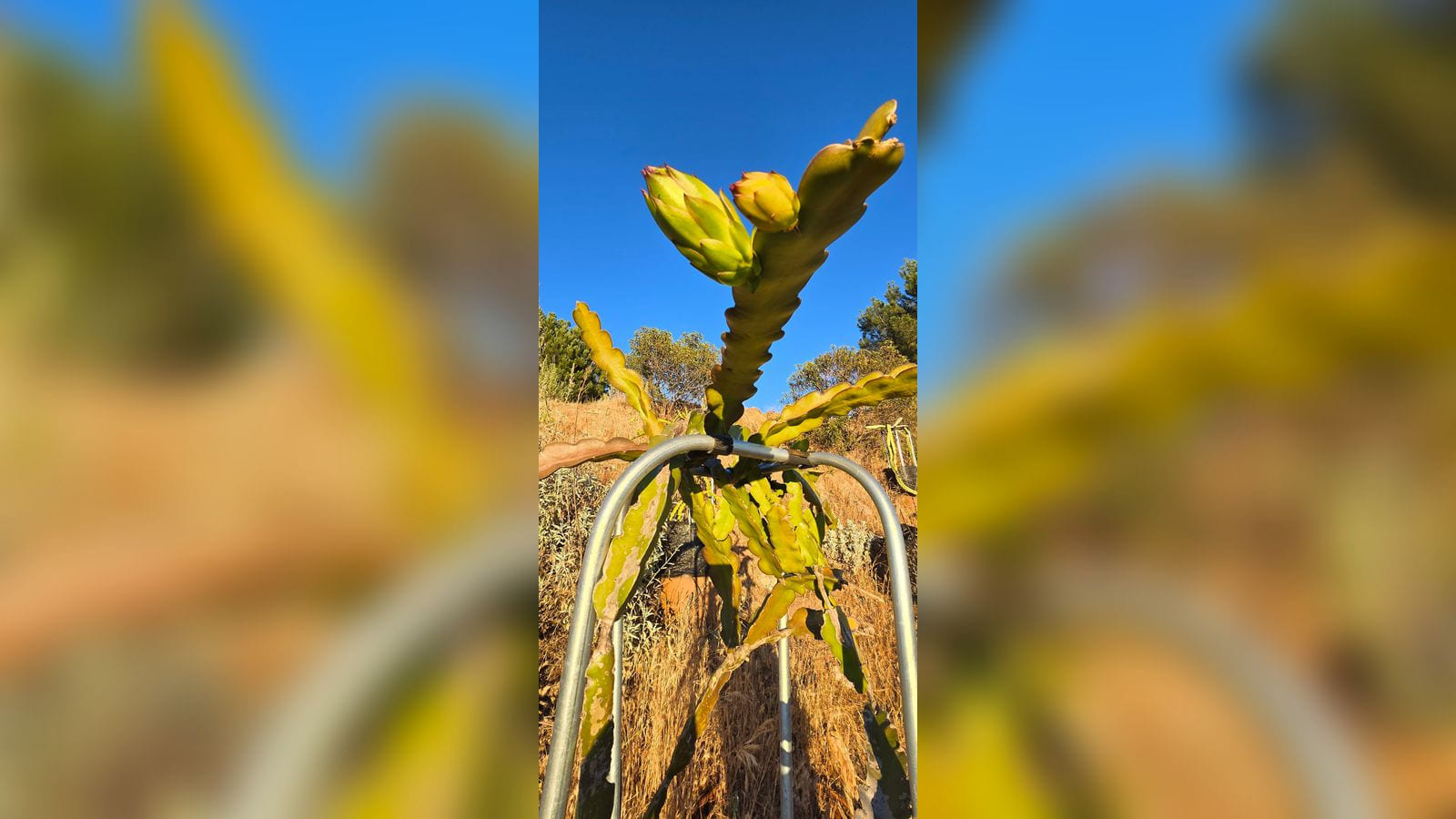
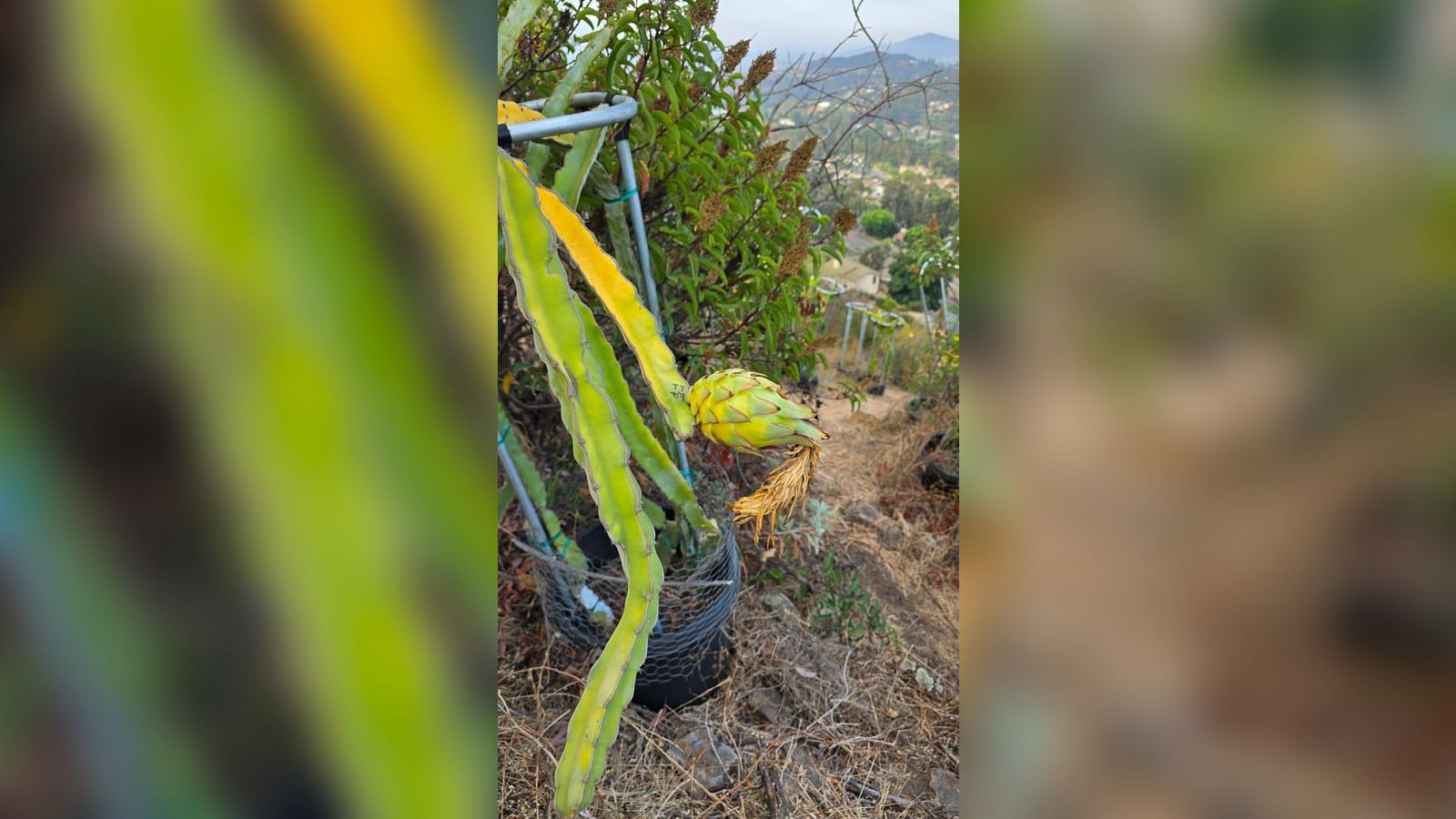
Once the peel turns uniform yellow and the spines begin to loosen, the fruit is technically ripe. However, you do not need to pick it immediately. Colombiana Yellow can remain on the plant for up to 50 days after reaching maturity, continuing to gain weight and density.[1] This extended window allows you to stagger harvests or wait for the perfect moment without fear of the fruit deteriorating rapidly. Just remember that the plant is still alive and growing. It will continue to flower and set new fruit while carrying ripe berries, so you may see buds, open flowers, and heavy yellow fruit all on the same stem at once.[1]
Ignore the "35-day" myth. Many online databases list Colombiana Yellow as ripening 35 days after flowering. This figure is a copy-paste error from Hylocereus records. Trust the 13 to 14 week summer timeline instead.
Confusion about harvest timing often comes from mixed data sources. Growers looking at community forums may see conflicting numbers. The table below clarifies which figures reflect the actual biology of this species versus generic assumptions applied to it.
| Source Type | Claimed Time to Harvest | Verdict |
|---|---|---|
| Community Database | 35 days after flowering | Incorrect. Applies Hylocereus timing to Selenicereus. |
| Peer-Reviewed Study | 13-14 weeks (Summer) | Accurate. Reflects true megalanthus physiology. |
| Peer-Reviewed Study | 20-22 weeks (Winter) | Accurate. Accounts for temperature-dependent slowdown. |
Plan your trellis space with this long cycle in mind. A single plant can carry fruit at multiple stages simultaneously. You might see a ripe yellow berry next to a 12-day-old fruit and a fresh bud. This overlapping production is normal and indicates a healthy, established vine. Keep your hand-pollination schedule consistent, because every successful pollination event starts a new 13 to 22 week countdown. The reward for this wait is a fruit that stays sweet and firm on the shelf, provided you let it finish its work on the vine.
Pollination
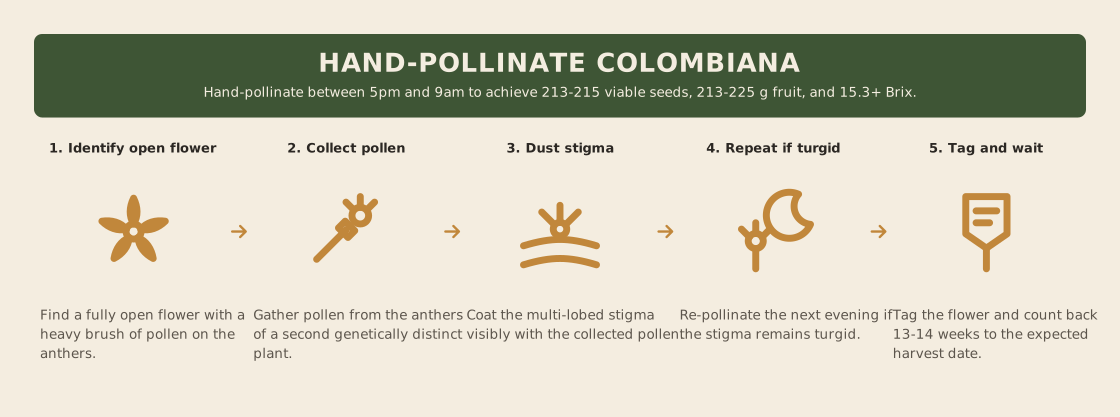
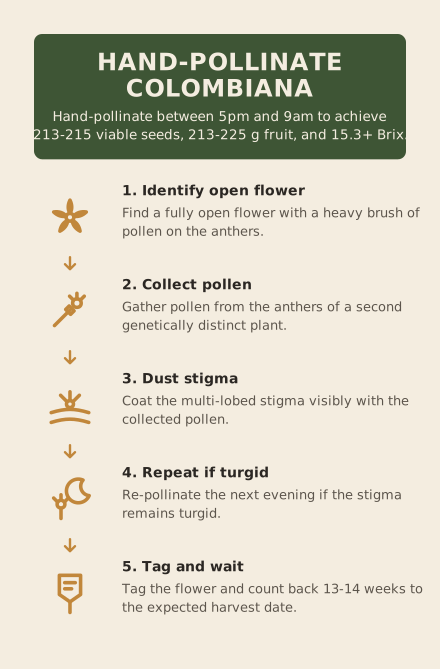
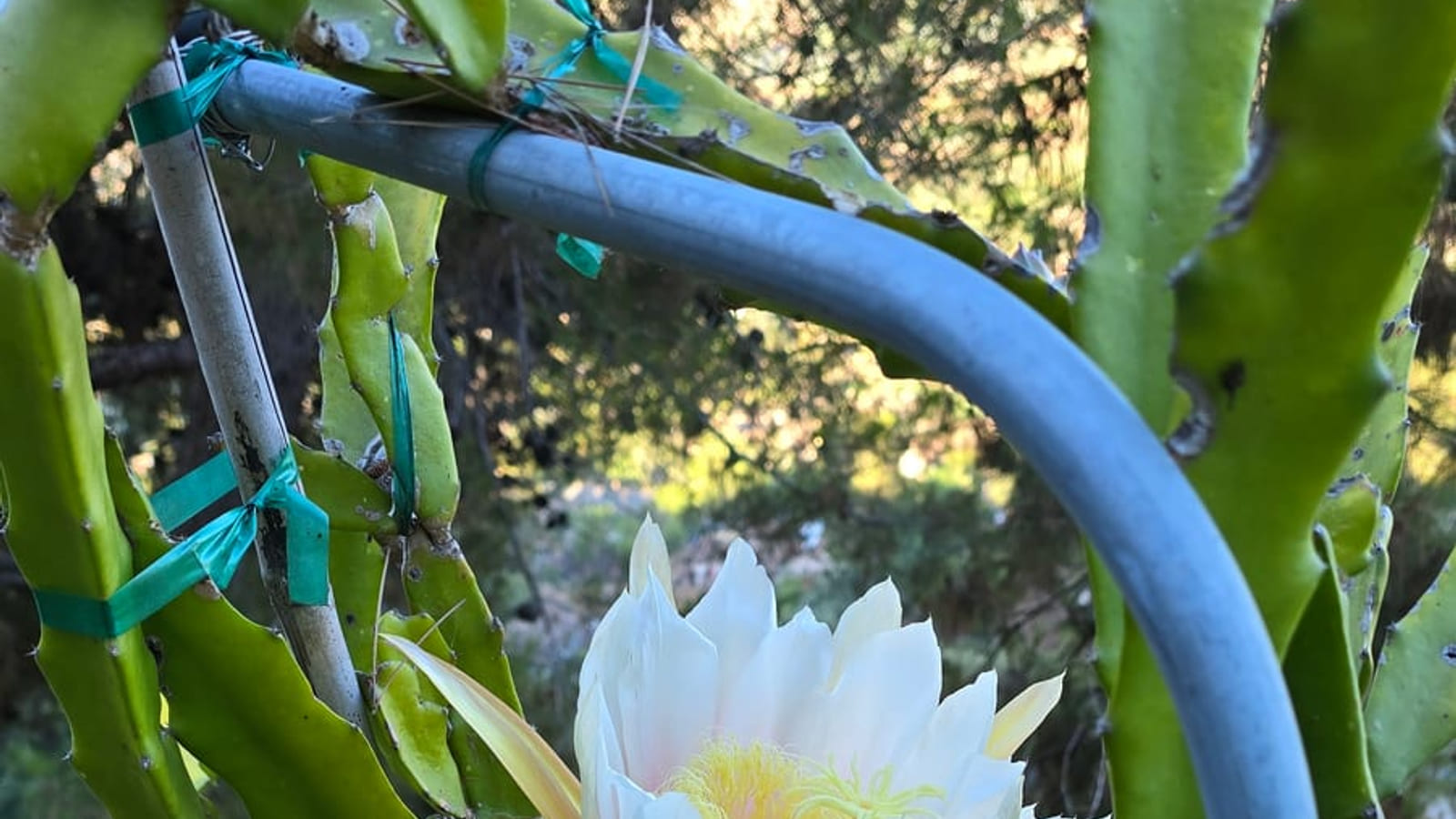
You cannot rely on nature to do the heavy lifting. While Colombiana Yellow is technically self-fertile, its tetraploid genetics result in low pollen viability and poor natural seed set. The plant will often drop flowers or produce small, underdeveloped fruit if left to its own devices. To get marketable yields, you must intervene. The window for this intervention is narrow and unforgiving. The flowers open only once, typically from about 5 pm until 9 am the following morning.[1] This single overnight window means you have to be present when the bloom is receptive. There is no second chance with a flower that has already closed.
Hand-pollination changes the outcome significantly. Studies show that brushing pollen onto the stigmas by hand raises viable seeds per fruit to 213-215, increases fruit weight to 213-225 g, and pushes total soluble solids to 15.3 Brix or better.[4] Even though the plant can set fruit with its own pollen, the quality difference is stark. A self-pollinated fruit often lacks the density and sweetness of a hand-pollinated one. If you want the honey-like flavor profile described in the fruit section, you need to ensure maximum seed set. The seeds drive the hormonal signals that tell the fruit to fill out and sweeten.
Many growers wonder if a second plant is necessary since the variety is self-fertile. The answer is yes, for reliability. UF/IFAS recommends planting at least two genetically distinct varieties and moving pollen between them with a small brush for consistent set.[7] While self-pollination works, cross-pollination with a different clone often results in more vigorous fruit development and higher seed counts. This is not about genetic incompatibility, as it is with red-skinned Hylocereus, but about maximizing the biological potential of the tetraploid genome. You can find more details on pairing strategies in our full variety guide, which sorts the self-fertile clones from the ones that need a partner.
Process Tip: Collect pollen from the anthers of a flower that has just opened in the evening. Use a small, soft brush to transfer it to the stigma of the same flower or a different one on the same plant. Repeat this process every night the flower remains open. The stigma is receptive for the entire duration of the bloom, but early transfer ensures the pollen tube has time to grow before the flower closes.
The effort pays off in the final product. A hand-pollinated Colombiana Yellow fruit will reach its full weight potential, often hitting the 300-800 g range mentioned earlier, with the high brix levels that define the variety. Skipping this step leaves you with smaller, less sweet fruit that may not justify the space the vine occupies. Treat pollination as a critical management task, not an optional extra.
Growing Colombiana
Colombiana Yellow demands a warmer, more stable environment than its red-skinned relatives. While most pitayas tolerate a range of subtropical conditions, yellow varieties are notably more sensitive to cold. Freezing temperatures damage or kill them more readily than red types, so protection is essential if you live in a zone with occasional frost.[7] The plant thrives in tropical and subtropical climates that are mostly free of frost, tolerating heat up to 100 F (38 C), but prolonged exposure to 31 F (-2 C) will ruin the fruit and potentially the vine.[5]
Flowering is triggered by long days. New vegetative shoots typically emerge at the end of winter, between February and April. Flowering follows in waves once days exceed nights in length and temperatures stay above 18 degrees C, generally running from May to November.[1] This long-day requirement means you cannot force early blooms with simple pruning; you must wait for the season to turn.
Support and Spacing
Because the plant becomes large and spreading, it requires a heavy-duty trellis. You are supporting several hundred pounds of stem, so the structure must be robust. Plant the vine 15 to 25 feet away from trees, structures, and electrical lines to give it room to spread without conflict.[6]
For flat-T trained systems, the number of cladodes you retain matters for yield. Leaving 12 to 15 cladodes per linear metre has been shown to maximize flowering and fruit production under high temperatures.[1] Thinning beyond this range can reduce the plant’s productive capacity.
Propagation: Own-Root vs. Grafted
Most commercial propagation is vegetative, using cladode or stem cuttings. This creates clones, but it also creates a pathway for disease. Mass import of raw cladodes is a known vector for cactus virus X, so always source tested, regulated planting material.[1]
Own-rooted Colombiana Yellow grows noticeably slower than Hylocereus varieties. It develops thinner cladodes with a sharply pronounced rib and a weak root system. Because of this, nurseries often graft it onto vigorous rootstock like Isis Gold or Vietnam White. Grafting accelerates establishment and allows growers to multiply small pieces of scion wood efficiently.[8] If you want a faster start, choose grafted stock. If you prefer own-root, be prepared for a slower, more delicate establishment phase.
The honest trade-offs
Colombiana Yellow demands patience and protection in ways red-skinned varieties do not. The plant grows noticeably slower than Hylocereus types, producing thinner cladodes with a sharply pronounced rib.[8] Its own root system is weak, which is why nurseries frequently graft it onto vigorous rootstock like Isis Gold or Vietnam White to jump-start establishment.[8] If you start from an ungrafted cutting, expect a long wait before the vine gains significant momentum.
Cold tolerance is another critical limitation. While all pitayas dislike hard freezes, yellow-skinned varieties are damaged or killed by freezing temperatures more readily than their red cousins.[7] A long-duration exposure to 31 F (-2 C) can ruin the fruit itself.[5] This makes Colombiana a risky choice for marginal subtropical gardens where frost is a recurring threat.
Handling requires a different mindset. The peel carries large spines that stay firmly attached until the fruit reaches full ripeness.[3] You cannot pick them early to save space; you must wait for the spines to loosen. The fruit also takes a long time to fill. Development after pollination spans 13 to 14 weeks in summer and stretches to 20 to 22 weeks in winter.[1] This is a stark contrast to the 30 to 40 days typical of red and white Hylocereus fruit.[1] The slow fill is tied to the plant’s biology: the embryo reaches the cotyledon stage only 70 days after pollination, compared to 17 days in H. undatus, and each flower carries roughly 2,000 ovules versus 7,200 in red varieties.[3]
Set reliability is also lower. The plant is tetraploid, and chromosomal aberrations reduce pollen viability and limit seed set.[3] While it can set fruit from its own pollen, the seed set is low and barely differs between self- and cross-pollination.[4] Hand-pollination is necessary to achieve marketable quality, raising viable seeds per fruit to 213-215 and pushing soluble solids to 15.3 Brix or better.[4] Red varieties generally set fruit more reliably with less intervention.
| Feature | Colombiana Yellow | Red-Skinned Beginner (e.g., H. undatus) |
|---|---|---|
| Growth Speed | Slow; weak own roots; often grafted[8] | Vigorous; establishes quickly on own roots |
| Cold Tolerance | Low; damaged/killed by freeze more readily[7] | Higher; more resilient to cool snaps |
| Handling | Large spines on peel until ripe[3] | Smooth peel; no spines |
| Set Reliability | Low seed set; hand-pollination required[4] | Higher natural set; less intervention needed |
| Time to Fruit | 13-22 weeks post-pollination[1] | 30-40 days post-pollination[1] |
| Flavor | 20.4% soluble solids; honey-like[2] | 10.21-13.3% soluble solids; berry-like[2] |
The reward for these extra steps is flavor. Ripe Colombiana hits 20.4% soluble solids, far above the 10.21% to 13.3% range of red-fleshed types.[2] But you are trading ease of care for a premium taste. If you lack the patience for slow growth or the infrastructure to protect from frost, a red-skinned variety is a more forgiving entry point.
Should you buy it
Colombiana Yellow is a specialist’s choice. It suits growers in warm, frost-free zones who prioritize exceptional flavor over high-volume production. If you have a site that rarely sees temperatures below freezing and you are willing to hand-pollinate flowers during their brief overnight window, this variety offers a reward few others can match. The sweetness is the primary draw, but the plant demands patience and specific conditions.
Climate Check: Pitayas generally thrive in tropical and subtropical climates, tolerating heat up to 100 F (38 C). However, yellow-skinned varieties like Colombiana are significantly more cold-sensitive than their red-skinned cousins. Long-duration exposure to temperatures near 31 F (-2 C) can damage the fruit or kill the plant. If your area sees regular frosts, you will need to protect the vines or choose a hardier variety.
You should also consider your willingness to manage the plant’s slow pace. Unlike red-fleshed Hylocereus types that set fruit quickly, Colombiana Yellow takes its time. The fruit development period is long, and the plant itself establishes slowly. If you want a vigorous vine that fills a trellis fast and produces heavy yields with minimal intervention, this is not the right starting point. The tetraploid nature of the plant means pollen viability is low, so relying on natural pollination often results in poor fruit set. You must be prepared to brush the stigmas yourself to get marketable fruit.
For growers who want the yellow fruit experience without the steep learning curve, consider alternatives that offer easier management or better cold tolerance. While Colombiana Yellow is the sweetest, other varieties may offer a more forgiving introduction to dragon fruit cultivation.
| Grower Profile | Best Fit | Why |
|---|---|---|
| Flavor chaser in a frost-free zone | Colombiana Yellow | Unmatched sweetness (20.4% soluble solids) and unique honey-like notes. |
| Beginner or cold-prone area | Red-skinned Hylocereus | Hardier, faster establishment, and less demanding pollination requirements. |
| High-volume production | Vigorous Hylocereus | Faster growth, higher yields per plant, and shorter fruit development time. |
| Yellow fruit, easier care | Yellow Palora | Similar yellow peel but different management profile; check specific care needs. |
If you are set on yellow pitaya but want a variety with a slightly different management profile, look at Yellow Palora. It is also a Selenicereus megalanthus, sharing the yellow peel and sweet flesh, but it has its own growth habits. Yellow Palora takes about 120 days, roughly 17 weeks, from pollination to ripe fruit. This is still a long wait compared to red varieties, but understanding the timeline helps in planning your harvest. We stock grafted Colombiana Yellow to help you bypass the slow establishment phase, giving you a head start on the vine’s growth.
Ultimately, buying Colombiana Yellow is an investment in quality over quantity. It is for the gardener who enjoys the ritual of night-time pollination and the satisfaction of harvesting a fruit that tastes like honey. If you lack the time for hand-pollination or live in a region with harsh winters, start with a red-skinned variety. You can always add Colombiana Yellow later once you have mastered the basics of pitaya cultivation.
Close
Year one is about survival and structure, not harvest. Expect slow vegetative growth as the plant establishes its root system and pushes out new cladodes. You will likely see no flowers or fruit in the first twelve months, especially if you started with own-rooted stock. The plant is building the framework needed to support heavy, spiny berries later. Patience is the primary input here.
For detailed care protocols, including winter protection and pruning strategies, review our full variety guide. If you are ready to tackle the hand-pollination process required for marketable yields, our pollination guide walks through the specific timing and techniques for Selenicereus megalanthus.
References
- Yellow Pitahaya (Selenicereus megalanthus Haw.): The Less Known of the Pitahayas, Foods (MDPI) (2025).
- Morphological and biochemical changes during fruit development in Selenicereus megalanthus, Technology in Horticulture (MaxAPress; UFES/UFFLA/University of Florida TREC) (2025).
- Breeding an underutilized fruit crop: a long-term program for Hylocereus (dragon fruit), Methods and Protocols / PMC (Tel-Zur) (2022).
- Effect of pollination method on fruit set and fruit characteristics in the vine cactus Selenicereus megalanthus (yellow pitaya), Journal of Horticultural Science and Biotechnology (Dag and Hoffmann) (2005).
- Pitaya (Dragonfruit) Growing in the Florida Home Landscape (HS303), UF/IFAS Extension (Crane and Balerdi) (2005).
- HS1068 Pitaya Growing in the Florida Home Landscape (archival EDIS PDF), UF/IFAS EDIS (2005).
- Suncoast Grown and Gathered: August Dragonfruit, UF/IFAS Extension Sarasota County (2025).
- Propagation: cuttings, grafting and rootstocks for slow varieties, Dragon Fruit Obsession (2025).
- Yellow Dragon Fruit Information and Facts, Specialty Produce (2026).
Illustration generated for this article