Sugar Dragon Cutting: The 8-S Clone Explained
A Sugar Dragon dragon fruit cutting is a vegetative clone of the Paul Thomson 8-S selection, known for its self-fertility and early flowering window. You can root these cuttings reliably in warm seasons, typically seeing initial roots within two to four weeks when kept in well-drained media under partial shade. This variety, sometimes sold as Voodoo Child, produces robust olive-green stems and large, magenta-fleshed fruit that often hits 18 Brix. Because it is self-fertile, a single cutting can set fruit, though cross-pollination with other varieties may improve size. The plant’s compact habit makes it suitable for trellises under 1.6 meters. If you are starting from scratch, ensure your cutting is at least six inches long and cured before planting to prevent rot. For detailed steps on curing and planting, see our complete cutting guide.
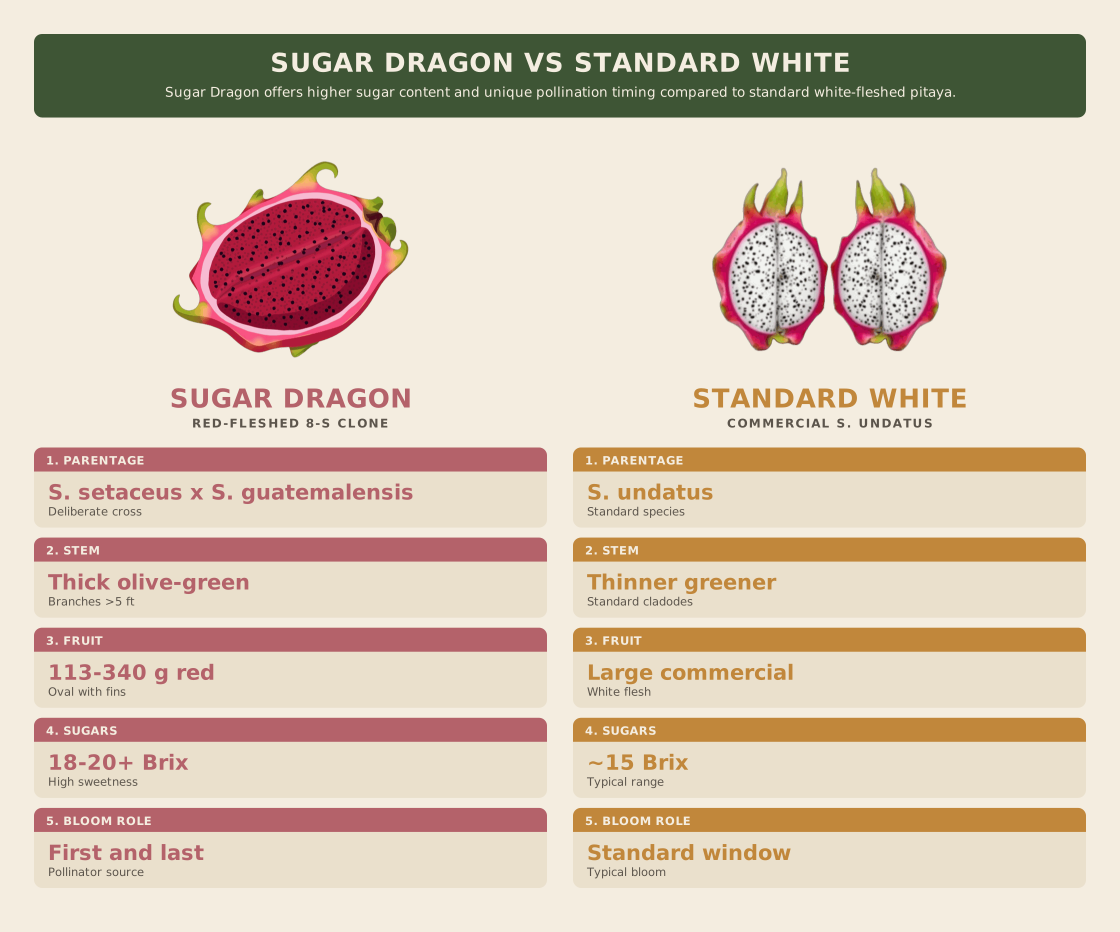
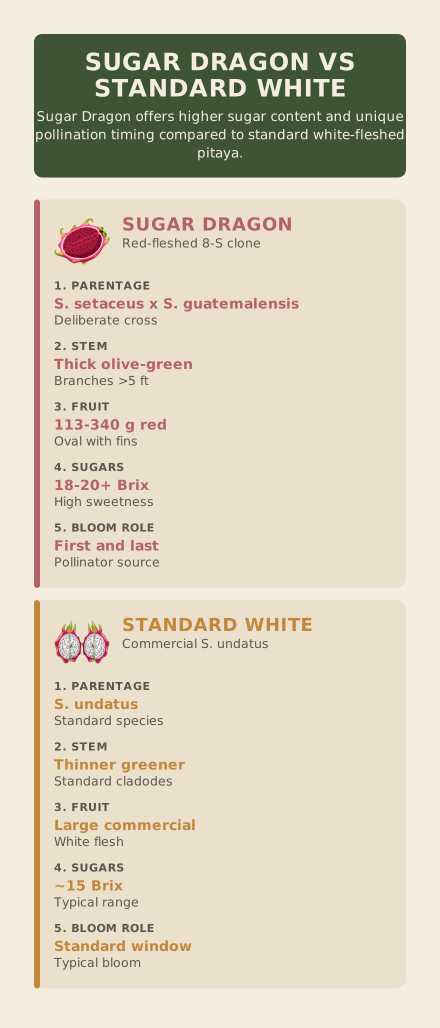
The 8-S lineage and the name collision
When you buy a Sugar Dragon cutting, you are acquiring a specific genetic line that has worn two different labels in the trade. The clone originated as Paul Thomson’s selection 8-S, a seedling from a deliberate cross between 'Houghton' and 'Rixford'.[8] This parentage is significant because Spicy Exotics notes that both the current trade names, Sugar Dragon and Voodoo Child, closely resemble their 'Houghton' parent in growth habit and stem structure.[8]
The confusion over the name stems from regional marketing rather than botanical difference. A Florida nursery initially renamed the 8-S seedlings 'Voodoo Child'. A few years later, a California grower took the exact same 8-S clone and marketed it as 'Sugar Dragon'.[8] If you see either name on a tag, you are looking at the same plant. The physical traits remain consistent: robust olive-green stems with thick, small spines along the rib line, and branches that can extend over five feet.[8]
Why the names matter: Knowing the lineage helps you predict performance. Because 8-S is a hybrid involving Hylocereus setaceus and Hylocereus guatemalensis (now classified under Selenicereus), it inherits vigor from both parents.[8][2] This genetic background explains why it is often the first and last variety to bloom on a farm, providing a long window for pollination.[8]
The taxonomy on older tags can also be misleading. You may see Hylocereus listed, but molecular studies have folded that genus into Selenicereus. The accepted names for the parents are Selenicereus guatemalensis and Selenicereus setaceus.[2] While the label changes, the plant’s behavior does not. It remains a self-fertile, early-ripening cultivar that produces magenta-fleshed fruit with grape and watermelon notes.[9] For more on how to handle the physical cutting once you have it, see our guide on dragon fruit cutting propagation.
The taxonomy: why Hylocereus on the tag is out of date
You might see Hylocereus printed on the label of your Sugar Dragon cutting. This name is technically obsolete, though the plant itself remains unchanged. Molecular studies have folded the cultivated pitaya genus Hylocereus into Selenicereus.[2] The accepted scientific names for the parents of the 8-S clone are now Selenicereus guatemalensis and Selenicereus setaceus.[2]
Major botanical databases reflect this shift. The GBIF backbone records Hylocereus guatemalensis and Hylocereus setaceus as synonyms, pointing to their accepted status under the Selenicereus genus.[7] Specifically, Selenicereus guatemalensis holds usageKey 10774886, and Selenicereus setaceus holds usageKey 4927441.[7]
Why this matters for you: If you search for care guides or disease information using the old Hylocereus name, you may miss recent research. Searching by Selenicereus ensures you find the most current data on root structure and pest management for your cutting.
Do not worry if your nursery tag still reads Hylocereus. Many growers and suppliers use the legacy name because it is familiar. The genetic identity of your Sugar Dragon cutting is stable regardless of the label. It is the same vigorous, self-fertile clone whether you call it by its old genus or its new one.
Judging a cutting before you buy
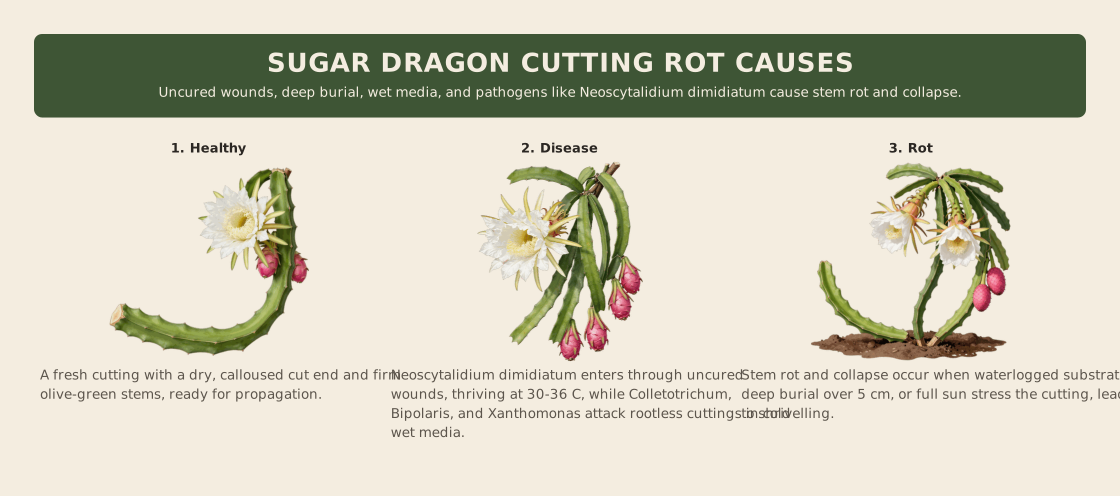
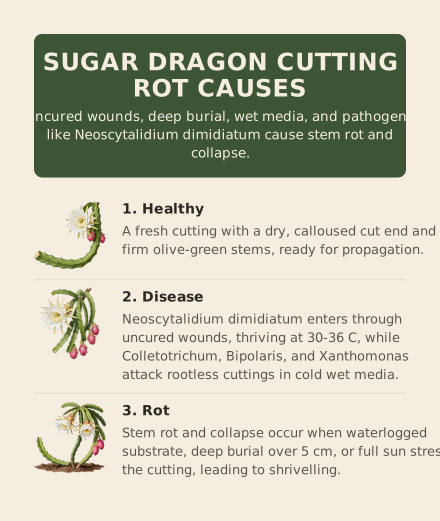
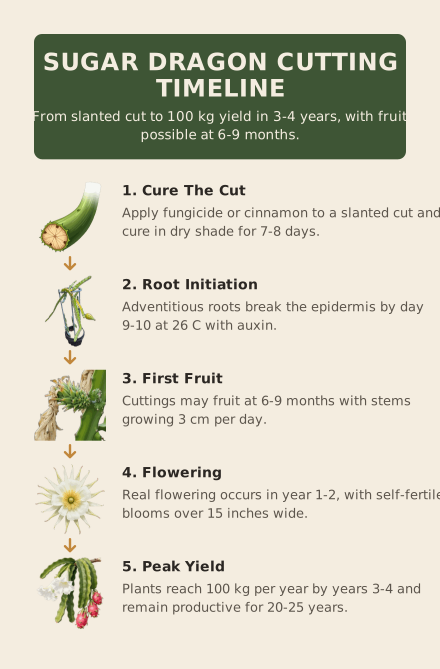
When you inspect a Sugar Dragon cutting, look past the color and check the wound. A fresh, wet cut is a liability. The University of Florida IFAS extension specifies that a proper cutting requires a slanted cut at the stem base, followed by a fungicide treatment and a curing period of 7 to 8 days in a dry, shady location.[5] If the seller hands you a piece that was sliced that morning and potted immediately, you are buying a high risk of rot. The cut surface needs time to callus over and seal itself against pathogens like Neoscytalidium dimidiatum, which enters through open wounds.[11]
Recent research offers a stricter standard for what "ready" looks like. A 2026 protocol from Hainan University air-dried 20 cm cuttings for 2 to 3 days until a waxy film formed over the excised basal tissue.[10] This waxy layer is your best visual indicator of a properly prepared cutting. It signals that the plant has successfully sealed the wound and is ready to focus energy on root production rather than fighting off infection. If the base looks shiny, wet, or raw, ask the seller how long it has been cured.
Check the base, not just the length. While earlier sections noted that cuttings should be at least six inches long, the condition of the cut end matters more for survival. A shorter cutting with a fully callused, waxy base will outperform a long, fresh-cut piece every time.
Proper curing is not just about drying; it is about preventing the introduction of disease into your garden. Vegetative propagation can spread pathogens, so reputable nurseries screen mother plants and disinfect tools.[1] When you buy from a source that follows these protocols, you are buying peace of mind. For a deeper look at how to handle the cutting once it arrives, review our dragon fruit cutting propagation guide.
Curing and planting, step by step
Success begins before the cutting touches soil. The age and position of the cladode on the mother plant dictate rooting potential. Basal cladodes, which are darker green and structurally tougher, root far better than young, light-green stems from the upper canopy. Cuttings under one year old root poorly because they retain the ontogenetic age of the donor plant, meaning a young stem lacks the physiological maturity to push roots effectively.[1]
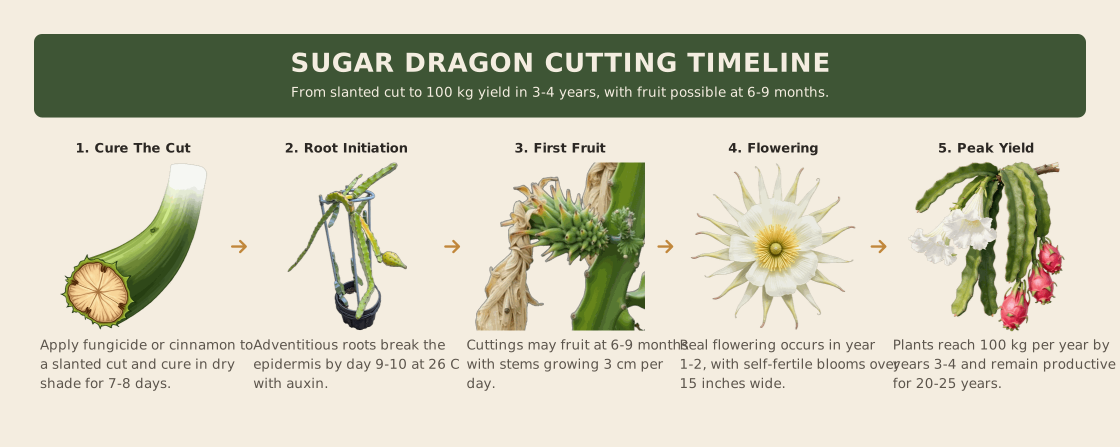
Once you have selected a mature basal segment, cure it to dry and heal the wound. A slanted cut at the stem base, treated with fungicide, should sit in a dry, shady location for seven to eight days.[5] This drying period prevents rot, which is the primary killer of fresh cuttings in warm, wet weather. If you cut into the succulent part of the stem rather than at the insertion point, you can protect the wound with Bordeaux paste or powdered cinnamon, both of which act as fungistatic and bacteriostatic barriers.[1]
The potted route is highly recommended. UF/IFAS advises planting cured cuttings in pots first. Let them build a robust root system for four to six months before moving them to the landscape. This protects the vulnerable young plant and ensures a stronger start in the ground.
When you are ready to plant, use well-drained media. Bury the basal end up to five centimeters deep in a substrate containing sand or perlite.[1] For the first three to four months, provide about 30 percent shading if your location has damaging insolation.[5] Too much shade leads to low production and poor fruit quality later, so aim for bright but filtered light during this establishment phase.
Do not fertilize immediately. Wait about a month after planting, or until you see clear signs of new growth.[5] Once the plant is active, switch to frequent, light applications. In the first year, apply 0.25 lb (118 g) of fertilizer per plant every two months. Use a balanced formula like 6-6-6, 8-3-9, or 8-4-12 that includes 2 to 3 percent magnesium.[5] This steady, gentle feeding supports the rapid vertical growth typical of the 8-S lineage without burning the new roots.
| Stage | Action | Why |
|---|---|---|
| Selection | Choose basal, dark green cladodes | Older tissue roots more reliably than young upper stems |
| Curing | Dry in shade for 7-8 days | Heals the wound to prevent rot[1] |
| Planting | Pot first, bury 5 cm deep | Builds root mass before landscape stress[5] |
| Feeding | Wait 1 month, then light doses | Avoids fertilizer burn on new roots |
Rooting: what actually happens and how long it takes
Once your Sugar Dragon cutting is planted, the clock starts on a biological process driven by temperature and stored energy. In warm seasons, you might see the first adventitious roots break through the epidermis in as little as nine days under ideal conditions, though two to four weeks is a more common window for visible progress.[10] This speed is not random. It depends heavily on the size of the cutting and the ambient heat. Longer cuttings from the Selenicereus undatus species, which shares lineage traits with your 8-S clone, develop root systems with greater length, volume, and mass because they carry higher carbon-to-nitrogen ratios and more carbohydrate reserves.[1] A six-inch segment has less fuel to burn than a ten-inch one, so expect slower initial establishment on smaller pieces.
Temperature acts as the throttle for this growth. Higher temperatures drive cell division in the root meristem, accelerating the process, while colder conditions slow it down significantly.[1] This is why spring and summer are the preferred propagation seasons. In a study of Selenicereus setaceus, a parent of the 8-S line, cuttings prepared in autumn produced no sprouting at all, whereas those prepared in spring rooted successfully.[3] If you are working in a cooler climate, do not expect the same rapid response. The plant’s metabolism simply cannot support the energy demands of new root formation when the air is cold.
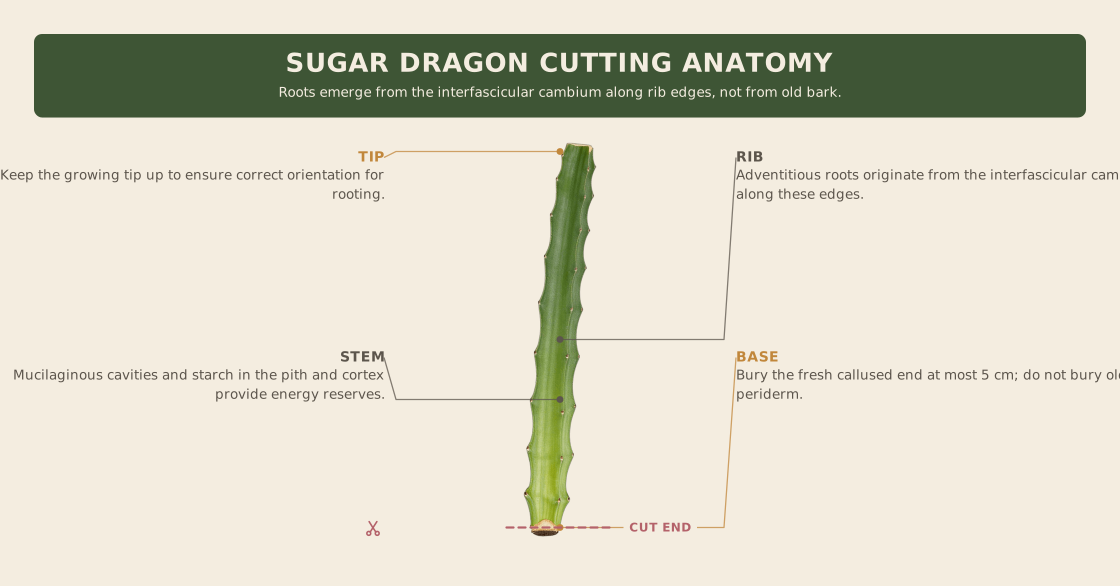
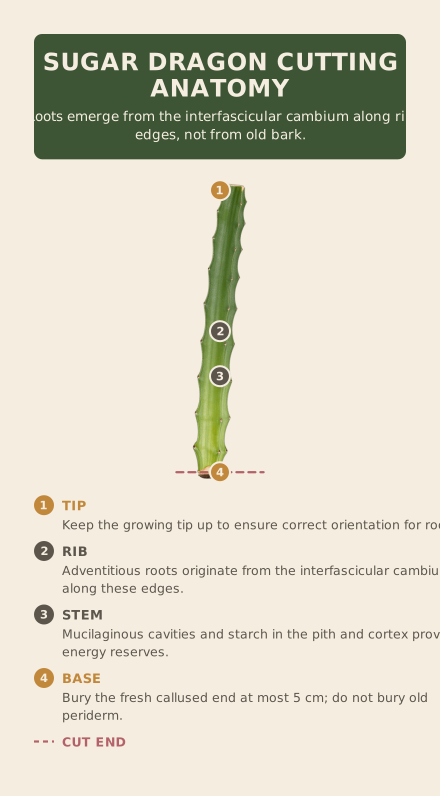
Why some cuttings fail to root: Anatomy matters. In Selenicereus setaceus, researchers found that adventitious roots could not form in regions where periderm (bark-like tissue) had already replaced the epidermis.[3] This hardened layer acts as a physical barrier. The species roots easily elsewhere because its pith and cortex contain abundant mucilaginous cavities and starch, which supply the water and energy needed for new roots to push through.[3] If your cutting is very old and woody at the base, it may struggle to root regardless of how well you care for it.
Hormones can boost the process, but they are not magic. In controlled trials, treatments with 1-naphthaleneacetic acid (NAA), indole-3-acetic acid (IAA), and potassium indole-3-butyrate (K-IBA) all achieved 100 percent rooting rates.[10] Specific concentrations yielded different results: 400 mg/L NAA produced the best combined total root growth and thickness, while 125 mg/L K-IBA increased average root length by 760 percent over untreated controls.[10] Another review noted that a quick 10-second dip in 10 mM indole-3-butyric acid also resulted in 100 percent rooting and improved root size.[1] You do not need to mix your own solutions. Most commercial rooting powders or gels contain these compounds. A light dusting of the cured cut end is sufficient to encourage the plant to focus its energy on root formation rather than just holding on to existing moisture.
Substrate choice supports this biological push. The Iberian agronomic review recommends using pots, black polypropylene bags, or alveoli filled with well-drained substrates containing sand or perlite.[1] Bury the basal end up to 5 cm deep and keep the setup under 50 percent shade.[1] Moisture must be maintained, but never allow the media to become waterlogged. Pitaya roots are susceptible to rot if oxygen is displaced by standing water. The goal is a moist, airy environment where the new roots can breathe and expand. For a detailed walkthrough on setting up your pots and managing moisture levels, see our complete cutting propagation guide.
Be patient with the timeline. While roots may appear in weeks, the plant needs time to build a functional system. UF/IFAS recommends letting potted cuttings establish a good root system for four to six months before transplanting them into the landscape.[5] During this period, the plant is investing heavily below ground. You might see little top growth initially, which is normal. Once the roots are established, the vine will begin to extend rapidly, potentially growing up to 1.2 inches per day under ideal conditions.[5] Watch for new green growth at the tips of the cladodes as your signal that the root system is active and functioning.
Timing and temperature: why autumn cuttings fail
You might think a cutting is a cutting, ready to root whenever you have time to plant it. But seasonality dictates success. A study on Selenicereus setaceus, one of the Sugar Dragon parents, found that cuttings prepared in autumn produced no sprouting at all, while those prepared in spring rooted best in peat-expanded perlite.[3] The researchers explicitly advise against autumn preparation. This isn't just a minor dip in success rates; it is a complete failure to initiate growth.
The mechanism is physiological. Pitaya rooting depends on cell division in the root meristem, a process driven by temperature. Colder conditions slow this division, reducing the rooting rate, while spring and summer warmth stimulates it.[1] If you plant a Sugar Dragon cutting when the soil cools, the cutting sits dormant. It does not rot immediately, but it does not root. It simply waits, draining its carbohydrate reserves without building the infrastructure to support new growth.
Don't fight the season. If you receive a cutting in autumn, store it in a cool, dry place and plant it in spring. Attempting to force roots in cold soil usually results in a dead stick by summer.
Temperature also affects the cutting's ability to utilize its stored energy. Pitaya grows best between 18 and 25 °C (65 to 77 °F).[5] Below this range, metabolic activity slows. Above 38 °C (100 °F), flowering is inhibited, and extreme heat can cause injury.[5] For a new cutting, the sweet spot is warm enough to trigger root emergence but not so hot that the cutting desiccates before it can drink. This is why spring is superior to autumn: the days lengthen and warm steadily, providing the consistent energy needed for the first adventitious roots to break through the epidermis.[10]
Light duration plays a role in the plant's overall vigor, even if it doesn't directly stop rooting. Flower opening is temperature and light driven, with hot days causing flowers to open around 6 p.m. and wither earlier, while cool cloudy days keep them open longer.[2] While this applies to blooms, the same environmental cues signal the plant to prepare for growth or dormancy. Planting in autumn sends a signal to slow down. Planting in spring sends a signal to accelerate.
Consider the cutting's size when planning your timing. The optimal cladode length for propagation is 15 to 25 cm, as longer cuttings carry more carbohydrate reserves to fuel root development.[1] A smaller cutting has less margin for error. If you plant a 15 cm cutting in autumn, it may exhaust its limited energy before spring warmth arrives. A 25 cm cutting has a better chance of surviving the wait, but it still faces the same physiological barrier to rooting in cold soil. For best results, match the planting time to the season that supports rapid cell division. If you miss the spring window, wait until the next one. Your Sugar Dragon cutting will keep better in storage than it will in cold, wet soil.
Water, soil and feeding after roots form
Once your Sugar Dragon cutting establishes its first roots, the care routine shifts from survival to steady growth. In a 2026 trial conducted at approximately 26 °C, treated cuttings broke through the epidermis with adventitious roots on day 9, just one day faster than the water-only control.[10] This rapid initial emergence means you should check moisture levels frequently in those first few weeks. The goal is to keep the media moist but never soggy, as excessive soil moisture is a primary cause of root rot and overall plant decline.[5]
Pitaya is a climbing cactus with segmented, three-ribbed cladodes that store water and nutrients.[1] Because these stems act as reservoirs, the plant is resilient to short dry spells but suffers significantly under prolonged drought. Research shows that a ten-day drought drops net CO2 uptake by 57 percent, a shutdown mediated by abscisic acid produced in the roots.[2] To avoid this metabolic stall, water deeply when the top inch of soil feels dry. In hotter weather, you may need to water more often, as temperatures above 38 °C inhibit flowering and 40 °C is the maximum survivable limit, provided the roots have access to water.[2]
Soil composition matters as much as watering frequency. The ideal pH range for pitaya is acidic to neutral, specifically between 5.5 and 6.5 according to biological reviews, though some cultural practice guides extend the acceptable optimum to 7.0.[2] Use a well-drained mix rich in organic matter. If you are growing in pots, ensure the substrate includes sand or perlite to prevent waterlogging.[1] Salinity is a silent killer; levels above 4 dS/m can be fatal to the plant.[1]
Feeding should wait until the plant shows active new growth. UF/IFAS recommends waiting about a month after planting before applying fertilizer.[5] Once you begin, use frequent, light applications. A balanced formula like 6-6-6 or 8-4-12 with added magnesium is effective. Apply roughly 0.25 lb (118 g) per plant every two months during the first year.[5] Over-fertilizing can burn the shallow roots, so less is often more.
Watch for signs of stress or disease. Stem and fruit canker caused by Neoscytalidium dimidiatum and rot from Colletotrichum gloeosporioides are common threats.[5] These pathogens thrive in warm, wet conditions, especially if there are open wounds on the cladodes. If you see soft spots or discoloration, improve air circulation and reduce watering immediately. Remember that while the plant can recover from light freezing injury, frost is the greatest limitation to cultivation, with -2 °C causing damage and -4 °C being lethal.[5]
Rooting reality check: While institutional sources report first root emergence at 9 to 10 days under hormone treatment, it typically takes 4 to 6 months to build a well-rooted potted plant ready for the landscape.[10] Patience pays off here. Do not rush to transplant until the root system is robust enough to support rapid vegetative growth.
Why growers buy 8-S as a pollinator, and the honest science on self-fertility
Many growers plant Sugar Dragon not just for its fruit, but to serve as a reliable pollen source for the rest of the trellis. Because this clone is typically the first and last variety to bloom on a farm, it provides a long window where viable pollen is available when other cultivars open.[8] Spicy Exotics notes that its pollen can be used with almost any other dragon fruit plant to create fruit, making it a valuable partner in a mixed planting.[8]
While Sugar Dragon is self-fertile, the broader science of pitaya pollination is more complex. UF/IFAS states that although pitaya flowers are hermaphroditic, self-incompatibility has been reported in several cultivars sold by nurseries.[5] This is why extension services recommend planting two or three different genetic types to ensure cross-pollination improves fruit set and size.[5]
Self-incompatibility in dragon fruit is often gametophytic. In studies of self-incompatible cultivars like 'Hongshuijing', self pollen germinates on the stigma but pollen tube elongation ceases halfway down the style, preventing fertilization.[6] This biological barrier means that even if a flower looks healthy, it may not set fruit without compatible pollen from a different clone.
Research also highlights the benefits of cross-pollination even for self-compatible varieties. In a two-year subtropical study, the white-fleshed clone NDFW-1 was self-compatible, yet manual cross-pollination still significantly increased fruit weight compared to self-pollination alone.[4] Conversely, the red-fleshed clone NDFR-1 was strictly self-incompatible and required cross-pollination for any fruit set.[4]
Grower’s note: Even if you trust your Sugar Dragon to set fruit on its own, introducing pollen from another variety often results in larger, better-formed fruit. The effort of hand-pollinating at night or early morning pays off in yield and quality.
What the vine and the fruit will do
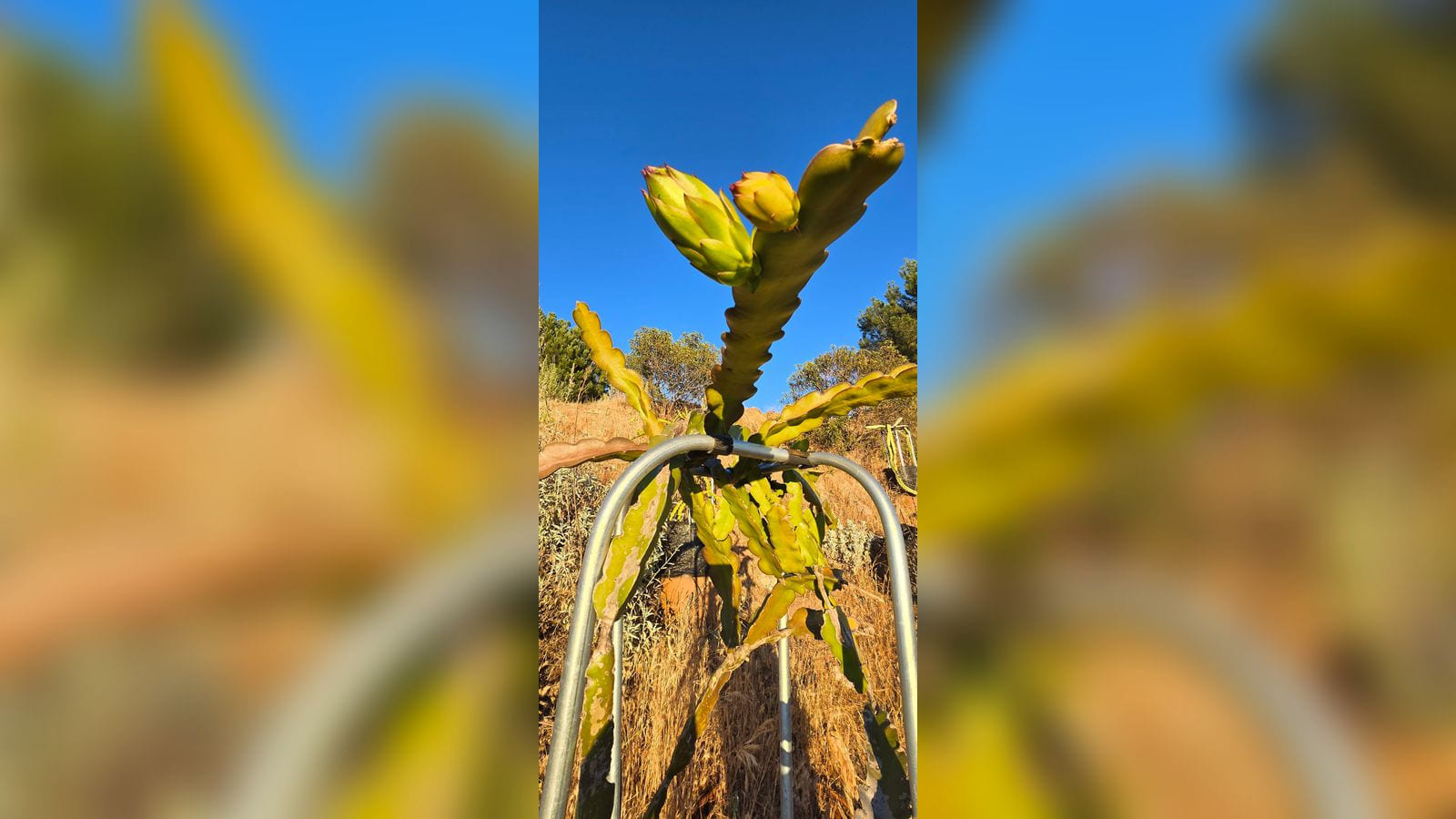
Once your cutting establishes, expect a vigorous climb. Sugar Dragon inherits strong growth habits from its parents, producing meaty olive-green stems that can extend over five feet.[8] Because pitaya is a climbing cactus, it needs a support structure. Keep your trellis under 1.6 meters so you can reach the fruiting cladodes without a ladder.[1] During the first stages of development, strip away lateral shoots. Leave only the most upright apical shoot to drive energy into vertical growth and establish a strong central column.[1]
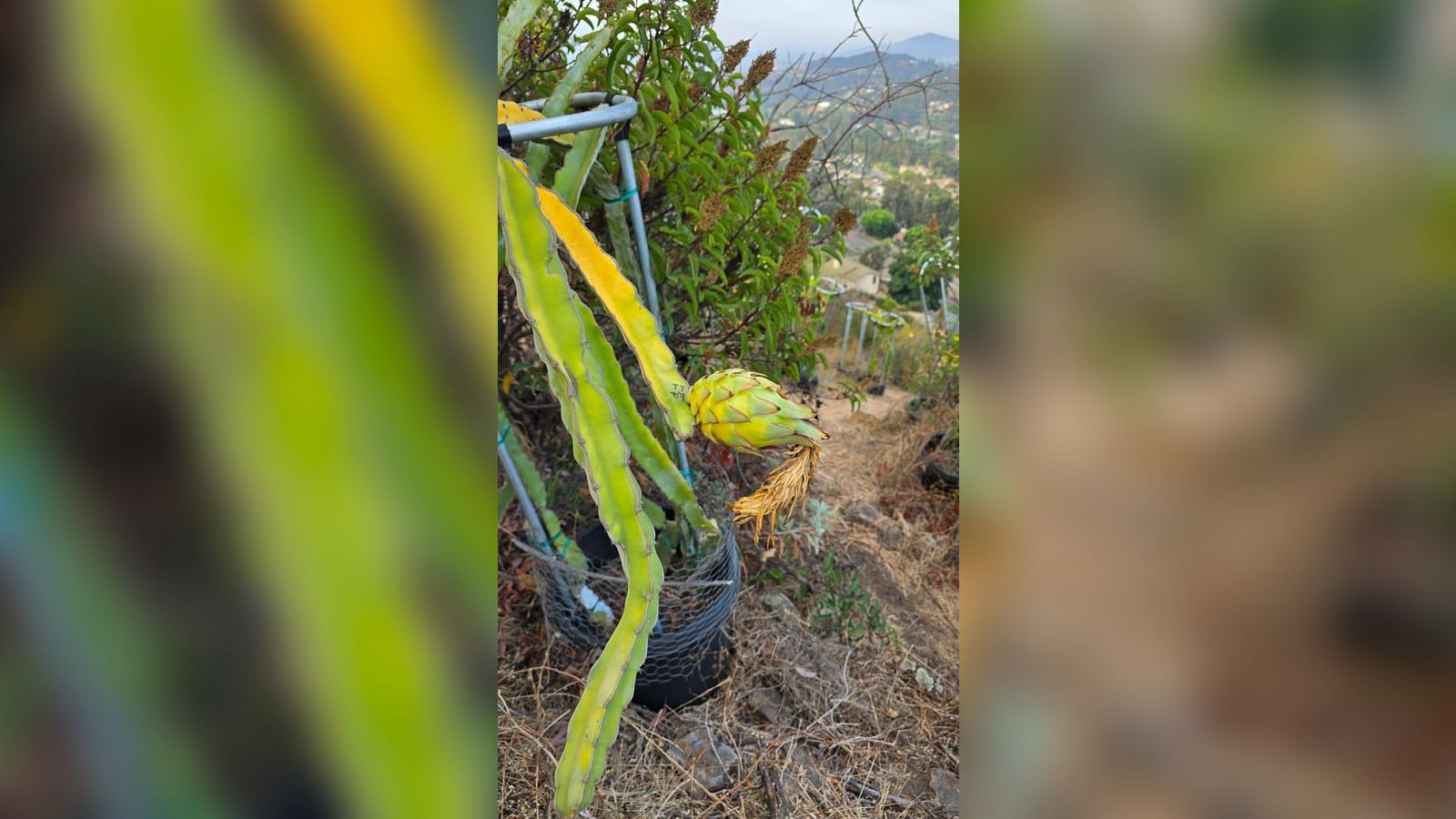
Vegetative propagation is the standard for a reason. Seedlings vary wildly in fruit and stem character and can take up to seven years to produce their first crop.[5] A cutting skips that wait. Many plants begin producing fruit six to nine months after planting.[5] In a Florida context, the ripening season for this type of pitaya typically runs from June to November.[5] Sugar Dragon is often the first variety to bloom on a farm, giving you an early start on the season.[8]
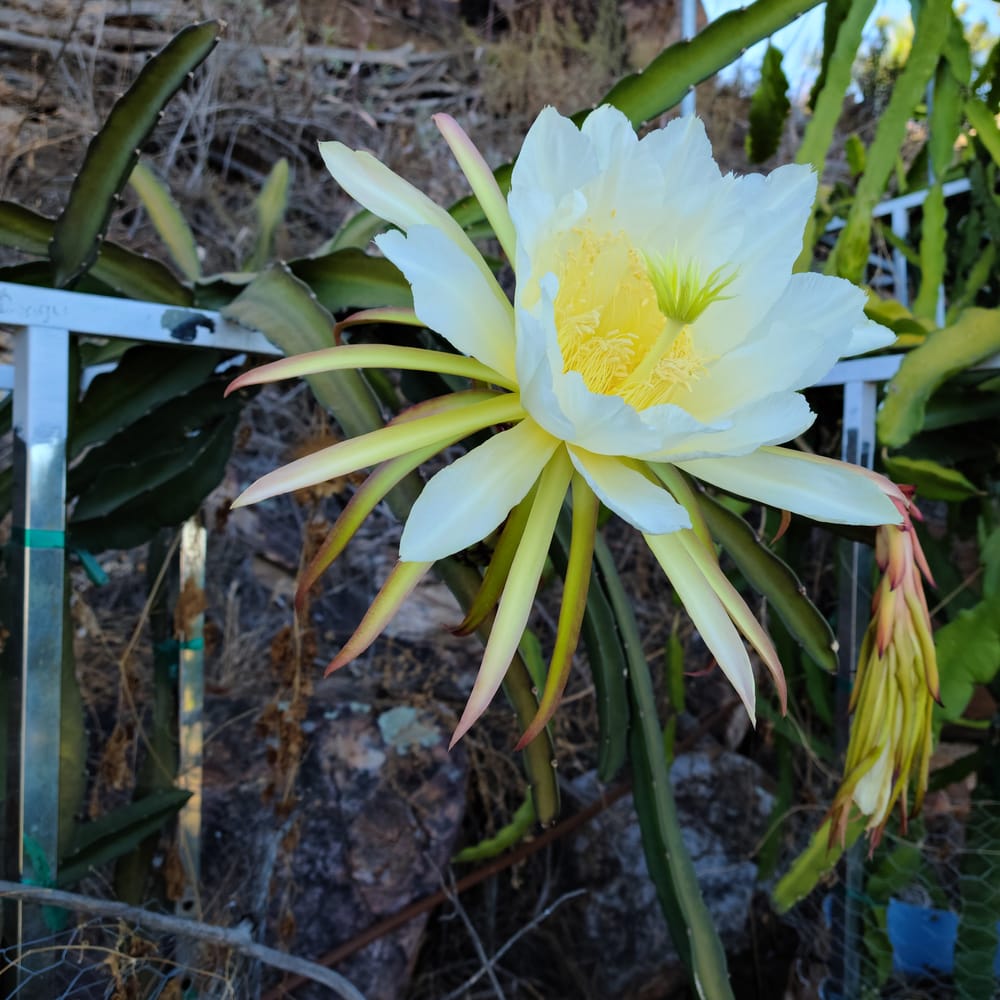
The flowers are dramatic. They open fully a few hours after sunset and close at sunrise.[8] Temperature and light drive this timing. On hot days, blooms may open around 6 p.m. and wither earlier if heat persists. On cool, cloudy days, they can stay open until late morning, though they usually look wilted by 10 a.m.[2] Hand pollination is recommended in the early evening or morning to ensure set.[5]
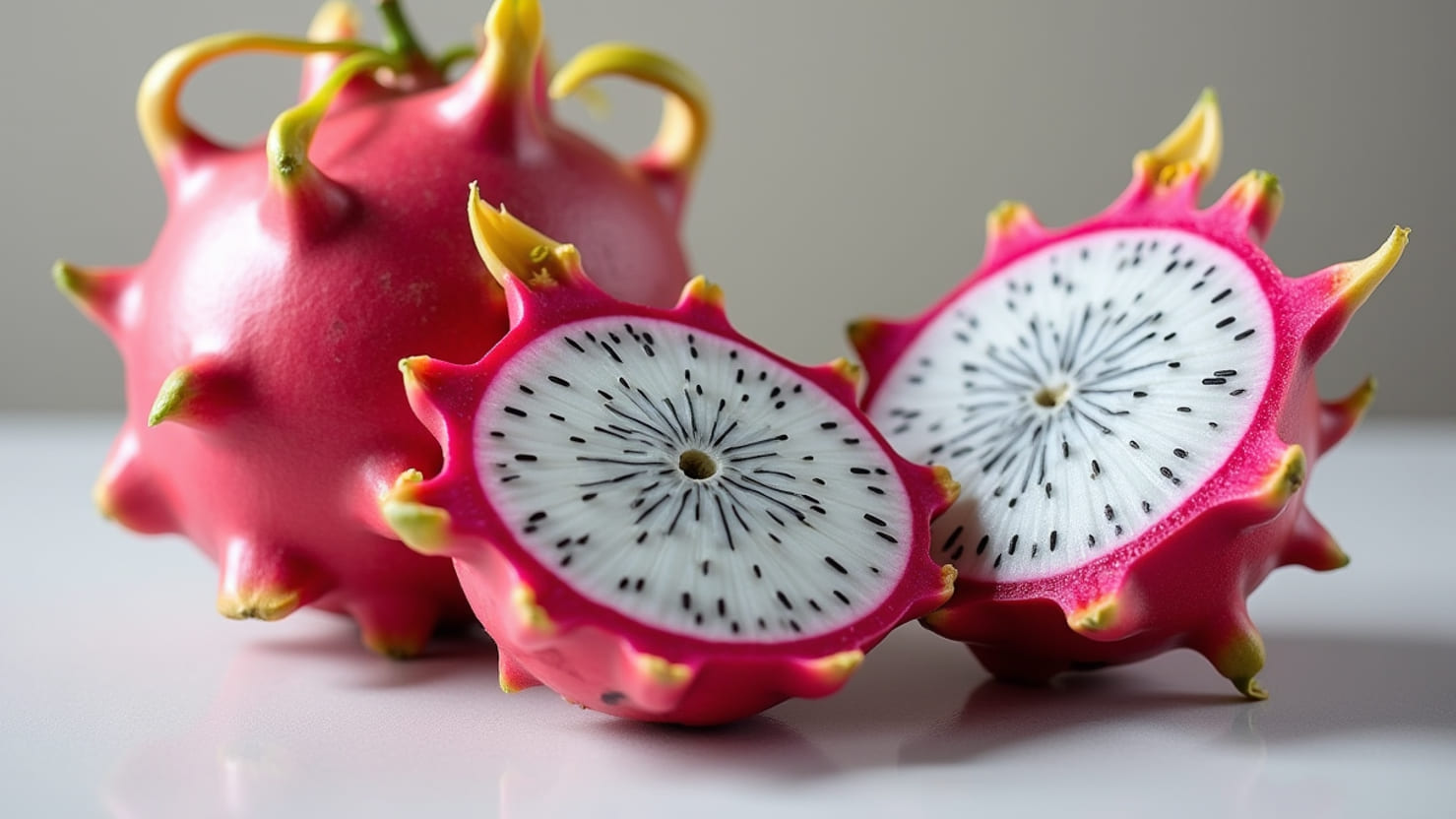
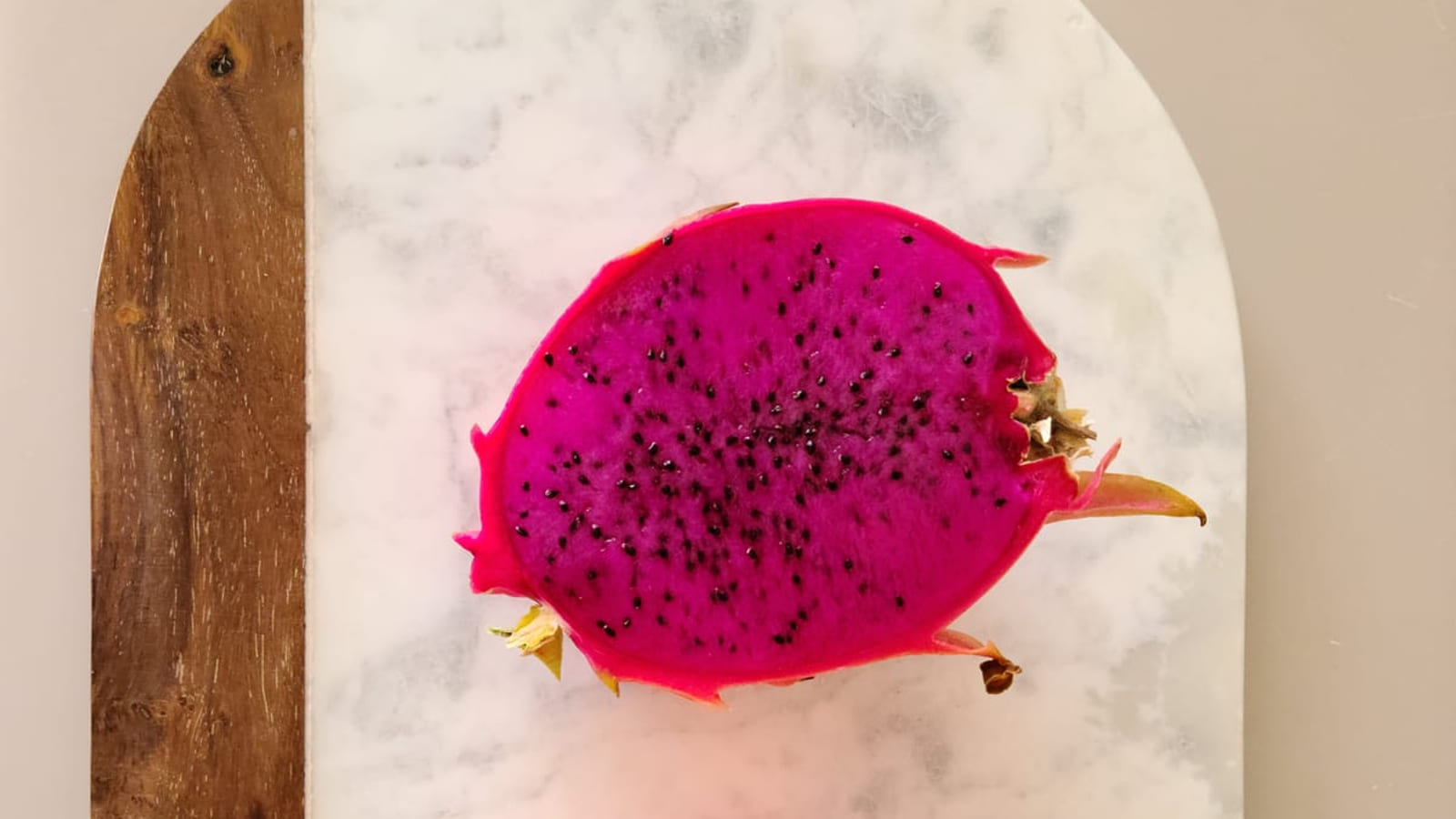
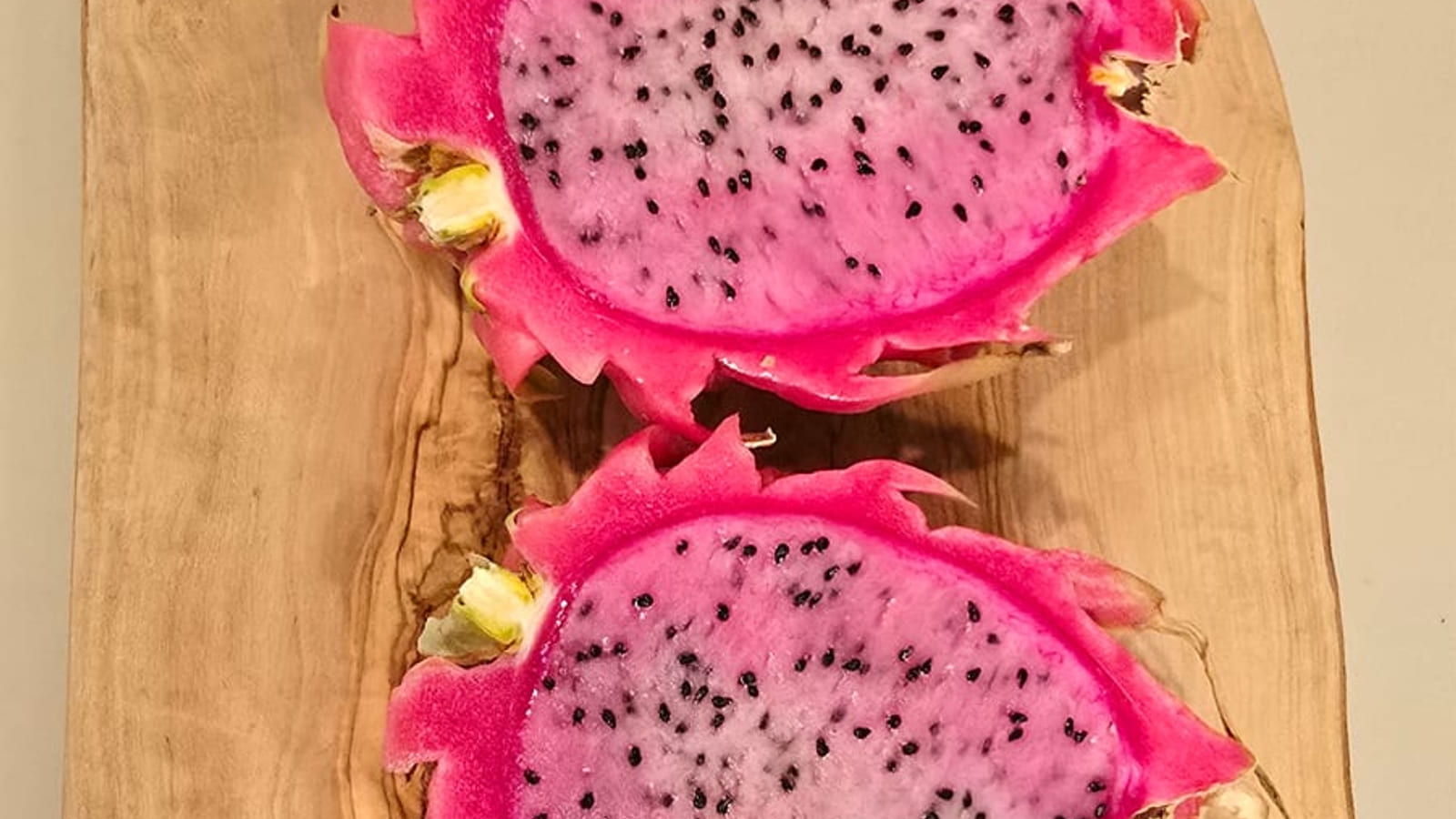
Fruit development takes about 30 to 35 days in summer, but this window stretches as temperatures drop in autumn.[2] Harvest only when the fruit is well-coloured. Cut the peduncle flush to the fruit surface to avoid leaving stubs that can rot.[5] Expect oval, red-skinned fruit with tiny deep green to almost brown fins.[8] Individual fruits weigh between a quarter and three-quarters of a pound, or roughly 113 to 340 grams.[8] The flesh is bright red-purple with a semi-firm texture.[8] Early tests averaged 18 Brix, with mature plants capable of pushing fruit into the twenties.[8]
Watch for canker. Neoscytalidium dimidiatum causes stem and fruit canker on Selenicereus hosts.[11] This pathogen enters through pre-existing wounds and forms appressoria on young, vulnerable tissues.[11] A fresh, uncured wound in warm, wet weather is a high-risk moment for a new cutting.[11] Always cure cuttings properly before planting to seal the base.
A well-maintained Sugar Dragon plant has a long productive life. Reviews suggest a lifespan of about 20 to 25 years.[1] UF/IFAS notes that three- to four-year-old plants can produce roughly 220 pounds (100 kg) of fruit per year.[1] This longevity makes the initial effort of rooting and training worthwhile. For more on getting your cutting established, see our guide on dragon fruit cutting propagation.
Mistakes that kill Sugar Dragon cuttings
Even a robust clone like Sugar Dragon can fail if you ignore the biological realities of its propagation. The most common error is planting a cutting that looks healthy but carries hidden pathogens. Because pitaya is propagated vegetatively, every cutting is a potential vector for disease. The Iberian agronomic review warns that informal grower-to-grower exchanges often disseminate bacteria, fungi, and viruses.[1] If you skip screening your mother plant or fail to disinfect your knife, you might be planting a ticking time bomb. A clean cut with a sterilized tool is not optional; it is the first line of defense against stem canker and rot.
Another frequent mistake is ignoring the anatomical limits of the cutting itself. A 2025 study on Selenicereus setaceus, one of the Sugar Dragon parents, revealed that adventitious roots form from the interfascicular cambium and push through perivascular fibers and cortical bundles without resistance.[3] However, the same study found that where periderm (bark-like tissue) has replaced the epidermis, rooting fails completely.[3] This means an old, woody section of a cutting will never root, no matter how much you water it. Always select fresh, green tissue from the lower portion of the mother plant, where the epidermis is still intact and capable of generating new roots.
Watch your soil salinity. Pitaya prefers well-drained sandy loam rich in organic matter, but it has a hard limit on salt. Salinity above 4 dS/m can kill the plant outright.[1] If you are using municipal water or fertilizing heavily, check your runoff. Raised beds are a smart choice in marginal drainage areas to prevent salt buildup around the root zone.
Patience is also a factor. Growers often panic when they see no immediate growth, but Sugar Dragon cuttings can be deceptive. UF/IFAS notes that pitaya cuttings can grow very fast, up to 1.2 inches (3 cm) per day, once established.[5] However, this explosive growth only happens after the root system is functional. If you pull the cutting to check for roots too early, you break the delicate new connections. Let the plant tell you it is ready by watching for new green shoot growth. If you are struggling with rooting, review our complete guide to cutting propagation for detailed timing cues.
Finally, do not underestimate the importance of pollination if you want fruit. While Sugar Dragon is self-fertile, relying solely on natural pollinators is a mistake. UF/IFAS reports that moths and bats are the primary natural pollinators because the flowers open at night, but actual moth and bat visits are seldom observed in cultivation.[5] If you want a heavy set of magenta-fleshed fruit, you must hand-pollinate at night or early morning. Do not assume the plant will do the work for you.
Questions people ask
Will one plant produce fruit? Yes. Sugar Dragon is self-fertile, meaning a single vine can set fruit without a partner. Spicy Exotics confirms its pollen works with almost any other dragon fruit plant, and the clone is often the first and last to bloom on a farm, giving you a long window to manage pollination.[8] However, adding a second variety usually increases fruit size and weight. Even self-compatible clones show significant gains in fruit weight when cross-pollinated manually.[4] If you want the biggest harvests, plant two genetically different types nearby.
Why do the flowers close so fast? They are designed for night pollinators. Sugar Dragon flowers open fully a few hours after sunset and close at sunrise.[8] Temperature and light drive this timing. On hot days, flowers may open around 6 p.m. and wither earlier if heat persists. On cool, cloudy days, they might stay open until 11:00 or 12:00, though they look wilted by 10 a.m.[2] The effective pollination window is narrow: four hours before to twelve hours after anthesis. Hand-pollinate in the early evening or morning to catch the stigma when it is most receptive.[4]
How long until I eat the fruit? The timeline varies by season and temperature. Once a bud forms, it takes about 24 days to flower, and the fruit matures 30 to 50 days after flowering.[9] In summer, development is faster, often taking 30 to 35 days. In mid-autumn and early winter, cooler temperatures slow the process, so a fixed day count is unreliable.[2] Harvest only when the skin is well-colored and the fruit detaches easily from the peduncle.[5]
Is the flesh really sweet? The first test fruits averaged 18 Brix, and mature plants can push fruit into the twenties.[8] The flesh is bright red-purple with a semi-firm texture and notes of grape and watermelon.[8] It is less watery than many white-fleshed varieties, making it good for fresh eating, jams, or juice.[8]
Can I grow it in a pot? Yes, and it is often the best way to start. UF/IFAS recommends planting cured cuttings in pots first to build a strong root system for four to six months before moving them to the landscape.[5] This protects young plants from extreme weather and pests. Once established, the vine grows fast, sometimes up to 1.2 inches per day, and can produce fruit six to nine months after planting.[5] Keep the pot in partial shade for the first few months to prevent sunburn.[5]
Why Sugar Dragon Is a Proven Clone
You are buying a proven genetic line, not just a random stem. The Sugar Dragon cutting is a clone of Paul Thomson’s 8-S selection, a hybrid of Houghton and Rixford that has earned its reputation for reliability and flavor.[8] Whether the tag reads Sugar Dragon or Voodoo Child, the plant inside the packaging is identical. It is a vigorous, self-fertile grower that produces magenta-fleshed fruit with high sugar content and a long harvest window.[9]
Success with this variety depends on respecting its biology. Because it is a hybrid of Selenicereus setaceus and Selenicereus guatemalensis, it inherits a robust constitution but also specific rooting requirements.[2] The plant’s ability to flower early and late in the season makes it an excellent pollinator partner for other cultivars, ensuring you have pollen available when other vines are dormant. Its compact habit allows it to thrive on standard trellises, making it a practical choice for home growers who want high yields without excessive vine sprawl.
Do not let the name confusion or outdated taxonomy on nursery tags distract you from the plant’s performance. The shift from Hylocereus to Selenicereus is a botanical correction, not a change in the plant’s care needs.[2] Focus on the physical traits: olive-green stems, thick spines, and a growth habit that responds quickly to proper curing and planting. If you follow the steps for wound healing and root development, you will see why this clone is one of the most tracked cultivars in the trade.[9]
Next steps: If you have your cutting in hand and are ready to start the rooting process, review our detailed instructions on dragon fruit cutting propagation to ensure your wound heals correctly and roots form quickly.
References
- Pitaya as a New Alternative Crop for Iberian Peninsula: Cultural Practices, Plants (MDPI), Trindade et al. (2026).
- Pitaya as a New Alternative Crop for Iberian Peninsula: Biology and Edaphoclimatic Requirements, Plants (MDPI), Trindade et al. (2023).
- Morphoanatomical aspects of stem cuttings of Selenicereus setaceus (Salm-Dyck) A. Berger ex Werderm. (Cactaceae), Brazilian Journal of Biology (2025).
- Floral and pollination biology of dragon fruit reveals strategies for enhancing productivity through pollination management and reproductive window extension, Scientific Reports, Jadhav et al. (2025).
- Pitaya (Dragonfruit) Growing in the Florida Home Landscape (HS303), UF/IFAS Extension, Crane & Balerdi (2019).
- Global transcriptome dissection of pollen-pistil interactions induced self-incompatibility in dragon fruit (Selenicereus spp.), PeerJ (2022).
- GBIF Backbone Taxonomy: Selenicereus guatemalensis (10774886) and Selenicereus setaceus (4927441), with Hylocereus taxa as synonyms, GBIF / Species 2000 (2026).
- Sugar Dragon - H. setaceus X H. guatemalensis (clone 8-S) product record, Spicy Exotics nursery (2024).
- Sugar Dragon Cultivar - The Dragon Fruit Directory grow stats, Tendra / Dragon Fruit Directory (2026).
- Screening of Plant Growth Regulators for Promoting Rooting of Pitaya Cuttings, Plants (MDPI), Hainan University (2026).
- Plant-Associated Neoscytalidium dimidiatum - Taxonomy, Host Range, Epidemiology, Virulence, and Management Strategies, Journal of Fungi (MDPI), Dervis & Ozer (2023).