Red Rose Dragon Fruit: Honest Review & Grower Notes
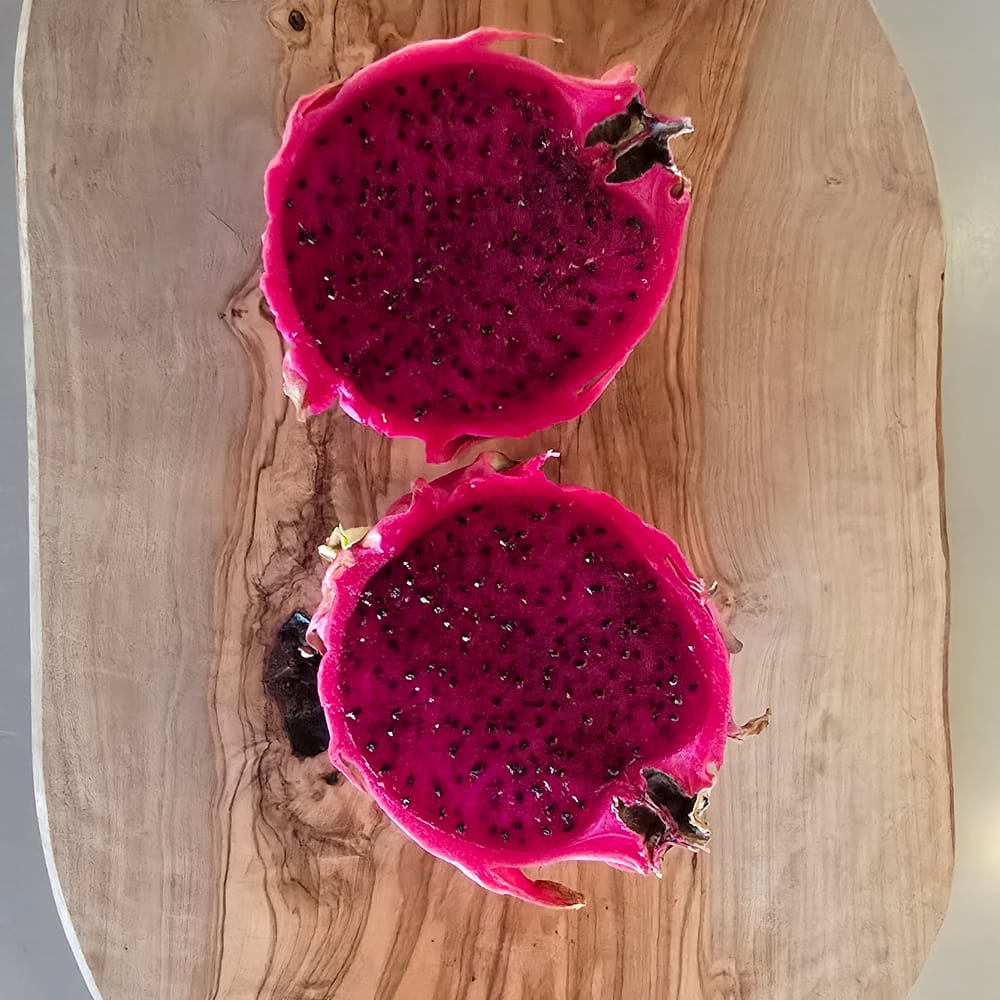
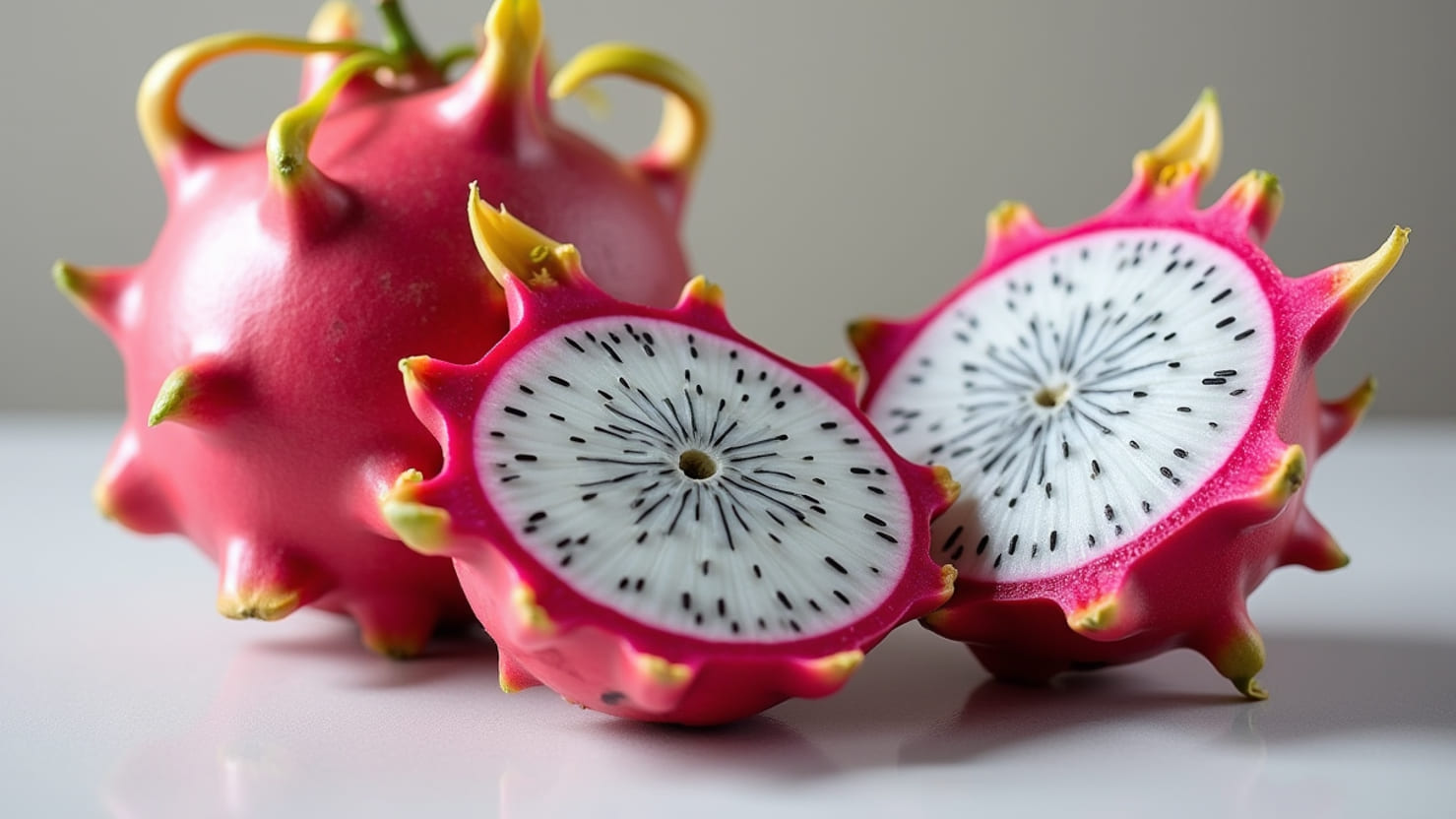
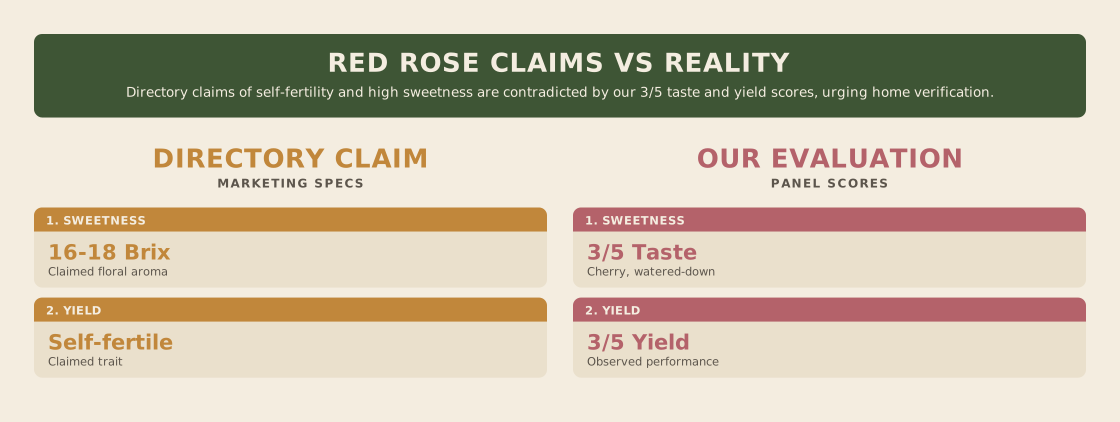
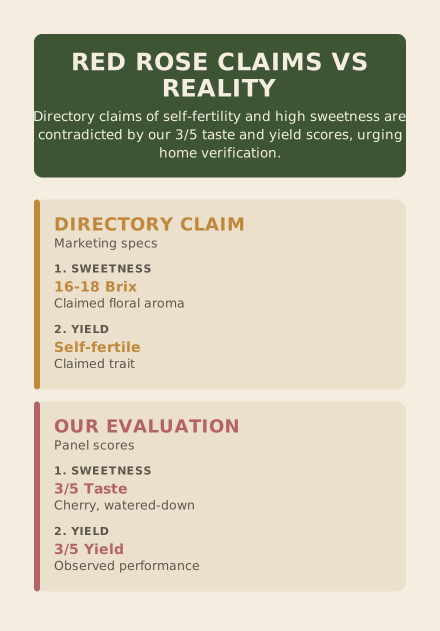
Red Rose is a red-fleshed pitaya cultivar in the Selenicereus polyrhizus group, sold by us under SKU RDR. The trade directory describes it as self-fertile with a Brix of 16-18 and a rose-floral aroma. Our own evaluation panel scored it 3/5 for taste, noting a cherry flavor and watered-down texture. The deep red-purple color comes from betacyanin pigments, specifically betanin.
If you are looking for other red-fleshed options, check our full cutting inventory.
Red Rose at a Glance
Where the Red Comes From
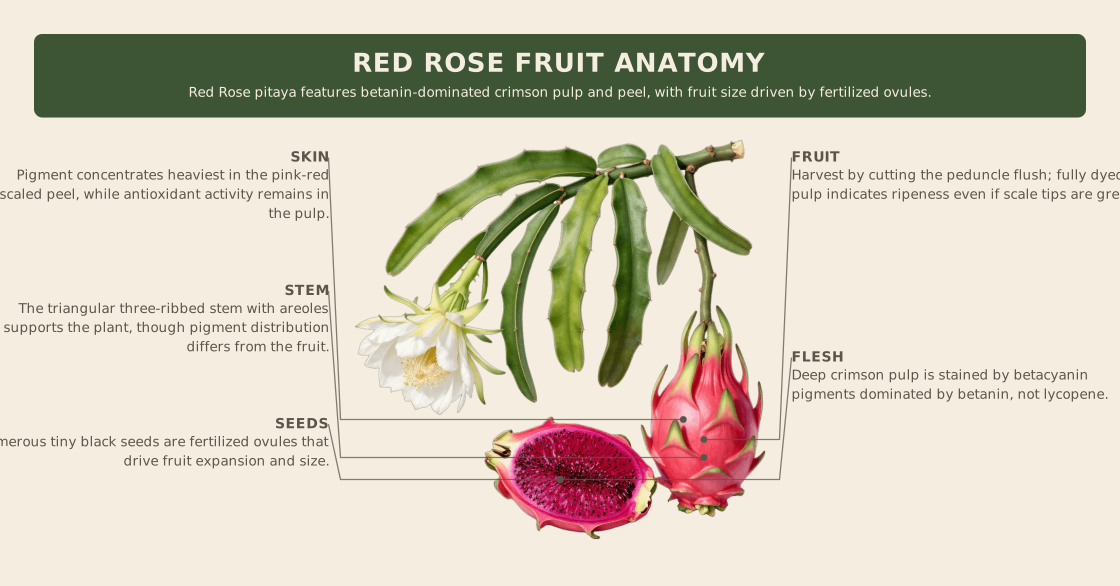
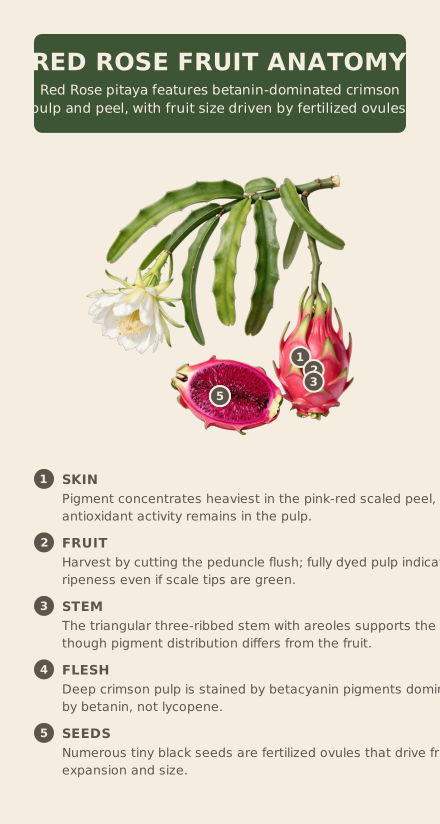
The deep red-purple flesh of Red Rose is the result of specific chemistry. The color comes from betacyanins, a group of pigments within the betalain family. Betanin is the main bioactive compound responsible for that intense hue. It is joined by isobetanin, bougainvillein-r-I, phyllocactin, and iso-phyllocactin. These compounds are distinct from the lycopene found in tomatoes or the anthocyanins in blueberries. They are unique to the Cactaceae family and a few other plant groups.
Research on red pitaya cultivars shows an interesting split. The peel often holds higher total betacyanin and anthocyanin content than the pulp. However, the pulp extract demonstrates stronger antioxidant activity, specifically in radical-scavenging tests. This means the pigment and the health-promoting activity are not concentrated in the same tissue.
Why your smoothie stays red but your cake turns brown
Betacyanins are sensitive to heat and pH. They degrade rapidly above pH 7 and at temperatures of 25 C and up. This instability is why red pitaya is an excellent natural colorant for cold foods like yogurt, ice cream, and confectionery. It is also why cooked pitaya dishes fade toward brown. If you bake with Red Rose pulp, expect the vibrant red to dull significantly. For best color retention, use the fruit in raw or cold applications.
The pigmentation process itself is gradual. Betacyanins, phenolics, and flavonoids increase as the fruit matures. Interestingly, pigmentation appears earlier in the pulp than in the peel. This gives you a reliable visual cue for ripeness. If the pulp is fully dyed red but the scale tips are still slightly green, the fruit is ripe. Waiting for the peel to turn completely red does not make the fruit sweeter. It only risks over-ripening and texture loss. The chemistry dictates that the color is already there, locked in the flesh, long before the skin catches up.
Ripeness, Sweetness and the Honest Verdict on Flavor
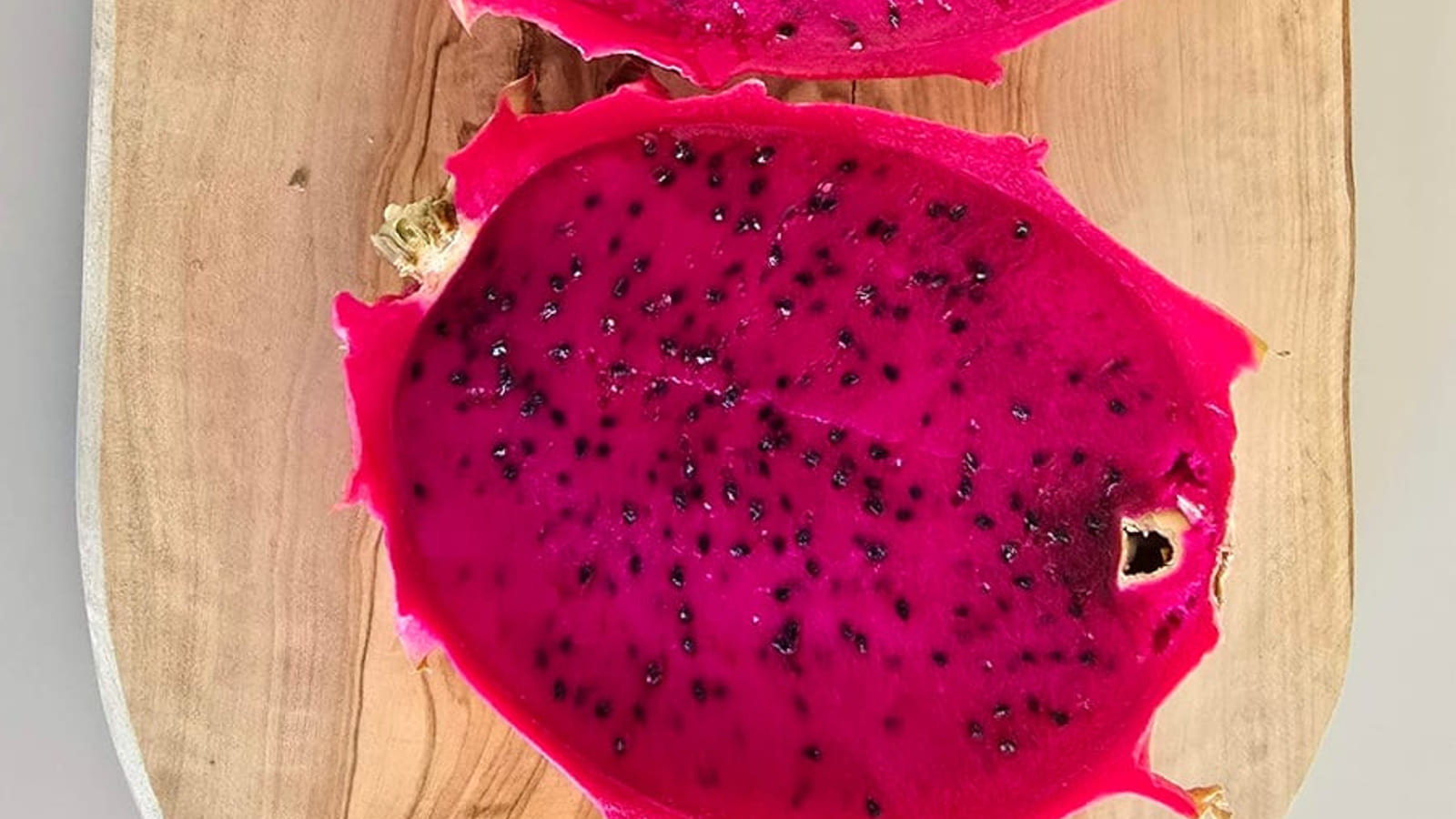
Knowing when to cut Red Rose requires trusting the flesh over the skin. Pigments and phenolics build gradually as the fruit matures, but the pulp colors before the peel does. If you slice open a fruit and the interior is a deep, uniform red while the scale tips still hold a hint of green, the fruit is ripe. Red Rose will not get sweeter by staying on the vine longer. Leaving that fruit on the vine longer will not raise the sugar content. It only increases the risk of texture breakdown and pest damage. Cut it when the flesh tells you it is ready, not when the skin matches the catalog photo.
Once harvested, the eating experience is defined by its sugar profile. The dominant carbohydrates in red pitaya are glucose and fructose, accompanied by oligosaccharides. These simple sugars provide immediate sweetness, but the fruit’s betalain pigments play a functional role beyond color. Betalains have been reported to exert antidiabetic effects and modulate glycemic response. The pulp also carries anthocyanins like cyanidin 3-glucoside and delphinidin 3-glucoside, which contribute to the antioxidant load. You are getting a complex chemical package, but the question remains: does it taste as good as the directory claims?
| Metric | Directory Claim | Sky Botanicals Verdict |
|---|---|---|
| Sweetness | 16-18 Brix | Noted as watered-down texture |
| Aroma | Rose-floral | Cherry note |
| Taste Score | Implied premium | 3/5 |
This gap between the trade sheet and our panel’s notes is the most important takeaway for any buyer. The directory pitches a high-Brix, floral experience. Our evaluation found a cherry flavor with a texture that lacked the density expected of a 16-18 Brix fruit. But it is exactly the kind of skepticism you should carry into every named variety.
Pollination: Self-Fertile on Paper, Prove It in the Garden
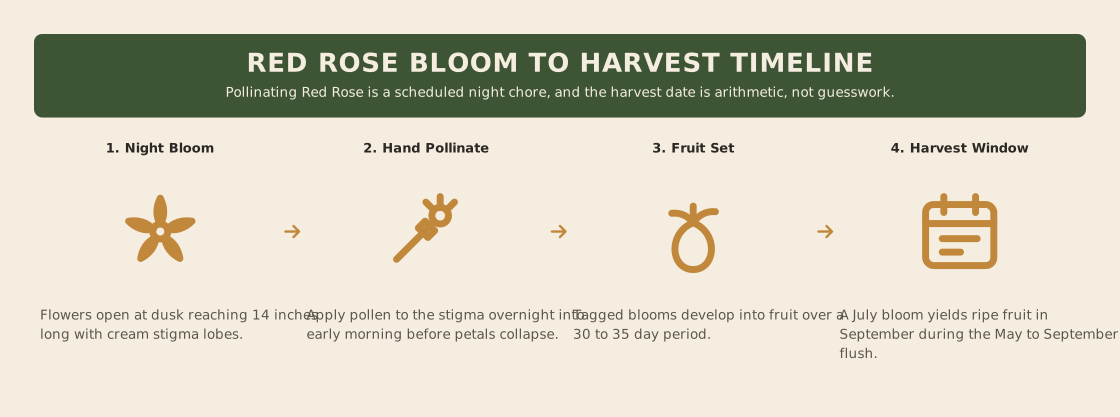
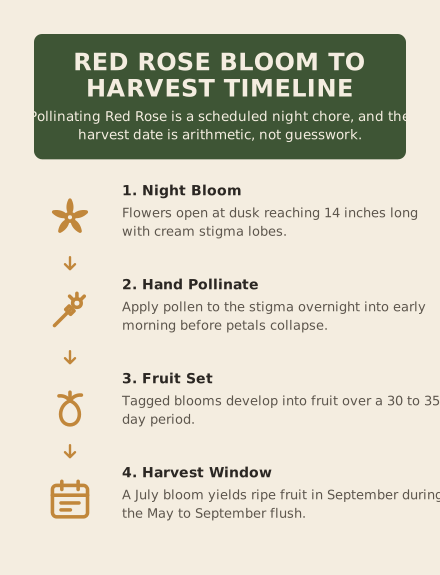
Red Rose is sold as self-fertile, but that label is a starting point, not a guarantee. Most cultivated dragon fruit species are heterostylous, meaning the stigma and anthers are spatially separated to encourage cross-pollination.[3] The flowers are large, fragrant, and nocturnal, often reaching 14 inches long and 9 inches wide.[1] They open at night when bees are gone, relying on moths and bats that are increasingly scarce in many gardens.[1] Without these vectors, fruit set and size suffer.[3]
Do not assume a red-fleshed plant will set fruit on its own. A controlled trial of the red-fleshed cultivar Red Jaina showed natural pollination set only 14.3% of flowers.[2] Hand pollination with compatible pollen raised that set to 77.4% and increased average fruit weight from 40.6 g to 164.7 g.[2] Bumblebees produced no fruit at all on the red cultivar.[2] By contrast, the white-fleshed White Jaina set 50-60% of flowers without help.[2] This proves self-compatibility is a per-cultivar trait, not a rule based on flesh color.[2]
University of Florida extension notes that self-incompatibility is poorly documented across nursery cultivars.[1] They recommend planting two or three different genetic types, not clones, to ensure set and size.[1] If you are unsure about your specific stock, read our guide on self-fertile versus cross-pollinating dragon fruit varieties to understand the genetic risks.
Test Your Red Rose
Tag individual flowers when they open. Count how many set fruit naturally. If set is poor or fruit come small, you must hand-pollinate. Collect pollen from the stamens and apply it to the lobed stigma during the night or early morning while the flower is still open.[1] Use pollen from a different genotype if possible.
The Single-Night Window
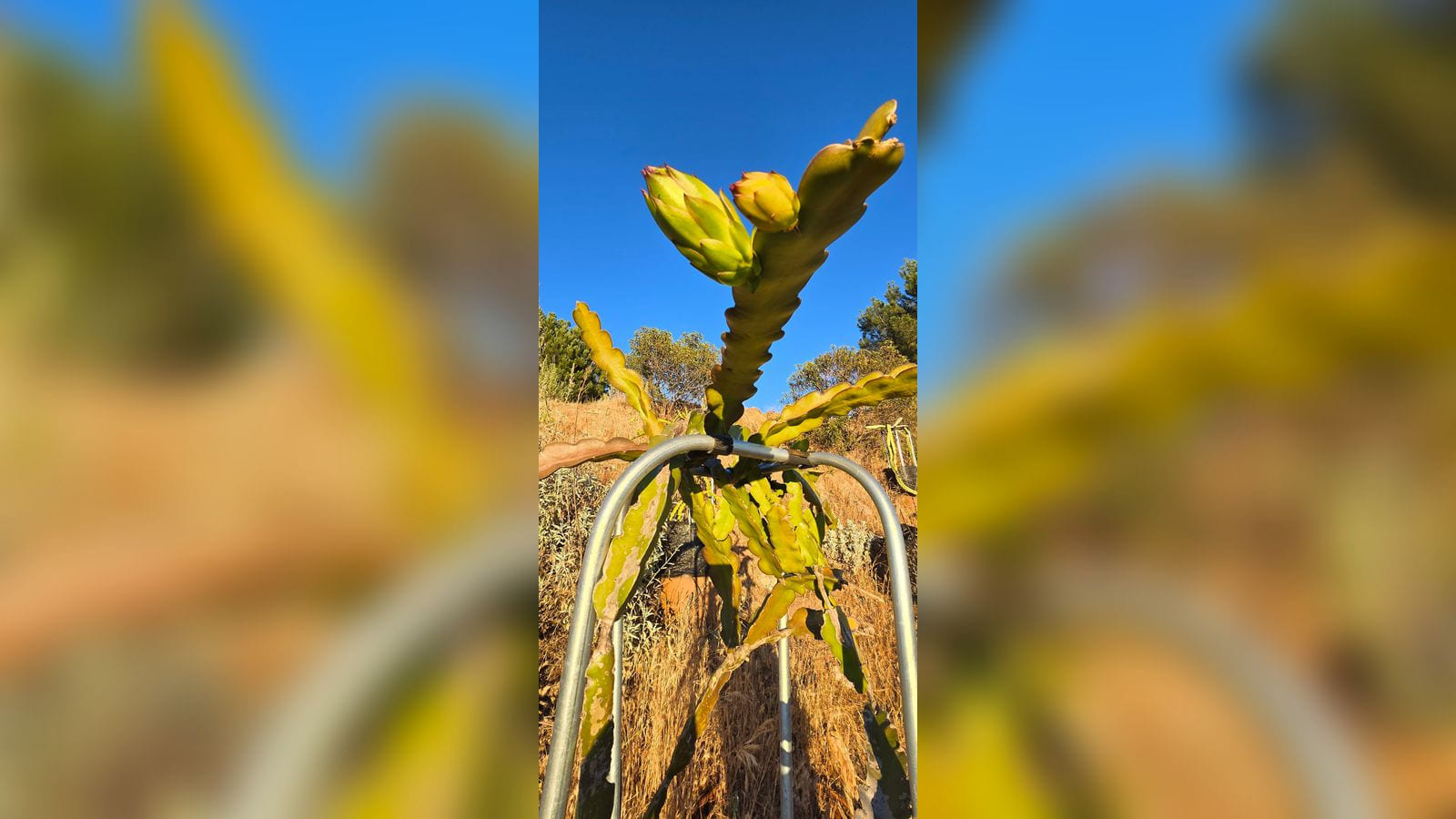
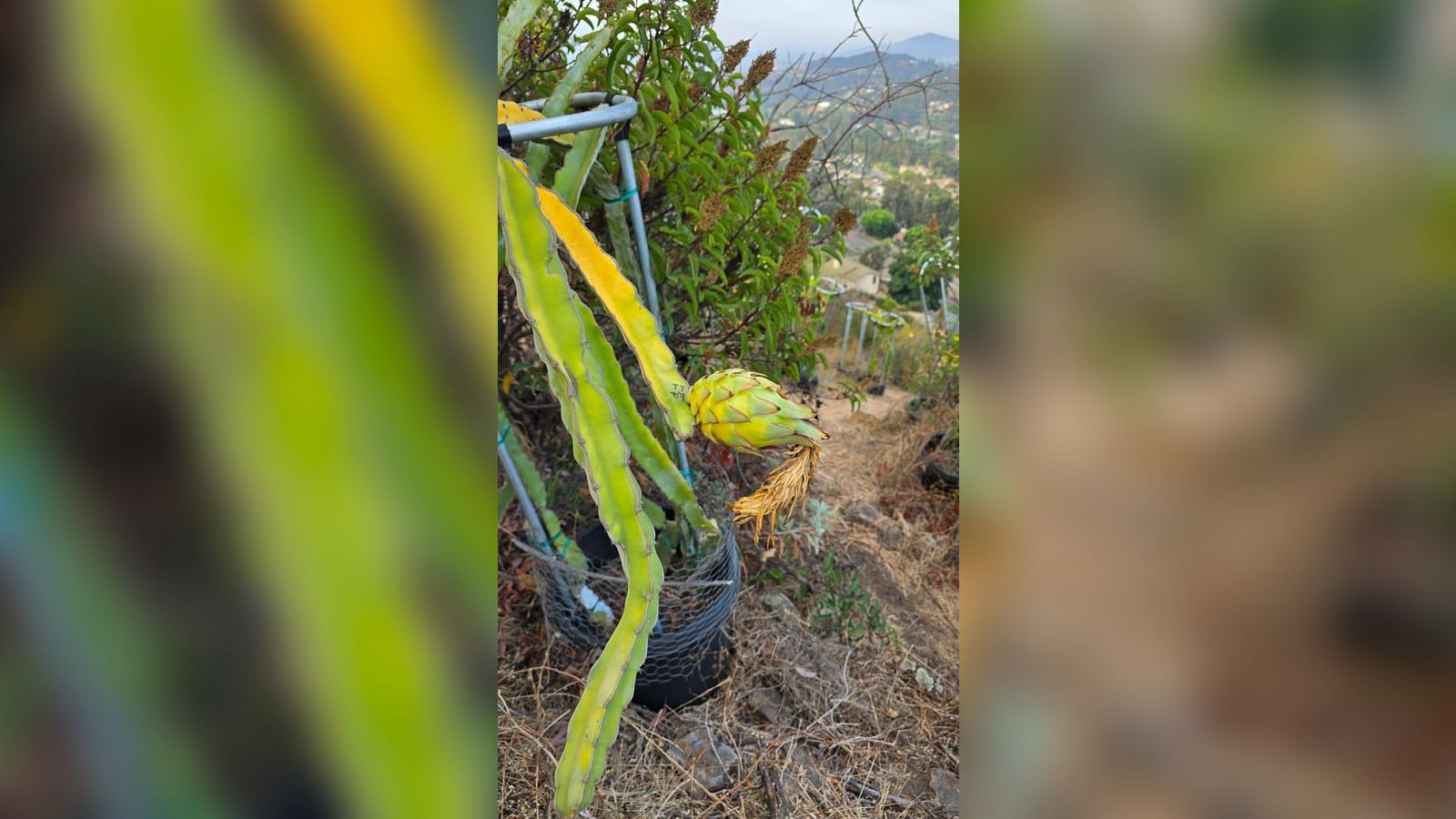
Dragon fruit flowers live for one night, and the timeline is tight. A bud takes about 25 days to open.[4] Once open, the flower must be pollinated before dawn or it wilts and drops. If pollinated, the fruit takes 30-35 days to ripen.[4] A bloom tagged in July is a September harvest.[4] This single-night lifespan means you cannot rely on daytime bees. You must be awake when the flower is.
| Stage | Duration | Action Required |
|---|---|---|
| Bud to Open Flower | ~25 days | Monitor for night opening |
| Open Flower | One night | Hand-pollinate if natural set is poor |
| Flower to Harvest | 30-35 days | Water regularly; avoid drought |
How to Grow Red Rose
Red Rose is a long-term commitment. A healthy planting can last roughly 20 years, with mature vines producing about 220 lb of fruit per year by age three or four.[1] Because the stems can reach 20 ft in length, your support structure must hold several hundred pounds of canopy.[1] Do not skimp on the trellis.
For US gardeners, outdoor success is largely limited to frost-free zones 10 and 11. In these regions, Red Rose can live permanently in the ground. Pitayas are injured by prolonged exposure below 31 F, though they can recover rapidly from light freezing.[1] They also struggle in heat, showing stress above 100 F.[1] The sweet spot for vigorous growth is 65-77 F.[1]
When you plant a cutting, expect a fast start but a slow finish. Whole stem segments of 6-15 inches, cured and planted correctly, can grow up to 1.2 inches per day.[1] However, developing a plantable root system in a pot takes 4-6 months.[1] Many plants will produce their first fruit 6-9 months after planting.[1]
Drainage rule: Do not add gravel, stones, or pot shards to the bottom of your container. Fill the pot with one free-draining mix all the way down and rely on a drainage hole.
Care Specifications
| Factor | Requirement | Why It Matters |
|---|---|---|
| Temperature | 65-77 F optimal; injury below 31 F; stress above 100 F | Extreme cold damages tissue; extreme heat halts growth. |
| Light | Full sun; 30% shade for first 3-4 months | Young cuttings scorch easily; too much shade later reduces yield. |
| Propagation | 6-15 in cuttings; cure 7-8 days; roots in 4-6 months | Curing prevents rot; rooting takes time despite fast shoot growth. |
| First Fruit | 6-9 months after planting | Early crops are possible, but full production takes years. |
| Support | Strong trellis for several hundred pounds; stems to 20 ft | Mature vines are heavy and long-lived. |
| Watering | Dry winter/early spring; steady water flower-through-harvest | Dryness induces bloom; drought during fruiting cuts production. |
| Pruning | 1-3 times per year, right after harvest | Opens canopy for airflow, reducing canker and rot. |
Red Rose requires a dry period in winter and early spring to trigger abundant bloom induction.[1] Once blooms appear, switch to regular watering. Drought from flowering through harvest will cut your production.[1] However, avoid excess soil moisture at all times, as it drives bacterial and fungal disease and root rot.[1]
Production pruning one to three times per year, done right after harvest, removes stems touching the soil and opens the canopy to light and air.[1] This airflow is critical. Canker (Neoscytalidium dimidiatum) and fruit and stem rots are the main diseases of a crowded, slow-drying canopy.[1] Pruning itself also induces flowering and branching, so a well-cut vine is a productive vine.[1]
Harvest, Storage and the Kitchen Use Case
In Florida, the pitaya ripening season runs June through November[1]. Because Red Rose flowers in successive flushes from May to September, you will not get one massive harvest day. Instead, expect a steady trickle of ripe fruit over several months. When a fruit is ready, use sharp hand clippers to sever the peduncle flush with the fruit surface[1]. Cut close, but do not nick the skin.
The fruit keeps for only 4 to 5 days at room temperature[1]. If you cannot eat it immediately, place the fruit in plastic bags and store them in the refrigerator. This extends shelf life to several weeks[1].
Using the Whole Plant
Red Rose sets fewer fruits than its bloom count suggests. This can feel disappointing if you are watching the vine light up with flowers all summer. Unopened dragon fruit flower buds are edible when cooked as a vegetable[1].
For the fruit itself, the kitchen literature supports processing over fresh eating if the texture is too watery for your taste. Frozen pulp is a standard ingredient for ice cream, yogurt, jelly, preserves, juice, and pastries[1]. Because the betacyanin pigments degrade with heat, use the pulp in cold applications to keep that vibrant red color. A scoop of frozen Red Rose pulp blended into plain yogurt provides a natural colorant and a sweet-tart flavor without the browning you would see in a baked good.
Tip: If you have an abundance of flowers but low fruit set, harvest the unopened buds before they fully expand. They are tender and cook quickly, turning a heavy-flowering vine into a productive vegetable patch.
Should You Grow Red Rose?
Red Rose is a generous bloomer, offering successive flushes from May through September rather than a single overwhelming harvest.[4] However, manage your expectations on flavor. Our evaluation panel scored it 3/5 for taste, noting a cherry profile with a watered-down texture.[5]
Fruit size is the other variable to watch. While the directory claims self-fertility, red-fleshed cultivars often struggle with natural set rates. In controlled trials, hand pollination with compatible pollen dramatically increased fruit weight compared to natural set alone.[2] If you want marketable fruit, you will likely need to step in at night. The flowers are large and fragrant, opening when bees are absent, so manual assistance is often required to achieve full size.[1] Tag your blooms and count the set. If the numbers are low, you have your answer on whether this specific plant is truly self-fertile in your microclimate.
Stock Status: Red Rose is currently out of stock. Join the waitlist to be notified when cuttings return. If you need a red-fleshed option now, browse our variety guide for in-stock alternatives. For technique on boosting fruit set, see our pollination guide.
It grows fast, it flowers often, and it delivers a striking red flesh that looks as good as it tastes in a smoothie or yogurt.
References
- Pitaya (Dragonfruit) Growing in the Florida Home Landscape, HS303 (Crane, Balerdi & Majid), University of Florida IFAS Extension (2019).
- Determination of the effects of bumblebee (Bombus terrestris), hand, and natural pollination on fruit set, yield, and quality in pitaya (Hylocereus spp.) cultivation under subtropical conditions (BMC Plant Biology 26:999, doi:10.1186/s12870-026-08831-0), BMC Plant Biology (peer-reviewed; Akdeniz University trial, Turkiye) (2026).
- Floral and pollination biology of dragon fruit reveals strategies for enhancing productivity through pollination management and reproductive window extension (Scientific Reports, doi:10.1038/s41598-025-21168-2), Nature Portfolio, Scientific Reports (peer-reviewed) (2025).
- Red Rose Cultivar, The Dragon Fruit Directory, Dragon Fruit Directory (dragonfruit.wiki) (2026).
- Red Rose Dragon Fruit Cutting (SKU RDR) product listing, Sky Botanicals (2026).