Alice Dragon Fruit: Pink Skin, White Flesh, Hand-Pollination
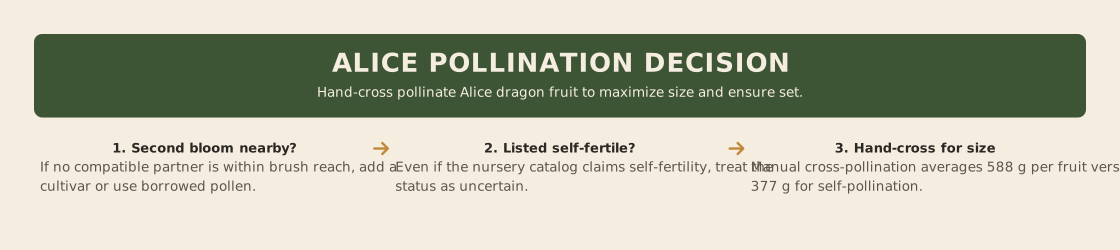
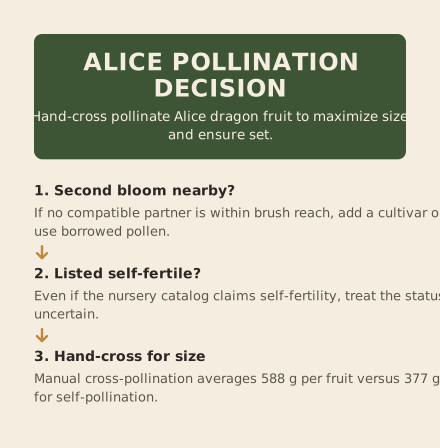
Grow Alice dragon fruit for its brilliant hot pink skin and juicy white flesh, but plan for hand-pollination to get reliable harvests. Named for California Rare Fruit Growers member Alice Snow, this white-fleshed Selenicereus undatus cultivar produces medium fruit weighing 0.5 to 1.0 lb. The taste is semisweet at about 13 Brix, making it a solid choice for smoothies or fresh eating, though the main caveat is pollination. Sources disagree on whether Alice is self-fertile or requires a pollen partner. Because dragon fruit flowers open only once overnight, relying on luck often leads to small or dropped fruit. A brush and a second blooming variety ensure you get the marketable size this plant is capable of producing.
You can find verified cuttings of Alice and other proven varieties in our dragon fruit cuttings shop.
Where Alice Came From
The name Alice honors Alice Snow, a member of the California Rare Fruit Growers association who helped bring this cultivar into circulation. You will see it listed in nursery catalogs under two variations: simply "Alice" or the more descriptive "Alice Snow-White." Both labels refer to the same plant, a white-fleshed selection that has gained traction among home growers for its reliable vigor and attractive fruit.
While the origin story is clear, the label itself is less stable than you might expect. Dragon fruit trade names are commercial markers, not fixed scientific identifiers. DNA analysis conducted during the University of California variety trials revealed that several distinct-sounding names actually represent the same genetic cultivar. For example, "Bien Hoa Red" and "American Beauty" were found to be identical clones, while other marketed varieties proved to be near-clones of one another. This synonymy is common in the crop.
Buy for the source, not just the name. Because cultivar labels can shift or overlap, the most reliable indicator of what you are growing is the nursery’s accountability. A cutting from a specialist who tracks their stock and stands behind their identification is worth more than a catchy name on an unverified tag.
This instability explains why you might encounter conflicting information about specific traits, such as pollination requirements. It is not necessarily a flaw in the plant, but a reflection of how dragon fruit genetics are managed in the trade. Peer-reviewed work confirms that cultivated dragon fruit includes both self-compatible and self-incompatible clones, with many exhibiting heterostyly, where the stigma and anthers are physically separated to encourage crossing. When you buy from a reputable source, you are buying a verified piece of that genetic puzzle, ensuring that the "Alice" you plant matches the description you read.
The Fruit: Looks, Flavor, Brix in Context
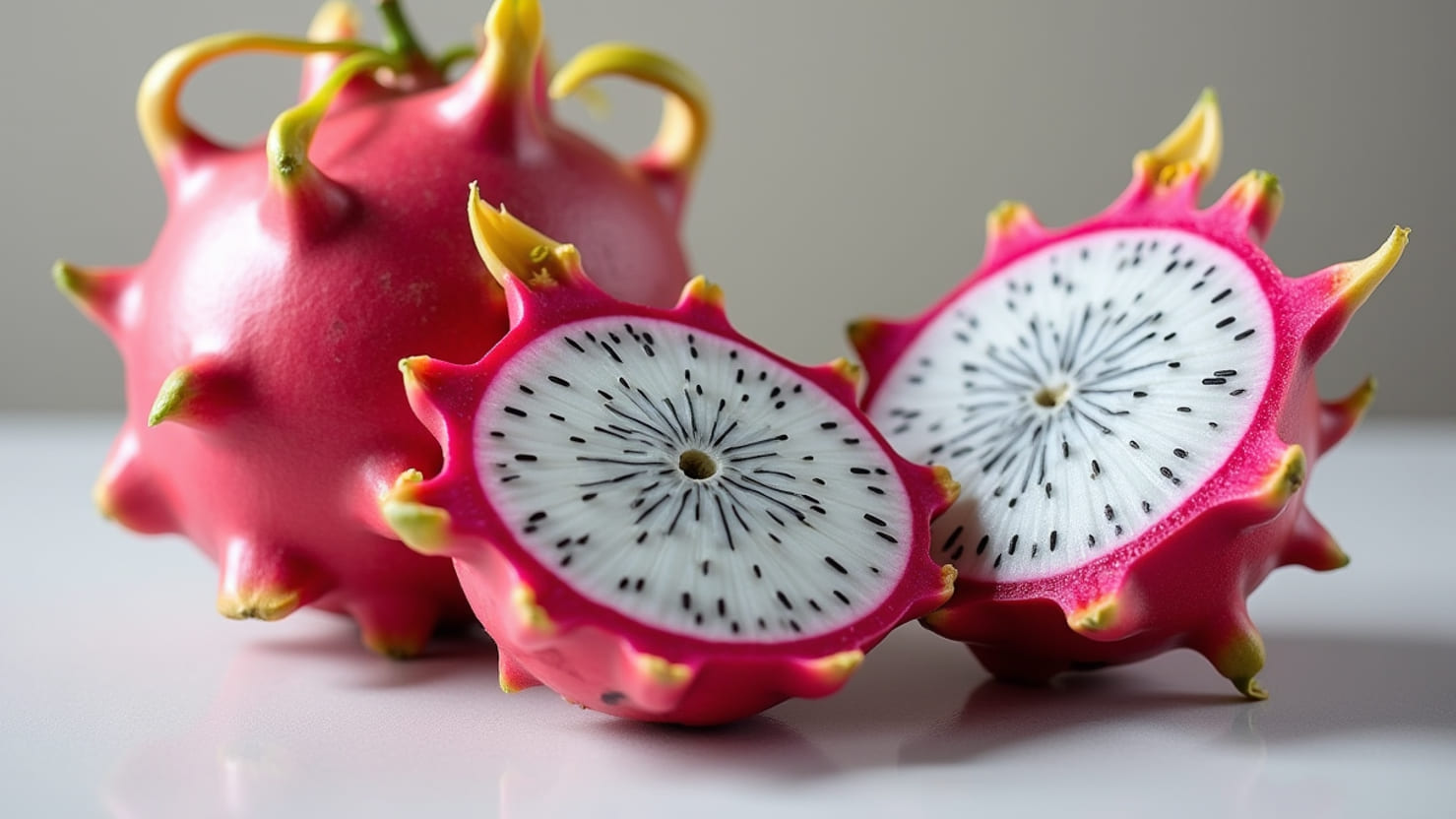
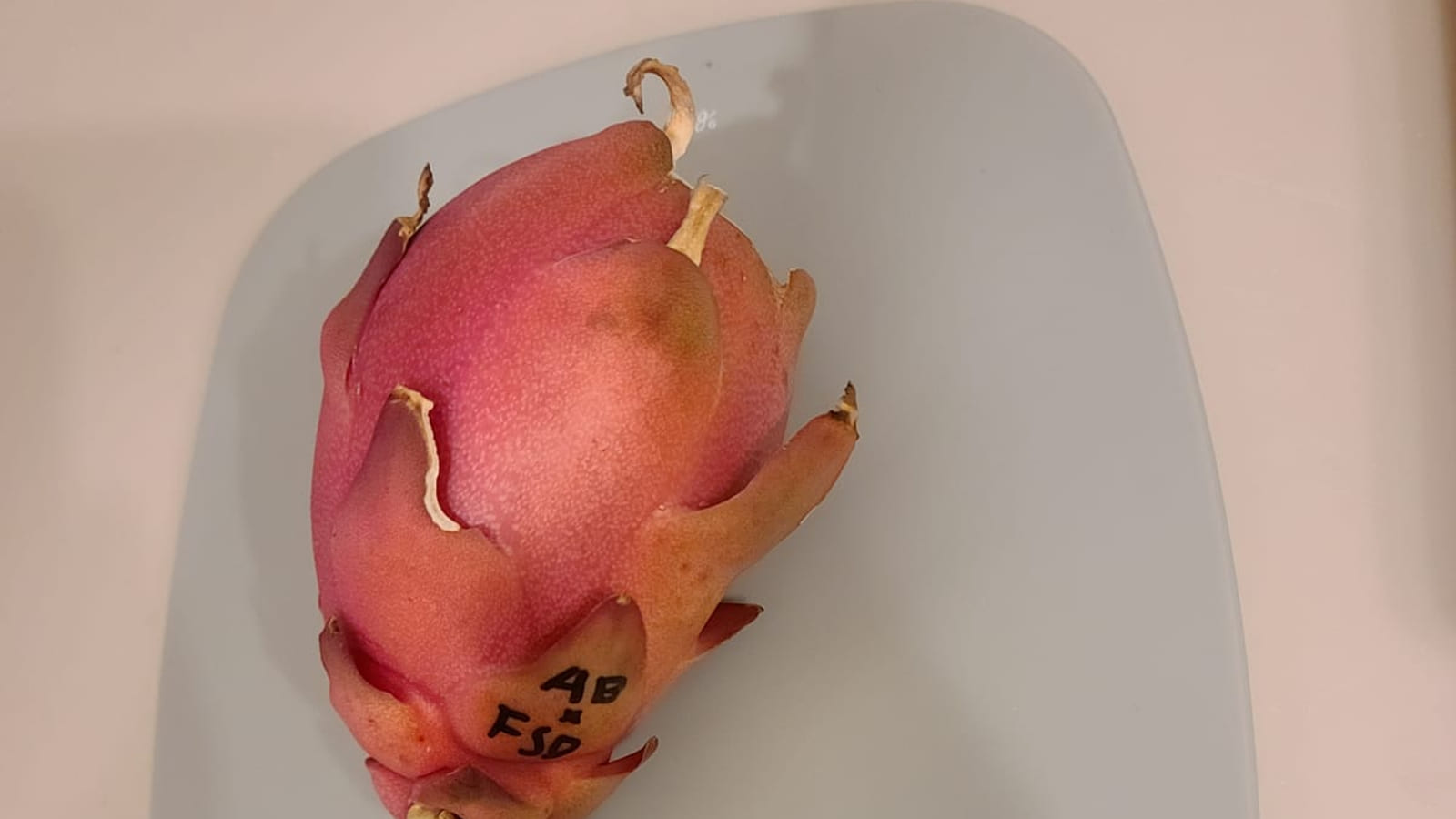
At full ripe, Alice presents a striking appearance that few dragon fruits can match. The skin is a brilliant hot pink, accented by green fins, and described by the introducing nursery as one of the most eye-catching of all varieties[6][8]. The skin itself is thin, measuring about 5 mm, which makes the fruit delicate but easy to slice open for immediate serving. Inside, the flesh is bright white, juicy, and sold primarily as a fresh dessert fruit or smoothie ingredient[6][7].
Growers often hesitate at the term "semisweet," but context makes the flavor profile clear. White-fleshed dragon fruit is naturally the most carbohydrate-dense of the commercial types, yet it lacks the heavy pigmentation and antioxidant load of red-fleshed varieties[2]. This means the flavor is cleaner and lighter, not deficient. Alice sits at roughly 13 Brix, placing it mid-scale for sweetness[6][7]. For perspective, the UC Cooperative Extension San Diego variety trial measured commercial pitaya cultivars between 11.9 and 21.2 Brix[5]. While Alice was not in that specific trial, its 13 Brix reading confirms it is a sweet fruit, just not as intense as the highest-scoring red or yellow selections.
Alice at a Glance
| Spec | Detail |
|---|---|
| Flesh Color | Bright White |
| Fruit Weight | 0.5 to 1.0 lb |
| Skin | Hot pink with green fins; ~5 mm thick |
| Sweetness | Semisweet / Mid-scale |
| Brix | ~13 (Context: UCSD trial range 11.9-21.2) |
| Use | Fresh dessert, smoothies |
Why white flesh tastes different: White-fleshed Selenicereus undatus is the most carbohydrate-dense species, but it carries fewer phenolics and red pigments than its red-fleshed cousins[2]. This results in a milder, less complex flavor profile. If you prefer the deep, berry-like notes of red dragon fruit, Alice will taste lighter. If you prefer a clean, refreshing sweetness that does not overpower other ingredients in a smoothie, Alice is an excellent choice.
Does Alice Need Another Variety to Set Fruit?
The trade disagrees on Alice’s pollination needs, and both sides are technically correct. Pine Island Nursery, which introduced the cultivar commercially, states it requires cross-pollination to set fruit [6][8]. Rare Dragon Fruit, an Australian specialist, lists it as self-fertile and recommends it for home growers [6][8]. This contradiction is normal for dragon fruit rather than a red flag. Cultivated stock includes both self-compatible and self-incompatible clones [1]. Most plants are heterostylous, meaning the stigma and anthers are physically separated to encourage crossing [1]. Your specific cutting may lean one way or the other, but the biology explains the conflicting advice.
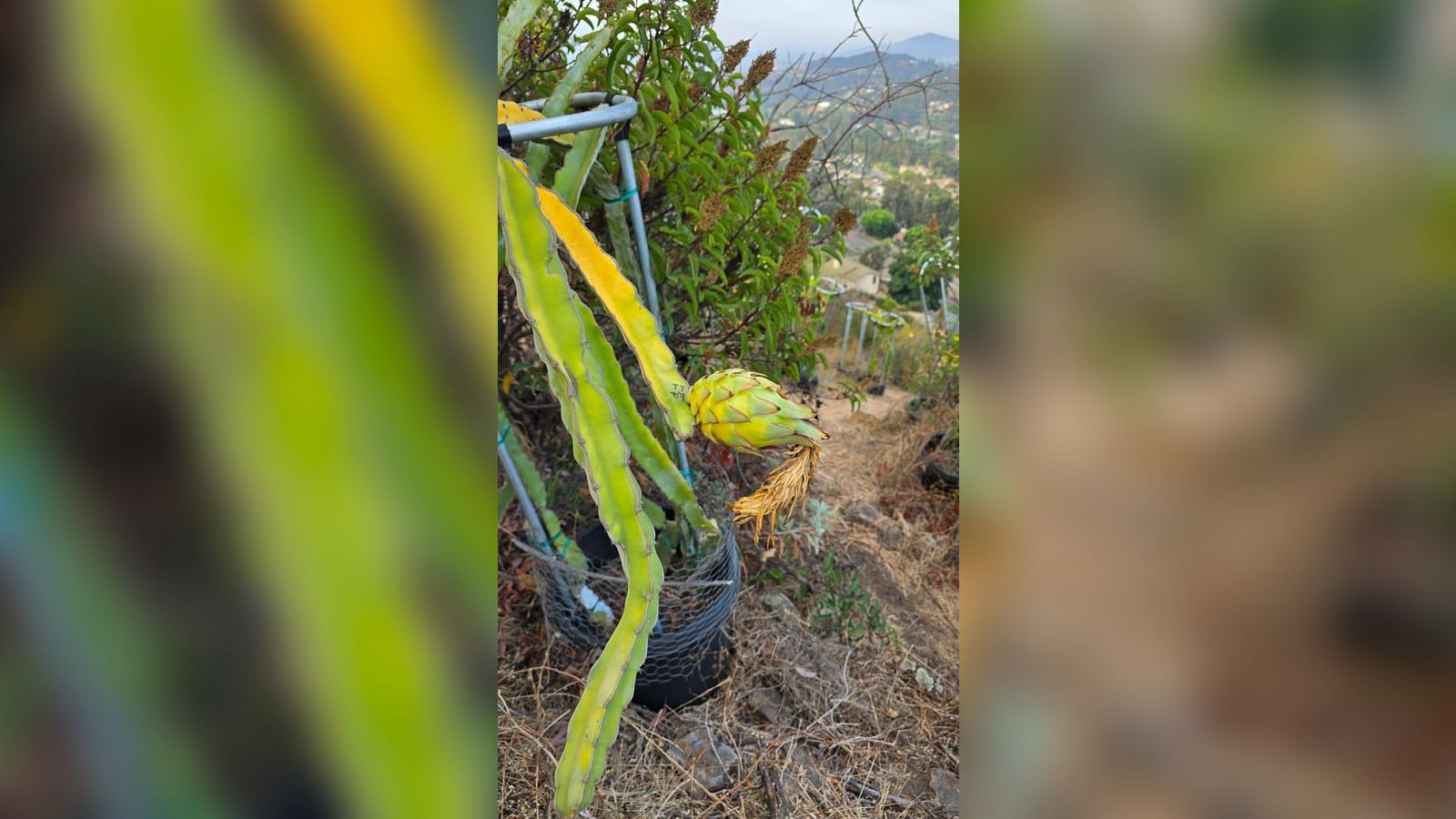
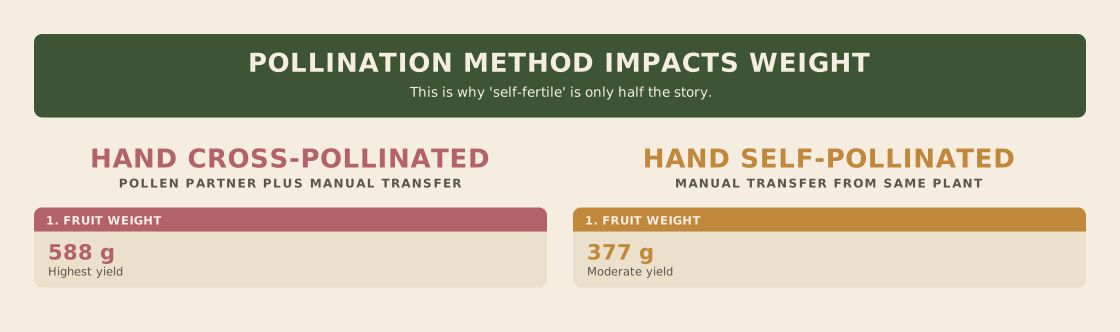
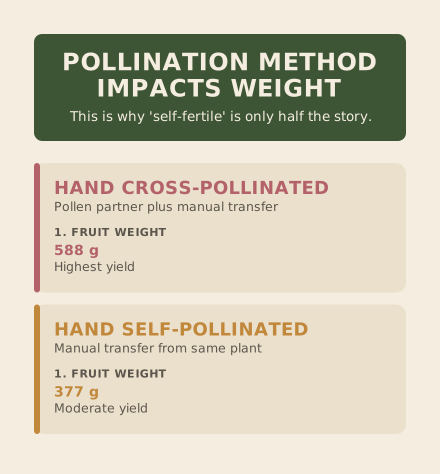
Even if your Alice is self-compatible, pollination method dictates fruit size. A two-year trial on white-fleshed stock showed manual cross-pollination averaged 588 g per fruit [6][7]. Manual self-pollination yielded 377 g [6][7]. Unassisted open pollination produced only about 200 to 208 g [6][7]. The difference between a marketable fruit and a dropped bud is often just the brush you use on bloom night. Dragon fruit flowers open once, overnight, and can reach 14 inches long [6][8]. They are powerfully fragrant and rely on bats and moths in the wild [6][8]. Rain on bloom night or a lack of nocturnal pollinators leads to poor set [6][8]. Hand-pollination removes this risk.
Because dragon fruit is non-climacteric, it does not ripen after harvest [6][7]. An Alice picked green stays mediocre forever [6][7]. You must leave the fruit on the vine to full ripe. If you rely on open pollination, you may get a small fruit that never reaches its potential sweetness. If you self-pollinate, you get a decent size but miss the yield boost. Cross-pollination delivers the heaviest fruit. For a deeper breakdown of how different cultivars behave, see our guide to self-fertile versus cross-pollinating dragon fruit varieties.
The practical rule is simple. Treat Alice as needing a partner that blooms the same night. Pair it with another variety from our stock to ensure you have pollen ready when the flowers open. This guarantees you hit the higher weight benchmarks and avoid the disappointment of small, unripe fruit.
Growing Alice in the Backyard
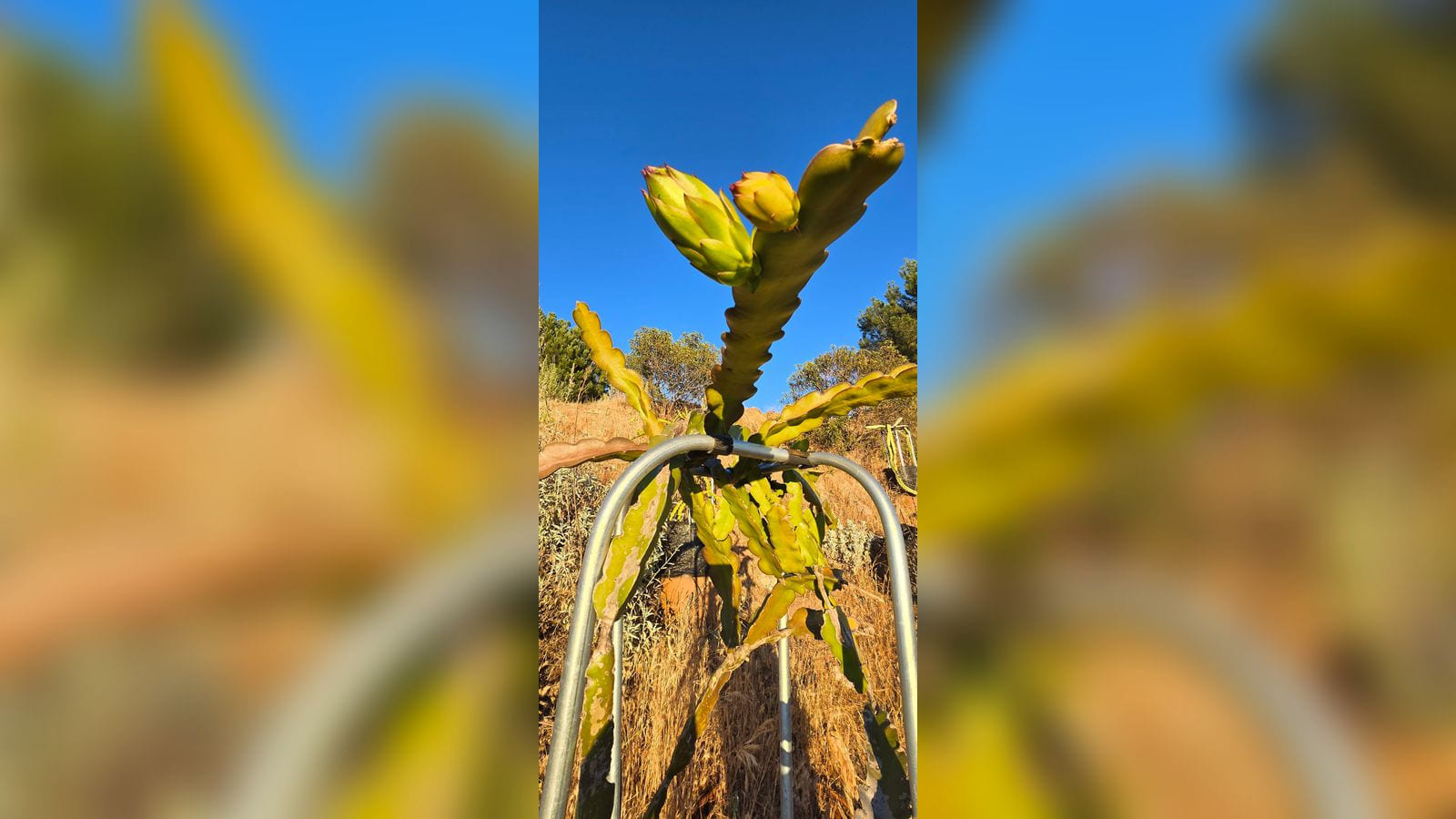
Alice is a climbing cactus, not a tree. Like all Selenicereus, it is a CAM plant with three-sided succulent stems that can reach 20 ft, clinging to supports with aerial roots and forming a shallow, dense root mat[4]. A commercial planting can stay productive for 20 to 30 years, so the structure you build now will support the plant for decades[4]. Because the stems are heavy and the root system is shallow, you must install a sturdy support before you plant. A flimsy post will topple once the canopy expands.
The variety grows at a medium rate and produces extra-large white night flowers[8]. Flower initiation is driven by long days and warmth, so natural flowering in the Northern Hemisphere runs roughly from April through November[1]. Be aware that heavy rain around bloom causes flower drop and fruit rot[1]. If you are in a wet climate, consider a temporary rain cover for the flowering period to protect your set.
Alice thrives in full sun and well-drained soil. It endures heat up to about 40 C and short spells of frost, but it will not survive sustained freezing[6][10]. This makes it ideal for USDA zones 10 and 11, which is coastal Southern California growing country where the variety was selected[6][10]. Growers in zone 9 can succeed with protection, such as frost cloth or a sheltered microclimate. Note that some cultivar databases list a sensitivity to rust disease, so ensure good air circulation around the stems to keep foliage dry[8].
| Factor | Requirement |
|---|---|
| Light | Full sun |
| Water | Deep but infrequent; well-drained soil |
| Soil | Well-drained, sandy or amended loam |
| Support | Heavy-duty trellis or post installed before planting |
| Climate | Zones 10-11; tolerates 40 C heat and short frost |
| Feed | Feed during active growth |
From Bloom to Harvest: Timing an Alice
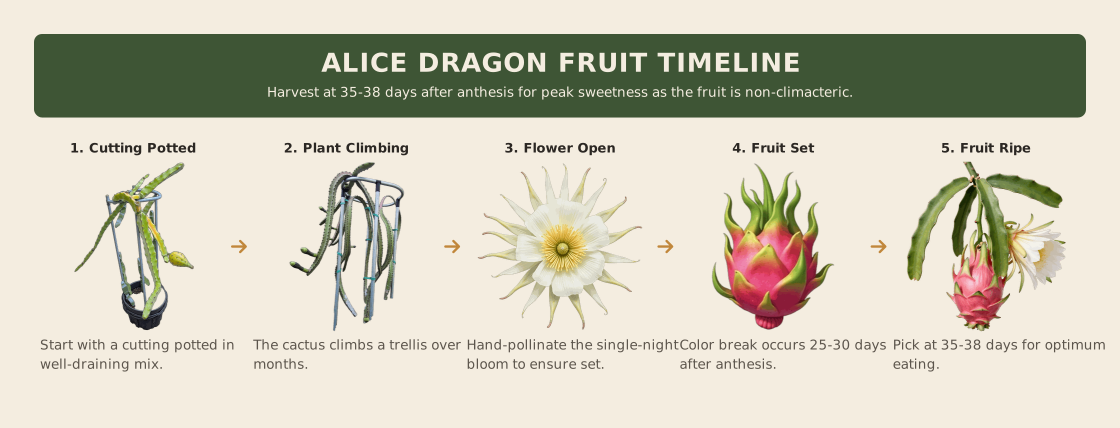
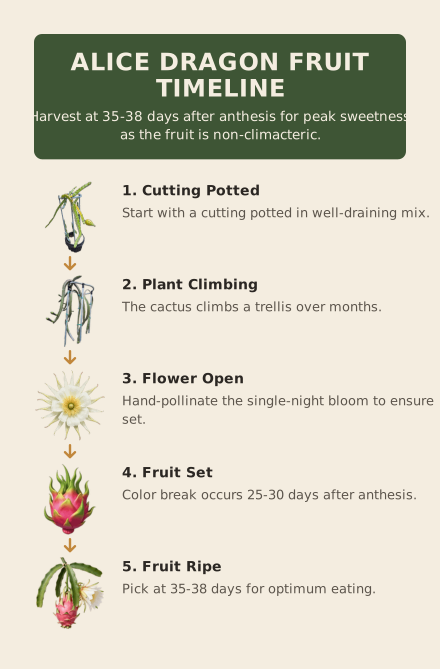
Dragon fruit is non-climacteric, so it does not ripen after harvest. An Alice picked too early will remain mediocre, lacking the sugar development and aromatic complexity that define a good eating experience. You must leave the fruit on the plant until it reaches full maturity. This requires patience and precise timing, as the window between perfect ripeness and spoilage is narrow.
The clock starts at anthesis, the moment the flower opens. While the exact duration from bud to bloom can vary, the post-pollination timeline is more consistent under stable conditions. At a mean temperature of about 28 C, pitaya fruit typically reaches color break 25 to 30 days after anthesis.[3] This visual shift from green to the brilliant hot pink characteristic of Alice is your first major signal, but it is not yet time to harvest.
Minimum harvest maturity occurs between 30 and 32 days after anthesis.[3] However, waiting for the optimum fresh-eating window yields better results. For Alice, this sweet spot falls between 35 and 38 days after anthesis.[3] During this period, the flesh develops its full semisweet profile and juicy texture. Harvesting before this window often results in fruit that is bland or watery, while waiting too long invites trouble.
Leaving fruit on the vine much beyond the optimal window causes splitting, a drop in soluble solids, and the development of off-odors.[3] The thin 5 mm skin of Alice makes it particularly susceptible to splitting if the plant receives a sudden influx of water or if the fruit over-matures. In Southern California trials, commercial pitaya cultivars were harvested between 37 and 48 days after flowering, providing a practical benchmark for growers in similar climates.[5] While Alice was not in that specific trial, its 13 Brix reading suggests it benefits from the upper end of that range to achieve its full flavor potential.
Watch for splitting. If you see cracks forming on the skin, harvest immediately. Splitting indicates the fruit is past its prime and will not improve in storage.
Is Alice Worth Growing?
Alice earns its place in your garden if you value visual impact and reliable, mild flavor over maximum sugar content. The fruit is undeniably striking, with brilliant hot pink skin and green fins that make it one of the most eye-catching varieties available [6]. Inside, the bright white flesh is juicy and clean-tasting. This is a sweet fruit, but it is not intense. White-fleshed dragon fruit is naturally carbohydrate-dense but lacks the heavy pigmentation and antioxidant load of red-fleshed types, resulting in a lighter profile [2]. If you are chasing the highest possible Brix, Alice will not satisfy you. If you want a dependable, attractive dessert fruit that looks as good as it tastes, it is a strong candidate.
The yield is honest and medium-sized. This is not a heavy cropper like some commercial red varieties, but it is consistent. The real decision point is pollination. Alice’s requirement is disputed in the trade: the introducing nursery states it needs cross-pollination, while other specialists list it as self-fertile [6]. This ambiguity is common in dragon fruit genetics, where clones vary in compatibility . However, the data is clear on one point: pollination method changes fruit size. In trials of white-fleshed stock, manual cross-pollination produced significantly larger fruit than open pollination [1]. If you will not manage pollination, skip Alice. If you are willing to brush flowers on bloom night, you will get marketable fruit.
How Alice Stacks Up Against Our Sweetest Picks
| Variety | Best For | Sweetness Profile |
|---|---|---|
| Alice | Visual appeal, mild fresh eating | Mild (approx. 13 Brix) |
| Red-fleshed varieties | High yield, robust growth | Moderate to High |
| American Beauty | Red flesh, antioxidant load | High |
| Yellow varieties | Intense flavor, commercial quality | Very High |
Sweetness varies by harvest timing and climate. Red-fleshed varieties like American Beauty and yellow types typically score higher on Brix meters than white-fleshed types like Alice.
Grower’s Verdict: Grow Alice if you want a beautiful, manageable plant for fresh eating and you are willing to hand-pollinate. Choose a red-fleshed variety like American Beauty if your primary goal is maximum sugar content and you do not mind a less vibrant exterior.
For growers who want to ensure reliable set, consider pairing Alice with a red-fleshed variety. This ensures you have a pollen partner for Alice’s flowers while also giving you access to the higher Brix levels found in red-fleshed stock. Red varieties carry markedly more vitamin C and phenolics, offering a more complex flavor profile [2]. If you are starting from scratch, stocking a mix of Alice and a high-sweetness red variety gives you both visual appeal and intense flavor.
Alice Dragon Fruit FAQ
Growers often ask if Alice is self-fertile. The answer depends on who you ask, because the trade is split. Pine Island Nursery, which introduced Alice commercially, states that the plant requires cross-pollination to set fruit[6]. Conversely, the Australian specialist nursery Rare Dragon Fruit lists Alice as self-fertile and recommends it for home growers[8]. This dispute is common in dragon fruit cultivation, where peer-reviewed work confirms that cultivated clones can be either self-compatible or self-incompatible[1]. Most plants are also heterostylous, meaning the stigma and anthers are physically separated to encourage crossing[1]. Even if your specific cutting is self-compatible, pollination method dictates yield size. A pollen partner plus hand-pollination on bloom night is the only way to consistently turn set into marketable fruit[1].
Regarding sweetness, Alice sits in the mid-scale band. This places it below the highest-scoring red and yellow selections, which can reach 18-21 Brix, but it is a sweet fruit[9][5]. The flavor is semisweet and very juicy, making it ideal for fresh eating or smoothies rather than intense dessert applications[6][7][8]. Because dragon fruit is non-climacteric, it does not ripen after harvest, so you must leave the fruit on the vine until it reaches full color break[3]. Timed from flowering at a mean temperature of about 28 C, pitaya reaches color break 25-30 days after anthesis[3]. The minimum harvest maturity is 30-32 days after anthesis, but the optimum for fresh eating is 35-38 days[3]. Leaving fruit much longer causes splitting, a drop in soluble solids, and off-odors[3]. In Southern California trials, commercial cultivars were harvested 37-48 days after flowering, providing a realistic window for your local conditions[5].
Can you grow Alice in a pot in zone 9? Yes, but with caveats. Alice is a climbing cactus with 3-sided succulent stems that can reach up to 20 ft, so it needs a heavy support structure even in a container[4]. The plant thrives outdoors in USDA zones 10-11, but it is survivable in zone 9 with protection[10][6]. It endures heat to about 40 C and short spells of frost, but not sustained freezing[10]. Since flower initiation is driven by long days and warmth, natural flowering in the Northern Hemisphere runs roughly April through November[1]. Heavy rain around bloom causes flower drop and fruit rot, so a covered pot location can help protect the blooms[1]. The flowers open once overnight, are up to 14 in long, and are powerfully fragrant[4]. In the wild, bats and moths pollinate them, but declines in nocturnal pollinators are a documented cause of poor fruit set[4]. This is why growers hand-pollinate with a brush in the evening[4].
What pairs as a pollen parent? Since Alice is a white-fleshed Selenicereus undatus, any other blooming Selenicereus undatus variety is a compatible partner[1]. The key is overlapping bloom times. Because the flowers open only once overnight, you need a second variety that blooms on the same night to ensure pollen availability[1]. While specific cultivar pairings are not listed in the provided data, the general rule for this species is that cross-pollination between different clones of the same species maximizes fruit size and set reliability. If you cannot find a second blooming variety, you can attempt manual self-pollination, but expect smaller fruit compared to cross-pollinated yields[1].

Key Takeaways
- Buy from a specialist who tracks stock, as trade names are commercial markers rather than fixed scientific identifiers, and DNA analysis has proven that distinct-sounding names can represent identical clones.
- Expect medium fruit weighing 0.5 to 1.0 lb with brilliant hot pink skin and white flesh, but accept that the flavor is semisweet at roughly 13 Brix rather than intensely sugary.[6]
- Plan for hand-pollination on bloom night using a brush and a second blooming variety, because relying on luck often leads to small or dropped fruit despite conflicting reports on self-fertility.[1]
- Harvest only when the fruit reaches full ripe color, as dragon fruit is non-climacteric and will not sweeten further after being picked green.[3]
- Monitor for rust disease sensitivity and provide heavy support for the climbing stems, which can reach 20 ft and remain productive for decades in suitable zones.[4]
Next Step: If you are ready to set fruit, review our guide on hand-pollination techniques to maximize your harvest size.
References
- Floral and pollination biology of dragon fruit reveals strategies for enhancing productivity through pollination management and reproductive window extension, Scientific Reports (Nature Portfolio) (2025).
- Comparative analysis of nutrient composition and antioxidant activity in three dragon fruit cultivars, PeerJ (PMC) (2024).
- Pitaya Fruit Maturity Index Implementation, National Taiwan University / APEC-FLOWS Postharvest Toolkit (Dr. Chun-Ta Wu) (2014).
- Strawberry Pear (Fruits of Warm Climates, pp. 347-348), Purdue University NewCrops (Julia F. Morton) (1987).
- Pitahaya or Dragon Fruit Production in California: A Research Update (variety trial results, San Marcos CA), UC Cooperative Extension San Diego County / UC Small Farm Program (Lobo, Bender, Tanizaki) (2013).
- Alice - Dragon Fruit variety listing, Pine Island Nursery (2026).
- Alice Snow-White - Dragon Fruit Plant, Dragons Alley Nursery (2026).
- Alice - dragon fruit variety dossier, Pomology variety database (2026).
- Overall Dragon Fruit Production and Global Marketing, Food and Fertilizer Technology Center (Univ. of Hawaii CTAHR authors) (2019).
- Pitaya (dragon fruit): cultivation, hardiness and pests overview, Wikipedia (2026).