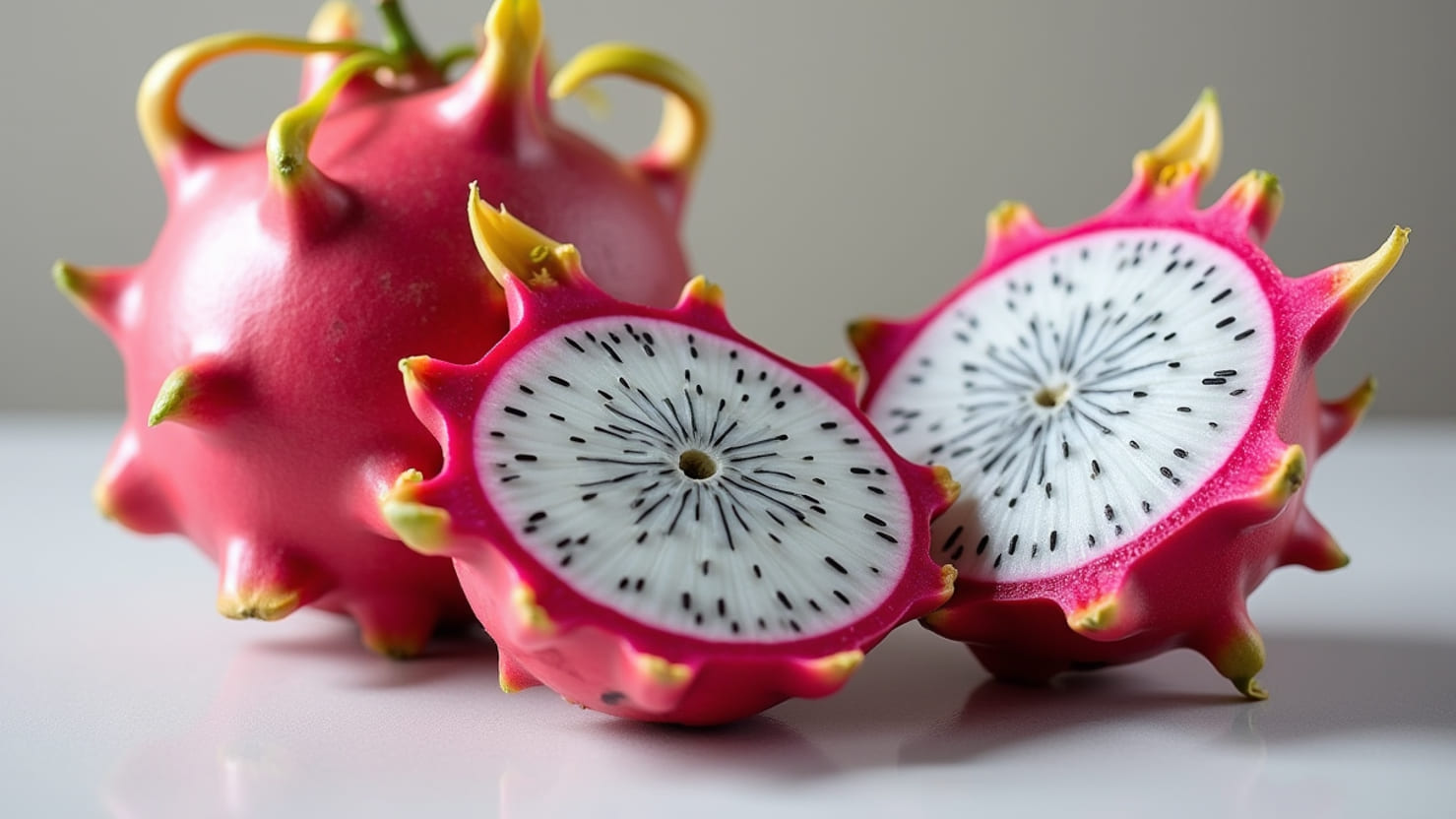
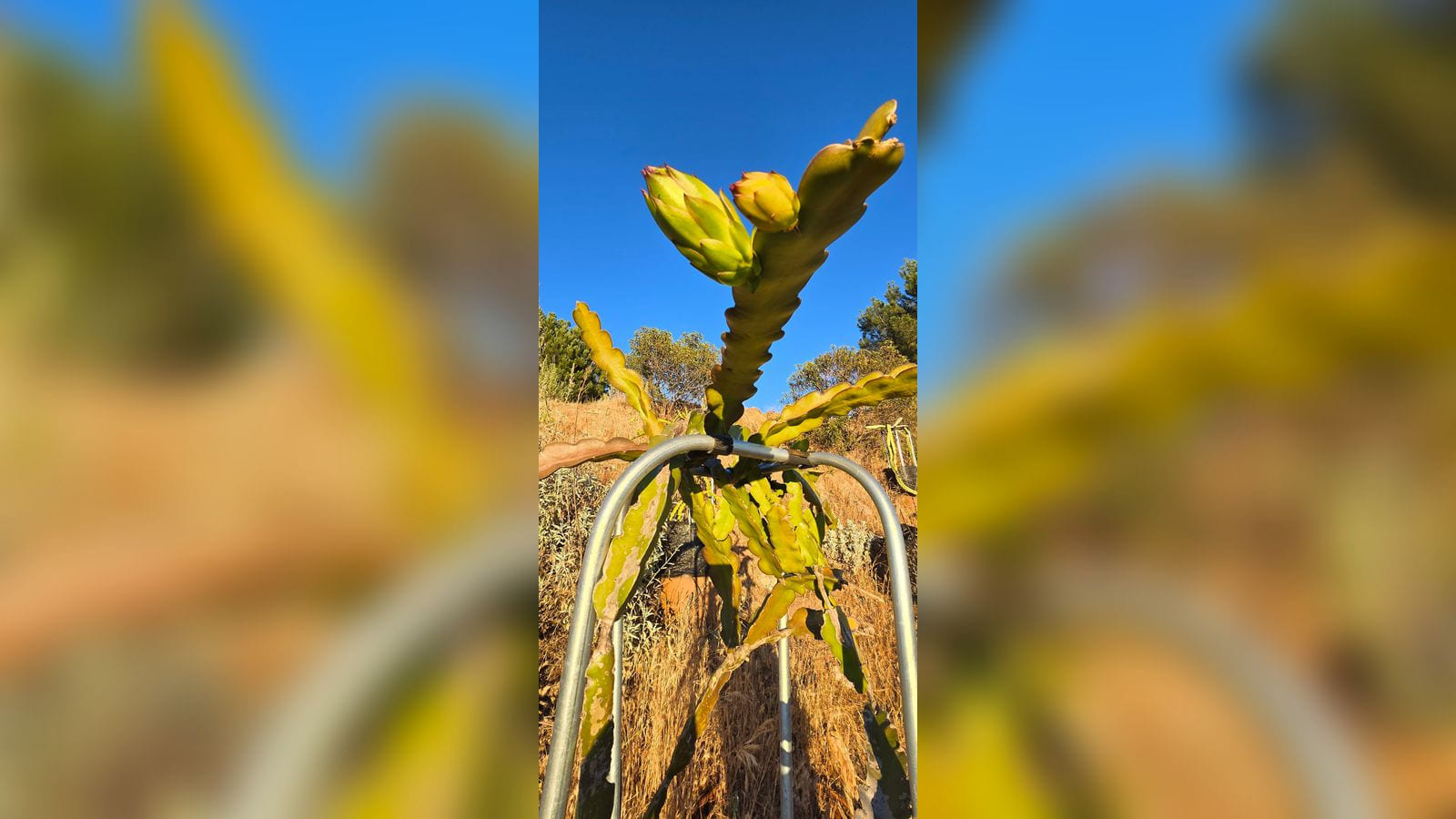
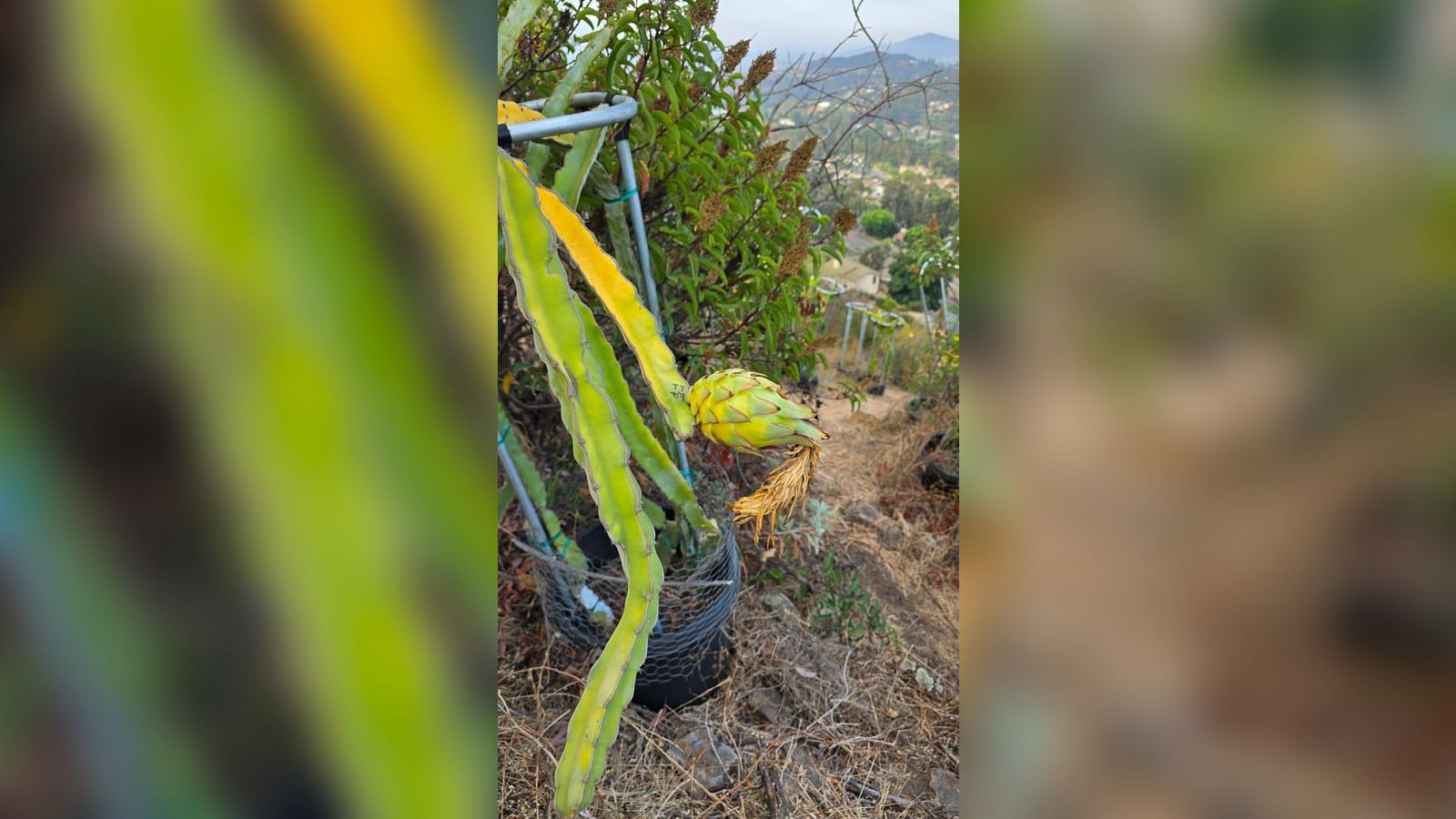
5 Star Dragon Fruit: Real Name or Marketing Myth?
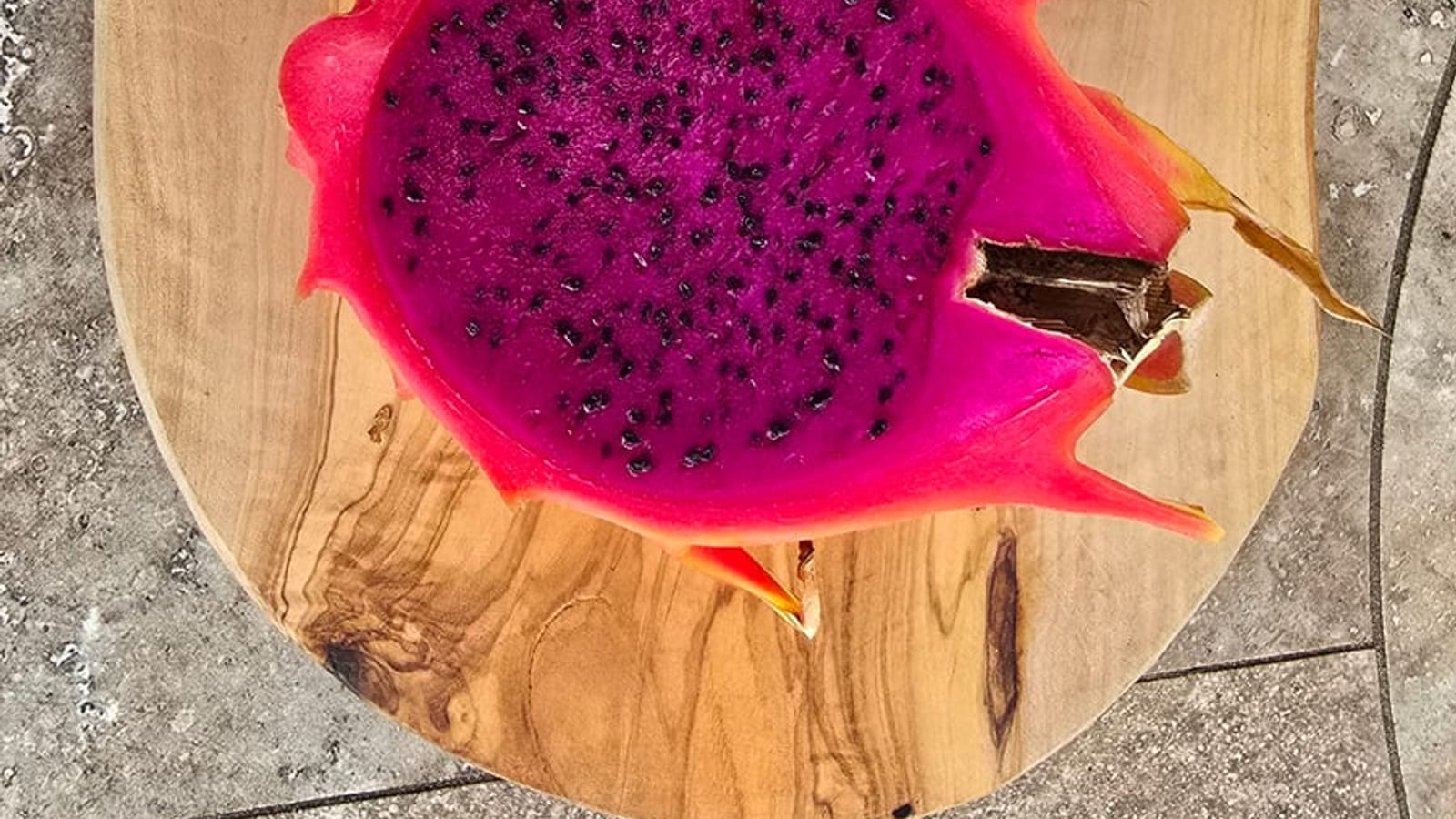
There is no registered dragon fruit cultivar called "5 Star." You are likely seeing a retailer’s five-star flavor rating, a consumer review score, or a confusion with similar names like Asunta 5 Starburst or Dark Star. Dragon fruit labels in the nursery trade are often informal marketing terms rather than botanical identifiers. Because pitaya was domesticated recently, many plants sold under catchy names lack formal registration, meaning a label alone cannot guarantee specific flavor, size, or pollination traits. When you buy a cutting, you are buying a clone of the parent plant, so the genetic source matters more than the sticker. If you are looking for high-rated red-fleshed varieties that actually exist in cultivation records, we stock proven performers like American Beauty and Asunta 5 Starburst. These plants have verified traits, such as specific Brix levels and cross-pollination needs, that informal star ratings cannot provide. Check our red-fleshed dragon fruit collection for plants with real data.
Why a name like 5 Star can exist on a label but not in a catalog
The International Code of Nomenclature for Cultivated Plants sets strict rules for what counts as a valid cultivar name. To be registered, a name must be original, formed in modern language, and written in lower-case letters. It cannot consist solely of a number or code unless that specific designation was already in use before January 1, 1998. A label reading "5 Star" fails these tests on multiple fronts. It is composed of a digit and a word, which the Code explicitly discourages for new registrations, and it is liable to cause confusion because it reads like a rating rather than a botanical identifier. The Code governs cultivar names, not trade designations, which is why a catchy marketing term can sit comfortably on a nursery tag without ever appearing in an official registry.[1]
This disconnect between retail labels and botanical records is not new. Consider the cultivar 'Cactus', selected at the National Cactus and Succulent Show in Brighton, England, in 1976. Its name records the location of its discovery rather than any characteristic of the plant itself. It remains a valid cultivar name only because it was established before the 1959 rule change that required names to originate with the plant. This episode is cited in the Code’s commentary as the exact reason for the origin-recording rule. It provides a clean precedent for treating a retail label like "5 Star" as provenance or marketing rather than as botany.[1]
The volume of new names exacerbates this confusion. The 2006 edition of the Code, which is the current standard, notes that since the 1995 edition, three cultivars have been registered for every one registered in the preceding 95 years. This explosion in registrations is why name collisions and rebrands are now chronic in young hobby crops like dragon fruit. When you see a name that does not fit the Code’s strictures, you are likely looking at a survivor of this chaotic naming environment, where informal labels persist because the Code does not police them.[1]
Growers often use star language to describe quality, but they attach it to measured data, not just vibes. For example, the open fruit of the cultivar 'Rixford' is described in grower writing as having medium to large magenta pulp, sweet flavor, and 18 Brix on a refractometer, with the note "all around 5 stars." Here, the five-star language is attached to a specific, measured refractometer reading on a named California hybrid. It is a grower’s assessment of performance, not a catalog entry. This distinction matters because it highlights that "5 Star" is a judgment of quality, often based on a single season’s data, rather than a fixed genetic identifier.
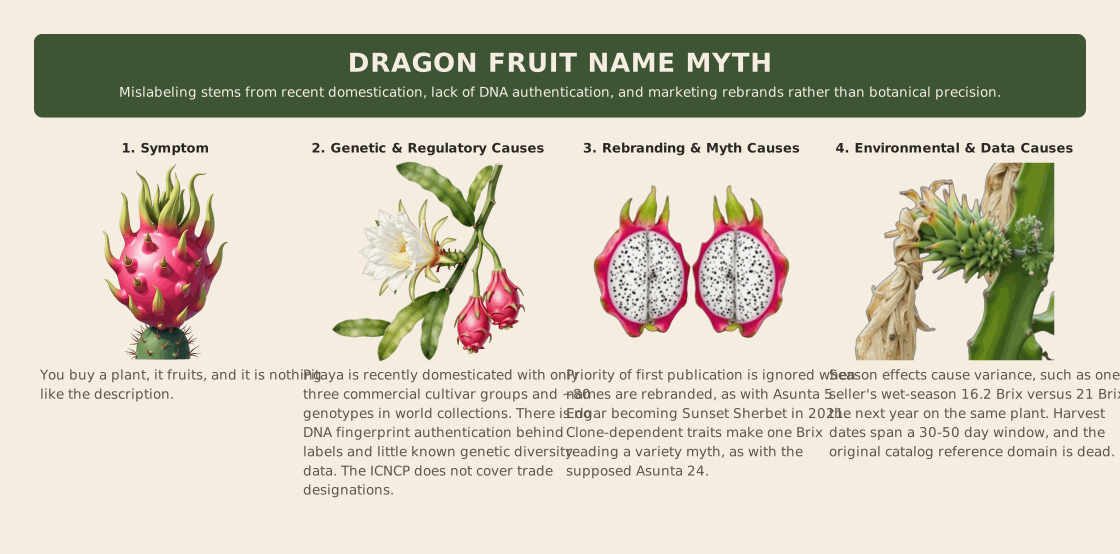
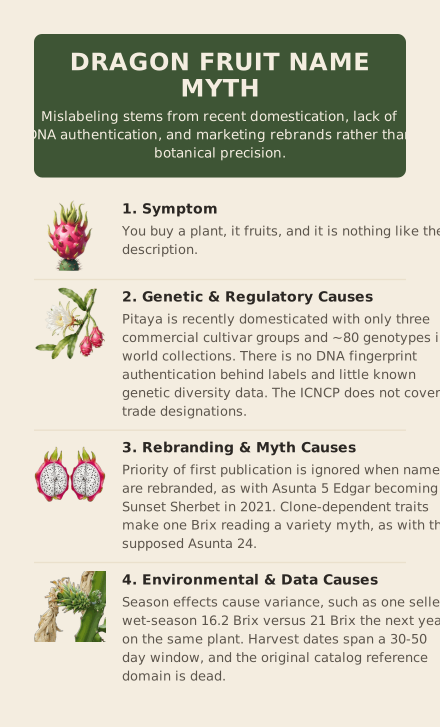
What people usually mean by 5 Star
When you see "5 Star" on a dragon fruit listing, you are almost always looking at a consumer review score or a retailer’s flavor rating, not a botanical name. In UK and Australian supermarkets, for instance, Vietnamese dragon fruit sold under the Red Dragon brand has received five-star consumer ratings, and frozen varieties on major online grocery pages have shown perfect five-star scores across all reviews.[15] A search engine scraping these retail sites will return those star ratings as the primary result, creating the illusion that "5 Star" is a specific variety.
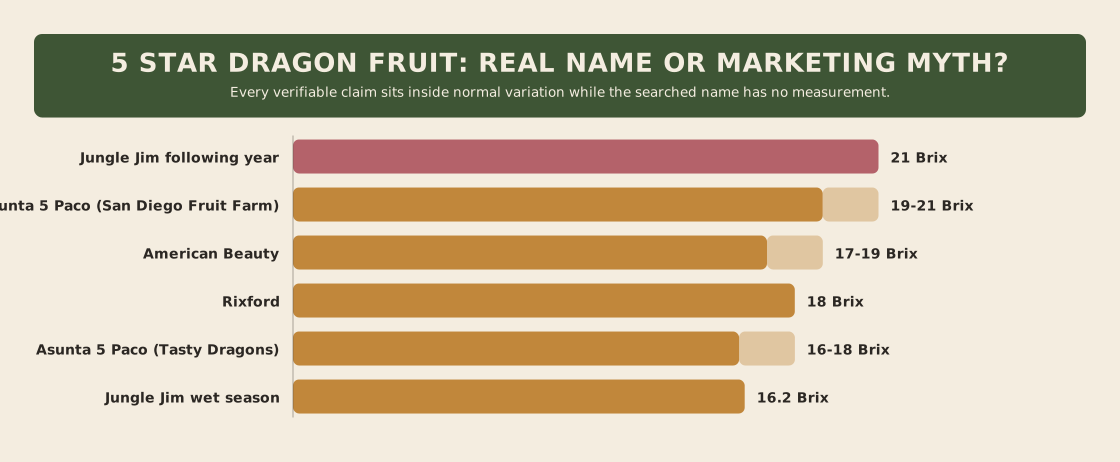
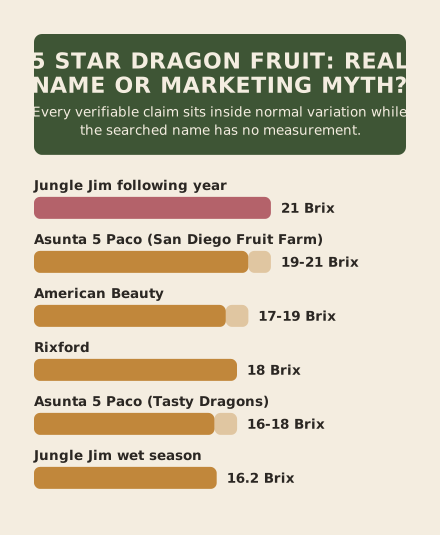
Nursery catalogs often use similar language to describe quality without implying registration. Rare Dragon Fruit in Australia, for example, confidently rates a cultivar called Jungle Jim as a "5-star variety" for flavor, texture, and visual appeal.[10] The seller provides measured data to back this up, noting Brix levels rising from 16.2% in a wet season to 21% in a drier year, but the "5 star" label remains an opinion on performance rather than a genetic identifier.[10] Similarly, grower notes on the cultivar 'Rixford' describe the fruit as "all around 5 stars" alongside a specific refractometer reading of 18 Brix.[11] In both cases, the stars are a judgment of taste, not a name.
Some retailers use star systems as part of a broader rating scale. Pine Island Nursery in Florida, which lists 52 named varieties, uses a five-level scale ranging from poor to excellent.[8] They describe Makisupa as an "excellent" magenta-fleshed fruit, but they do not use "5 Star" as a standalone name.[8] When a nursery does not use a formal rating system, the term "5 Star" often appears in user-generated reviews or forum posts where growers share their subjective experience with a plant they bought under a different name.
Confusion also arises from name collisions with real cultivars that contain the number five. The Dragon Fruit Directory lists "Asunta 5 Starburst" and "Asunta 5 Fire," both of which are actual, tracked plants.[7] A search for "5 Star" will inevitably surface these entries, leading buyers to assume the two are related. Asunta 5 Starburst is recorded as having red flesh and requiring cross-pollination, with data tracked by a small number of growers.[7] It is a real plant, but it is not "5 Star."
The most reliable way to distinguish a rating from a variety is to look for the data that accompanies a true cultivar. American Beauty, for example, is tracked by 18 growers across 20 plants, with logged bud counts and harvest averages.[7] The directory records its magenta flesh, 17-19 Brix, and self-fertile status.[7] This level of detail, including specific days to flower and fruit ripening times, is what defines a cultivar in the trade. A "5 Star" label rarely comes with this kind of provenance.
If you are shopping for a high-quality red-fleshed plant, ignore the star rating and look for the name. If the seller cannot provide a registered cultivar name or a link to a directory entry with grower data, you are likely buying a clone of an unnamed selection or a mislabeled cutting. The stars on the box are marketing; the name on the tag is botany.
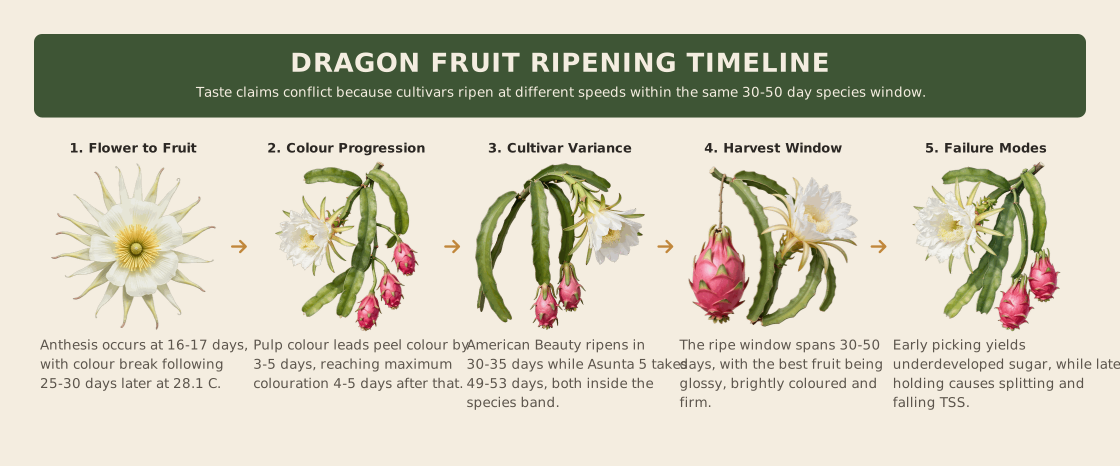
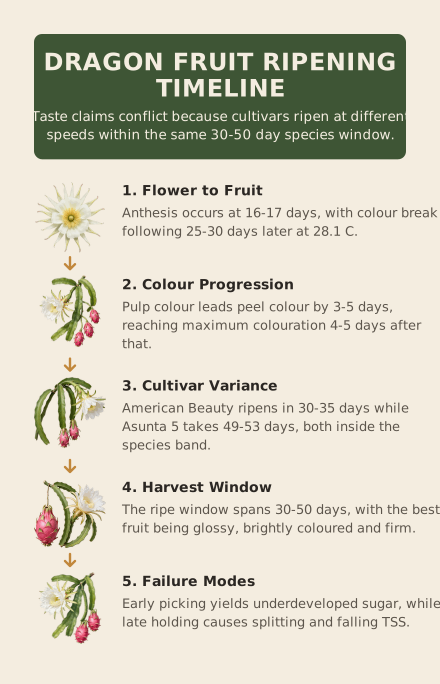
Reading a flavour claim like a scientist
When a nursery or retailer claims a dragon fruit is "5 Star" or "excellent," they are usually offering a subjective rating, not a botanical guarantee. To evaluate these claims practically, you need to understand how fruit chemistry and handling actually work. A label cannot control what happens to the plant after it leaves the pot, nor can it account for the biological variability inherent in pitaya.
Pigment variability and the limits of Brix data
Red and magenta flesh colors come from betacyanins, but these pigments are not static. In red-fleshed pitaya, betacyanin concentration shifts significantly depending on the developmental stage of the fruit and even within different parts of the same fruit, such as the pericarp versus the pulp or seeds.[3] This means a cutting sold as a "deep red" variety may produce fruit with varying color intensity and antioxidant load from one harvest to the next.
Similarly, published Brix (sugar content) figures should be treated as snapshots, not constants. A claim of "18 Brix" reflects one season, on one rootstock, in one specific climate.[13] If your local weather, soil, or pollination conditions differ, your fruit will differ. There is no genetic switch that locks in a specific sugar level regardless of environment. When you see a high-star rating based on flavor, remember that flavor is a complex interaction of sugars, acids, and aromatics that fluctuates with the plant's health and the fruit's maturity.
Post-harvest handling affects the final taste
Even if you grow a genetically superior plant, poor handling can ruin the fruit before you ever taste it. Dragon fruit is susceptible to chilling injury, which manifests as flesh translucency, wilting, softening, browning of the outer flesh, darkening of the scales, and notably, poor flavor.[6] A "5 Star" fruit that has been stored too cold or for too long will taste flat or off, regardless of its genetic potential.
To preserve quality, harvest in the cool of the morning and precool the fruit within 48 hours. Store it above 7°C. If you pack fruit in single layers with the stylar end up in ventilated corrugated fibreboard, untreated fruit can keep for 15 days at 7-9°C, or 30-40 days at 5°C.[6] This data comes from the APEC-FLows maturity toolkit, which emphasizes that storage conditions are as critical to the eating experience as the variety itself.
Practical takeaway: Treat "5 Star" as a marketing opinion, not a scientific measurement. Judge the plant by its growth habit and the actual fruit it produces in your garden. Measure your own Brix with a refractometer if you want data, and handle your harvest with care to ensure the flavor you grew is the flavor you taste.
The one label claim you can test in your own garden
You cannot verify a marketing name, but you can verify a physical trait. The most reliable test for any red or magenta cutting is the pollination requirement. This is a binary outcome: the fruit sets, or it does not. It does not rely on taste, weather, or the seller’s honesty.
Published research on dragon fruit clones shows that self-fertility is a property of the specific genetic line, not the flesh color[4]. In a two-year field study, a red-fleshed clone was strictly self-incompatible and required pollen from another genotype to set fruit at all, while a white-fleshed clone was self-compatible[4]. This means you cannot assume a red variety will pollinate itself just because it is red.
If you buy a cutting labeled "5 Star" or any other informal name, you are buying a mystery regarding its pollination needs. The International Code of Nomenclature for Cultivated Plants does not police trade names, so a label can claim anything without legal consequence[1]. However, the plant’s biology will not lie. If your plant flowers and the fruit drops before ripening, you likely have a self-incompatible clone that needs a compatible pollinator.
To test this, you need two different genetic types. The standard advice from extension services is to plant two or three different varieties and cross-pollinate them to ensure fruit set[5]. If you only have one plant, you can hand-pollinate its flowers with pollen from a different plant. If the fruit sets and ripens, you have a compatible pair. If it fails, you have a self-incompatible plant that needs a different partner, or you have a self-compatible plant that failed for another reason.
Practical tip: Keep a log of which flowers you hand-pollinate and with what pollen source. If a "5 Star" cutting sets fruit only when crossed with a known self-fertile variety like American Beauty, you have confirmed it is self-incompatible. This data is more valuable than any flavor rating on the tag.
This test works because pitaya is a recently domesticated crop with limited genetic diversity data[2]. There is no commercial DNA database to verify a label, so the only proof is what the plant does in your garden[2]. A cutting is a clone, so its behavior is fixed. If it fails to set fruit without cross-pollination, it will always fail, regardless of what the label says[14].
Don’t wait for the first harvest to judge the plant. Watch the flowers. If they open and close without setting fruit, and you have not cross-pollinated, you have your answer. This simple observation saves you from waiting years for a plant that cannot produce fruit alone.
Growing an unnamed red or magenta selection
You are buying a clone, not a label. If the cutting produces red or magenta flesh, you are growing a member of the Hylocereus polyrhizus group or a close relative. The pigment itself is the primary identifier. Red-fleshed pulp contains betacyanins, which white-fleshed varieties lack entirely. This pigment is why red-fleshed cuttings command higher prices, but it does not tell you the sugar content or the pollination needs. Those traits are locked in the specific genetics of the plant you received, not in the color of the pulp.
Why color is not enough. Betacyanin levels vary between developmental stages and across different parts of a single fruit. A red cutting does not guarantee the same antioxidant load or deep color in every harvest. Published data on specific cultivars often reflects one season on one rootstock in one climate. Your plant’s performance will depend on your local conditions.
Self-fertility is a property of the clone, not of the flesh color. Some red-fleshed plants are self-compatible; others are strictly self-incompatible and will drop flowers without pollen from a different genotype. A two-year field study found that while one red-fleshed clone required cross-pollination to set fruit at all, another white-fleshed clone was self-compatible but still produced heavier fruit when hand-pollinated. You cannot assume your unnamed red selection will set fruit on its own. If you want reliable harvests, plant two or three genetically different types and cross-pollinate them manually. This is the standard advice from extension services for any dragon fruit, regardless of what the tag says.
When you plant your cutting, skip the gravel. This common practice raises the perched water table, keeping the mix directly above the stones wetter than it should be. Instead, fill the pot with one free-draining mix all the way down and ensure the pot has a drainage hole. This simple change prevents root rot, which is the most common cause of failure in container-grown dragon fruit.
| Trait | Red/Magenta Flesh | White Flesh |
|---|---|---|
| Pigment | Betacyanins present | No betacyanins |
| Sugar (per 100g) | ~5.60 g total sugar | ~6.06 g total sugar |
| Fiber (per 100g) | 1.01 g | 0.83 g |
| Vitamin C (per 100g) | 3.40 mg | 5.64 mg |
The nutritional data above is from published analyses of H. polyrhizus and H. undatus. It shows that red-fleshed fruit is not automatically sweeter or more nutritious in every metric. White-fleshed varieties can have higher sugar and vitamin C levels. The value of a red selection lies in its pigment and flavor profile, which are subjective and variable. Do not expect a specific Brix level or flavor note just because the pulp is red. Measure your own fruit with a refractometer if you want to know what you are growing.
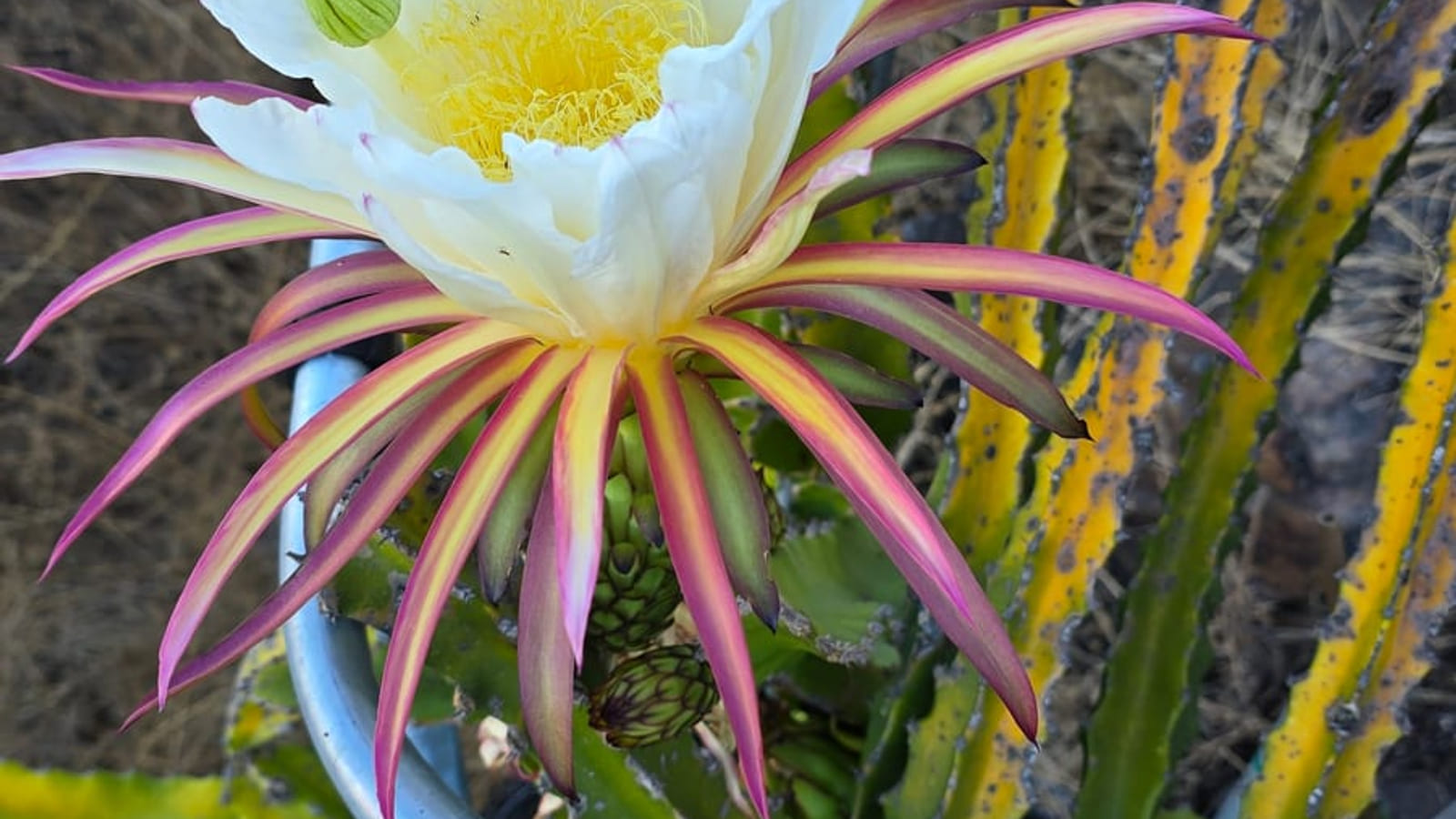
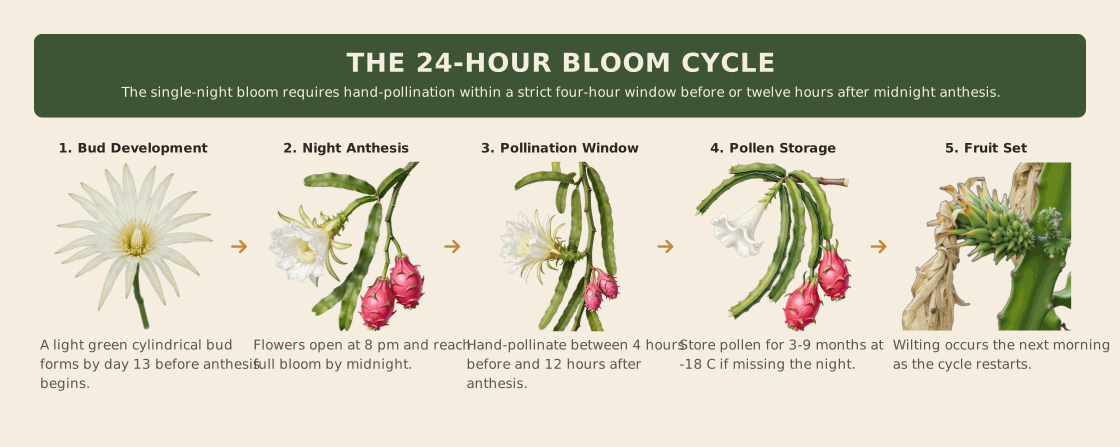
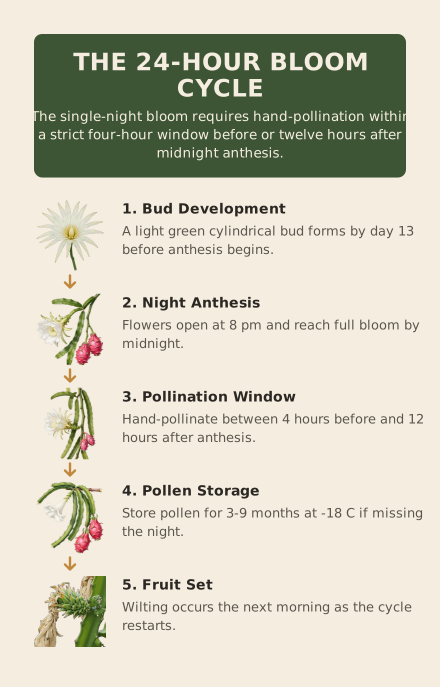
Flowering and fruit set are influenced by environmental cues, not just genetics. Flowers open at night, often around 8:00 pm in summer. Pollination is most effective in the early evening or morning. If you are growing an unnamed selection, you may need to experiment with hand-pollination timing. Observe when your flowers open and when they close. If fruit set is poor, try pollinating at different times. Microclimate manipulation, such as fogging or sprinklers, can extend the reproductive window and improve set, especially if you are in a dry climate.
Remember that dragon fruit is non-climacteric. It does not ripen after harvest. You must pick it at full ripeness. Early harvest gives underdeveloped flavor; late harvest causes splitting and off-odors. For an unnamed selection, you will need to learn its ripeness signs by observation. Look for color changes in the peel and a slight yield to gentle pressure. Do not rely on a generic "5 Star" label to tell you when to pick. Your plant’s specific timing is what matters.
Harvest and the ripeness trap
Dragon fruit is a non-climacteric crop. This means the fruit does not continue to ripen after you cut it from the vine. Unlike a tomato or a banana, a pitaya picked early will never develop its full sugar content or complex flavor. It stays exactly as sweet as the day you picked it. If you harvest too soon, you get a bland, underdeveloped fruit. If you wait too long, you risk losing the harvest entirely.
The window for perfect harvest is narrow. Delaying even a few days past full maturity causes the fruit to split. The skin cracks, inviting rot and pests. Inside, the total soluble solids decline, meaning the sugar drops. The flesh becomes translucent, a condition known as water-soaking, and the fruit develops off-odors. You are chasing a moving target where both early and late picks result in poor quality.
The splitting risk is real. Once the fruit reaches full color and firmness, check it daily. A delay of just a few days can turn a prize fruit into a split, watery mess.
Visual cues are your best guide, but they can be tricky. Peel color is a primary indicator, but it lags behind the actual internal ripeness. Pulp color changes three to five days before the peel shows its final hue. Full peel coloration follows another four to five days after that. If you wait for the peel to look perfect, you may have already missed the peak. The fruit should be glossy, brightly colored, and firm. Dull, soft, or leaking fruit is past its prime.
Time from flowering is another metric, though it varies by species and climate. For many red-fleshed varieties, color break occurs around 25 to 30 days after flowering under warm conditions. However, this is not a fixed rule. Environmental factors like temperature and water availability shift this timeline. You cannot rely on a calendar alone. You must observe the plant.
Consider the Yellow Palora, a Selenicereus megalanthus selection. This yellow-skinned variety takes about 120 days, or roughly 17 weeks, from pollination to ripe fruit. That is a significantly longer timeline than many red-fleshed hybrids. If you apply a generic 30-day rule to a Palora, you will harvest an unripe, hard, flavorless fruit. Each selection has its own rhythm. The only way to know yours is to track it.
Temperature also affects storage and shelf life. Pitaya suffers from chilling injury if stored too cold. Symptoms include flesh translucency, wilting, softening, and browning of the outer flesh. The scales may darken, and the flavor deteriorates. To avoid this, store harvested fruit above 7°C. Harvest in the cool of the morning and precool the fruit within 48 hours. Pack them in single layers with the stylar end up in ventilated boxes. Untreated fruit can keep for 15 days at 7 to 9°C, or up to 30 to 40 days at 5°C if handled correctly.
When you buy a cutting labeled with a star rating, you are buying a plant with unknown harvest behavior. You do not know if it splits easily, how long it takes to ripen, or if the peel color accurately signals internal sweetness. You are learning these traits through trial and error. This is the hidden cost of informal labels. You spend a season or two discovering the ripeness trap for yourself, rather than relying on verified data from a named cultivar.
Before you buy any cutting sold under a name you cannot find
You are buying a clone, not a description. If the label is a marketing term, you are gambling on the genetics of the parent plant. A cutting of 6 to 15 inches is a genetic snapshot of the mother plant, and that snapshot stays with you for the life of the vine, which can last about 20 years[5]. If the seller misidentified the stock, you will spend two decades growing a plant that does not match the flavor profile or pollination needs you paid for. There is no commercial DNA fingerprint database for dragon fruit to settle these disputes, so the burden of proof falls entirely on the nursery’s record-keeping.
Look for data that anchors the name to a physical reality. Serious growers log harvest dates, bud counts, and refractometer readings. For example, the cultivar 'American Beauty' is tracked by growers who record magenta flesh, 17 to 19 Brix, and fruit ripening 30 to 35 days after flowering[7]. This is verifiable. In contrast, a listing for '5 Star' offers no such anchor. It is a judgment, not a dataset. When you see a name that lacks a registry entry or a grower-logged history, assume the plant is an unnamed selection. You are buying a phenotype, not a provenance.
Check the pollination claim. Self-fertility is a property of a specific clone, not a flesh color. A red-fleshed plant might be self-incompatible and require a pollinator, while a white-fleshed one might be self-compatible[4]. If a seller cannot tell you whether the plant needs a cross-pollinator, they likely do not know the parentage. Planting two or three different genetic types is the standard advice to ensure fruit set, but this only works if you know what you bought[5].
Be skeptical of uniformity. In a crop with almost 80 genotypes maintained in field collections worldwide, most of which are wild or landrace types, variation is the norm[2]. If a nursery sells '5 Star' cuttings from multiple batches, ask if they come from the same mother plant. If they do not, the fruit quality will vary. Betacyanin content, which drives the red color and antioxidant load, changes between developmental stages and across different parts of a single fruit[3]. A cutting does not guarantee the same color or sugar content in every harvest, especially if the parent plant was stressed or grown in a different microclimate.
Finally, inspect the potting advice. A reputable nursery cares about the root zone as much as the label. Fill the pot with one free-draining mix all the way down and ensure it has a drainage hole. If a seller is careless about the pot, they are likely careless about the plant’s identity.
Named reds and magentas we can actually source
Since "5 Star" is a rating rather than a plant, your best move is to ignore the marketing gloss and look for names that carry verified data. The dragon fruit trade is flooded with informal labels, but several red and magenta cultivars have clear genetic records and grower-logged performance metrics. These are the plants that deliver the flavor profile people imagine when they see a five-star review.
American Beauty is the most reliable starting point for a home grower wanting deep color and sweetness. It is a self-fertile hybrid, meaning you do not need a second plant to get fruit, which simplifies the garden layout significantly. Grower logs show it produces magenta flesh with Brix levels between 17 and 19, a sweetness range that explains why it is frequently rated highly by consumers.[7] The plant is vigorous, flowering from May through September, and fruit typically ripens 30 to 35 days after flowering.[7] Because it is tracked by dozens of growers across multiple climates, you can trust that the cutting you buy will behave predictably in your own garden.
If you are willing to manage pollination, Asunta 5 Starburst offers a different profile. This variety requires cross-pollination, so you must plant it alongside another compatible genotype to set fruit.[4] It features deep red-green skin and a white-gold flower, with red flesh that is distinct from the magenta of American Beauty.[7] While the data on Asunta 5 Starburst is thinner than for American Beauty, the entry exists in cultivar directories and is attached to tracked plants, giving you a known genetic source rather than a mystery cutting.[7] The Asunta 5 series itself is complex, with variants like Paco and Patricia that have conflicting pollination claims in the trade, so buying a named, tracked selection like Starburst reduces the risk of ending up with a sterile plant.[12]
Another strong option is Makisupa, a hybrid of H. undatus and H. polyrhizus. It is self-pollinating, which makes it a low-maintenance choice for red-fleshed fruit.[8] The fruit is medium to large, reaching up to one pound, with magenta flesh that is sweet with a slight astringency.[8] The skin is pink with short green fins, and the plant is rated as excellent for flavor and texture by major nurseries.[8] This variety demonstrates that high ratings are often attached to specific, named hybrids rather than generic "star" labels.
| Variety | Flesh Color | Pollination | Key Trait |
|---|---|---|---|
| American Beauty | Magenta | Self-fertile | 17-19 Brix, high yield |
| Asunta 5 Starburst | Red | Cross-pollination required | Deep red-green skin |
| Makisupa | Magenta | Self-pollinating | Sweet with slight astringency |
| Jungle Jim | Deep purple/pink | Not specified | Berry-sorbet flavor, 16-21 Brix |
Jungle Jim is a newer selection that has gained attention for its intense flavor. It produces red skin with deep purple-pink flesh and a texture similar to red papaya.[10] Growers report Brix levels ranging from 16.2 in wet seasons to 21 in drier conditions, with a balanced berry-sorbet taste.[10] This variety is often described as a "5-star" plant in marketing copy, but the rating is based on its measured sugar content and flavor profile, not its name.[10] It serves as a clear example of how quality is assessed in the trade: through refractometer readings and taste tests, not star symbols on a tag.
When you are ready to choose, consult the variety guide for what each named type actually does in the ground. This resource breaks down the specific growth habits, pollination needs, and flavor profiles of the cultivars we stock. It helps you match a plant to your garden’s conditions rather than relying on a retailer’s subjective rating. By focusing on named varieties with documented traits, you ensure that the cutting you plant will produce the fruit you expect.
5 Star against the varieties the searches collide with
When you type "5 Star dragon fruit" into a nursery search bar, you are not looking up a botanical record. You are triggering a collision with real, registered, or widely traded cultivars that share similar naming structures. Because pitaya is a recently domesticated crop, the commercial landscape is dominated by three main species groups: Selenicereus undatus (white pulp), S. polyrhizus and relatives (red pulp), and S. megalanthus (yellow peel). While field collections hold nearly 80 genotypes, most are wild or landrace accessions, not formal cultivars.[2] This lack of formal structure is why search results for "5 Star" return a mix of legitimate plants with confusing names and pure marketing fluff.
One of the most common collisions is with the Asunta 5 complex. This is a real, self-sterile hybrid (H. guatemalensis x S. stenopterus) that comes in several named variants, including Asunta 5 Starburst, Asunta 5 Paco, and Asunta 5 Sunset Sherbet.[12] The name "Starburst" often triggers a "5 Star" search match, but it is a specific clone, not a rating. Data on these plants is messy. For example, Tasty Dragons lists Asunta 5 Paco at 16-18 Brix with a tart finish, while other sellers claim 19-21+ Brix for the same name.[16] Another seller describes Asunta 5 Sunset Sherbet as an improvement of Asunta 4, with fruit averaging 1-2 lb and a guava-berry flavor.[14] These discrepancies show that even within a named series, the "5" refers to the lineage, not a quality score.
Another frequent search result is Dark Star. This is a legitimate hybrid (H. guatemalensis x H. undatus) sold by major nurseries like Spicy Exotics.[9] Dark Star is self-sterile and requires a compatible pollinator, a trait that informal "star" labels often ignore. The name "Dark Star" contains the word "Star," which causes it to appear in searches for "5 Star," even though it is a distinct genetic entity. Similarly, Makisupa is a popular magenta-fleshed variety (H. undatus x H. polyrhizus) that is sometimes rated highly by growers, but its name has no "star" in it. The confusion arises because retailers use star ratings to describe flavor, leading buyers to assume the rating is part of the name.
Independent hobbyist references, such as Dragon Fruit Obsession, document over 24 specific varieties like American Beauty, Purple Haze, and Scott's Purple, but they have no page for a standalone "5 Star."[12] This absence in serious grower databases confirms that "5 Star" is not a recognized cultivar group. Instead, it is a shorthand for high performance. For instance, the cultivar Rixford is described by growers as having "all around 5 stars" quality, with 18 Brix measured on a refractometer.[11] Here, the star language is attached to a measured trait, not the plant's identity. When you see "5 Star" in a listing, check if it is actually referring to a neighbor like Asunta 5 Starburst or Dark Star, or if it is just a retailer's subjective opinion on a generic red-fleshed cutting.
Search Tip: If a listing says "5 Star Dragon Fruit" but does not specify a parentage (like H. polyrhizus x H. undatus) or a known breeder code (like the S-series from Paul Thompson), assume you are buying a generic red-fleshed clone with a marketing label. Ask the seller for the specific cultivar name or cross.
Questions people ask about 5 Star dragon fruit
Buyers often ask if they can verify a "5 Star" label before planting. The short answer is no, because there is no commercial DNA fingerprint database for dragon fruit. Marker work has so far been used to group accessions by morphology rather than to authenticate named cultivars, which means two plants sold under the same informal label can be genetically distinct[2]. You cannot send a cutting to a lab and get a certificate confirming it is the specific high-rated plant you intended to buy. The only verification is the fruit you grow yourself.
Another common question is whether a "5 Star" plant will produce fruit identical to the photo on the listing. Published ranges for dragon fruit across all cultivar groups show that length, weight, and Brix levels vary significantly even within a single clone depending on orchard location, environment, and cultural practice[2]. A "5 Star" rating is often a snapshot of one season’s performance. A two-week-old fruit and a five-week-old fruit of the same plant differ measurably in sugar content, so taste is not a fixed trait you can rely on a label to guarantee[6].
Growers frequently ask about pollination requirements for these unnamed selections. Self-fertility is a property of a specific clone, not of a flesh color or a marketing name. Field studies show that some white-fleshed clones are self-compatible while some red-fleshed clones are strictly self-incompatible, and the literature contains conflicting reports for many hybrids[4]. If you buy a cutting labeled "5 Star," you are buying a clone of an unknown parent. You must assume it may need cross-pollination unless you have verified data for that specific genetic line. Planting two or three different genetic types is the standard advice for increasing fruit set and size when labels are unreliable[5].
People also ask how long it takes for a "5 Star" cutting to fruit. A cutting is a clone, so it will fruit faster than a seedling, but timing depends on the plant's vigor and your climate. Many cuttings produce fruit six to nine months after planting, though this varies[5]. Treat the timeline for an unnamed red selection as a variable until you log your own harvest dates.
| Question | Reality |
|---|---|
| Can I DNA test a "5 Star" cutting? | No. There is no commercial database for dragon fruit cultivars. |
| Will it taste exactly like the rating? | No. Flavor varies by season, ripeness, and environment. |
| Is it self-pollinating? | Unknown. Self-fertility is clone-specific, not name-specific. |
| How long to fruit? | Often six to nine months, but highly variable. |
References
- International Code of Nomenclature for Cultivated Plants, 4th edition (Actus Horticulturae 78: 1-40, 2006; Arts. 1.2-1.4, 11.2, 15, and the 'Cactus' example). Full open-access text mirrored at hortikulture.ai, International Society for Horticultural Science (Brickell, Alexander, David, Jaeger, McNeill, Trelieuwey et al.), mirrored by Institutemaize.org.mx (2006).
- Pitaya Nutrition, Biology, and Biotechnology: A Review (Int. J. Mol. Sci. 24:13986; Sections 1, 2, 6, 7), MDPI, International Journal of Molecular Sciences (PMC10530492) (2023).
- Betacyanin content and antioxidant activity of red pitaya (Hylocereus polyrhizus) as affected by developmental stage and fruit part, Journal of Plant Growth Regulation, Taylor & Francis Online (2025).
- Floral and pollination biology of dragon fruit reveals strategies for enhancing productivity through pollination management and reproductive window extension, Scientific Reports 15, doi:10.1038/s41598-025-21168-2 (Kumar et al.) (2025).
- Pitaya (Dragonfruit) Growing in the Florida Home Landscape (HS303 / HS1068, rev. Crane & Balerdi), UF/IFAS Extension, University of Florida, Gainesville (2019).
- Pitaya Fruit Maturity Index Implementation (APEC-FLows post-harvest toolkit), APEC Policy Support Unit / National Center for Wetlands and Bio Ecological Engineering, National Taiwan University (Chacko & Paull) (2011).
- The Dragon Fruit Directory, full cultivar A-Z (150+ entries; no 5 Star), plus the American Beauty and Asunta 5 - Starburst cultivar pages, Tendra, The Dragon Fruit Directory (2026).
- Dragon Fruit variety viewer: 52 named varieties, no 5 Star; Makisupa rating entry, Pine Island Nursery, Miami, Florida (2026).
- Spicy Exotics catalogue: Makisupa (H. undatus x H. polyrhizus) and Dark Star (H. guatemalensis x H. undatus) variety pages; catalogue search for 5 Star returns no product, Spicy Exotics, Beaumont, Louisiana (2026).
- Jungle Jim Dragon Fruit: a 5-star rated purple-fleshed variety, 400 g fruit, 16.2 to 21 Brix, Rare Dragon Fruit, Australia (2025).
- File:Rixford fruit cut open august 2010.JPG (Wikimedia Commons), Wikimedia Commons (2010).
- Dragon Fruit Obsession variety library: 24 documented variety pages, none named 5 Star, and the Asunta 5 entry (H. guatemalensis x stenopterus, self-sterile, A5 variants listed), Dragon Fruit Obsession (dragonfruitobsession.github.io) (2026).
- With 5-Star Ratings, Vietnamese Dragon Fruit Spreads Its Red Color Across Australia, Vietnam Agriculture and Environment Newspaper, Publication and International Cooperation Department (primary Vietnamese text; Internet Archive captures 2024-07-18 and 2026-04-18) (2021).
- Asunta 5 dragon fruit: description, rebrand to Sunset Sherbet, origin California, Brix ~18-19, 49-53 days to harvest, 4-out-of-5 ratings, Exotic Fruits and Vegetables (Gorelov) (2022).
- Vietnamese dragon fruit rated 5 stars in Australian markets, Vietnam Agriculture and Environment Newspaper (VTV cab), Hanoi. English syndication of source 14; live at fetch time 2026-10-28 with no Internet Archive capture in the CDX index, so treat as a supporting citation for the retail-rating point only (2021).
- Asunta 5 Paco Dragon Fruit: Brix 16-18, maroon skin and fins, 1-2 lb, self-sterile, not vigorous but strong, Tasty Dragons, California (2026).