Super Shenron Dragon Fruit: Self-Fertile Red Flesh
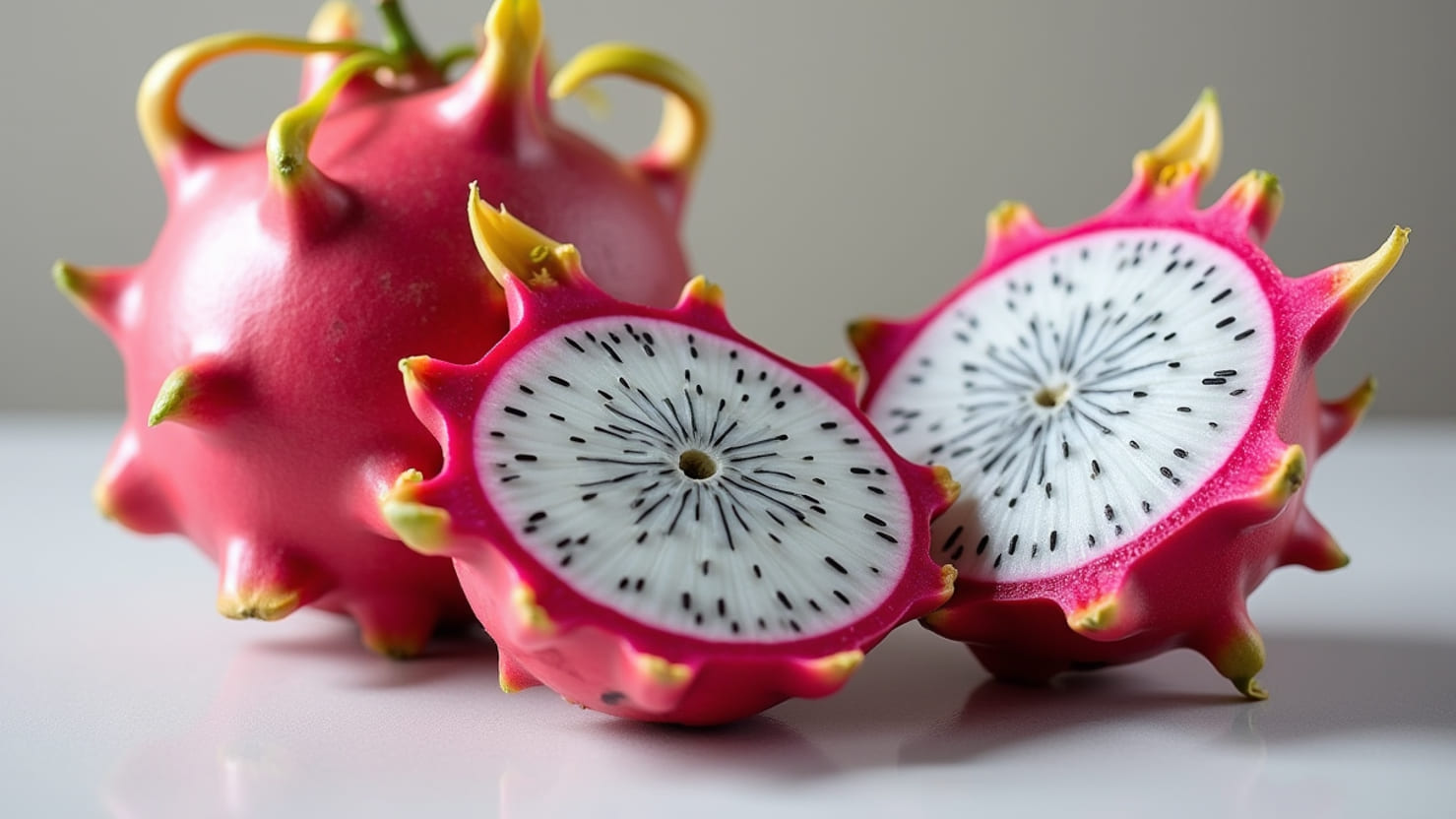
Super Shenron is a self-fertile, red-fleshed dragon fruit that delivers high sweetness without needing a second variety for pollination. Most red-fleshed cultivars require hand or cross-pollination to set fruit, but this Selenicereus undatus cultivar sets fruit on its own. The plant produces striking red skin, white flowers, and pulp with a sweetness of around 22 Brix. Originally from Taiwan, it suits both hobbyists and commercial growers because it removes the labor of manual pollination. You still need a heavy support structure and proper light management, as dragon fruit is photoperiodic. But for a grower wanting intense flavor and reliable fruit set from a single cutting, this is a standout choice. See our [care guide for red-fleshed pitaya] for more on lighting and support.
Where Super Shenron came from
Super Shenron traces its roots to Taiwan, a region with a long history of dragon fruit cultivation and breeding. Commercial nurseries consistently describe this cultivar as a product of that environment, selected for its ability to thrive in both small home gardens and large-scale commercial farms.[2] While Taiwan is a major hub for pitaya production, Super Shenron stands out for its field performance.
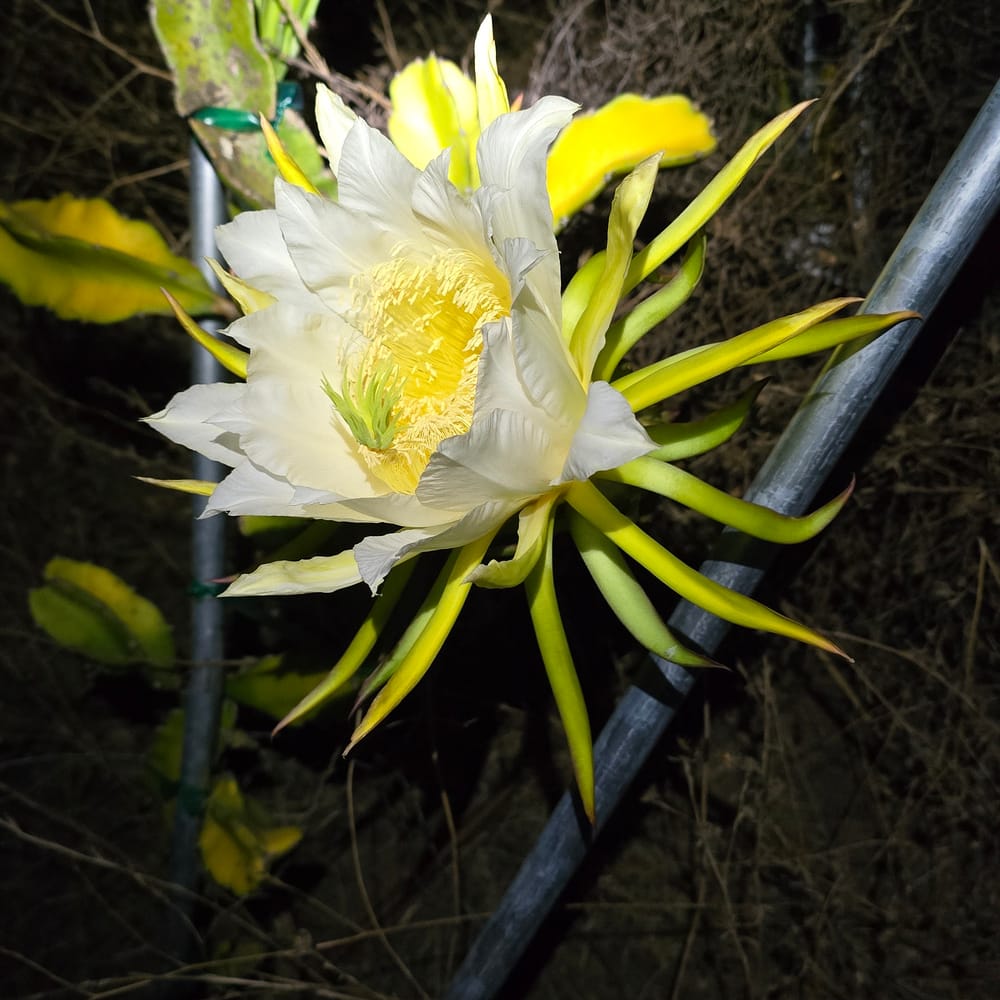
The plant is a red-fleshed cultivar of Selenicereus undatus. Directory listings for the cultivar highlight its red skin, white flowers, and a sweetness level that typically lands around 22 Brix.[1] These traits make it a valuable addition to any collection, offering both ornamental appeal and reliable fruit production.
Origin matters for performance. Because Super Shenron was bred in a region with established dragon fruit infrastructure, it is adapted to the kinds of support systems and light conditions common in professional orchards, making it a reliable choice for growers looking to scale up.
Why a self-fertile red-flesh variety is the rare part
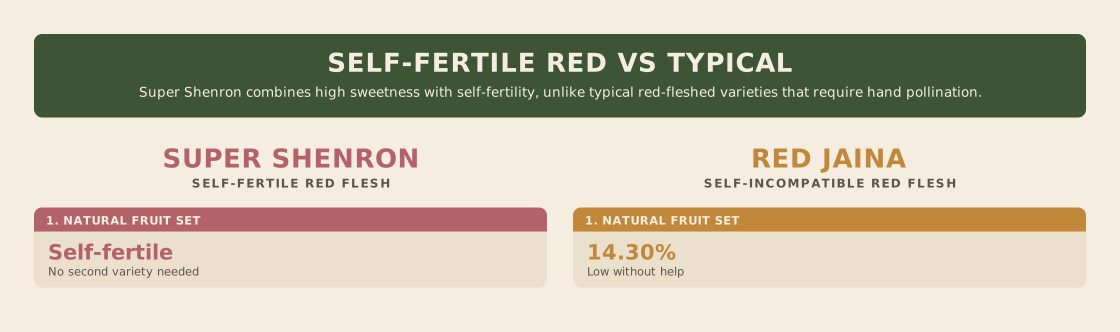
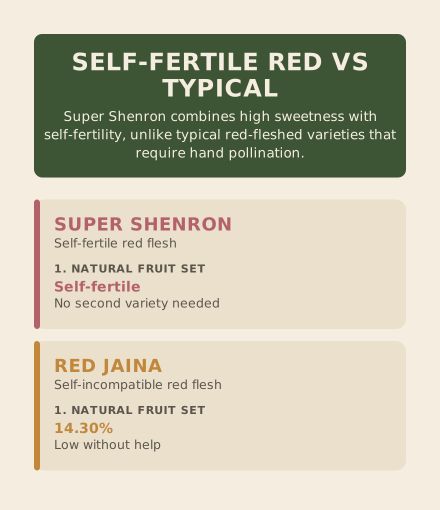
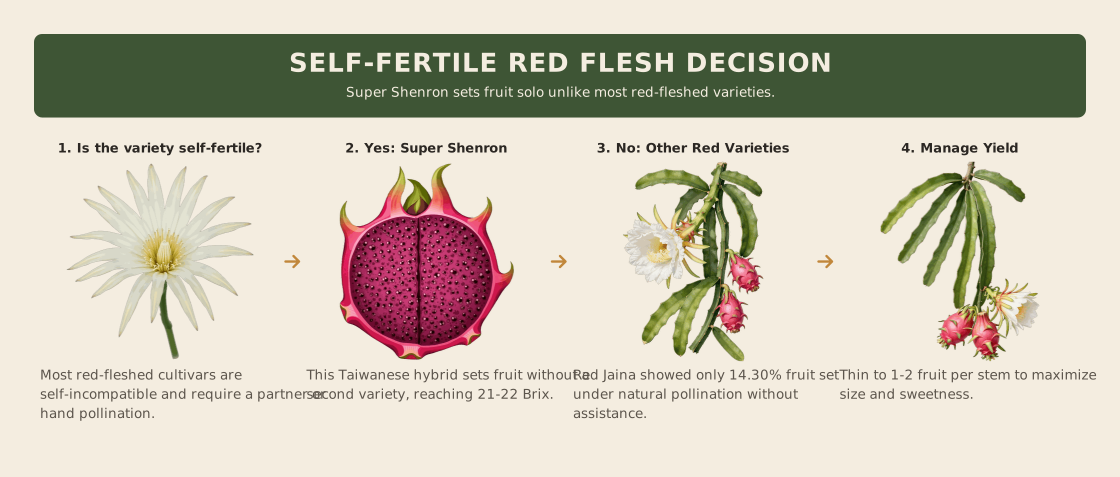
Most growers know that white-fleshed pitaya often sets fruit without help. A 2026 trial at Akdeniz University confirmed this for the cultivar White Jaina, which reached 60% fruit set under natural pollination alone[5]. Red-fleshed varieties rarely behave the same way. In that same trial, the red-fleshed Red Jaina managed only 14.30% fruit set with natural pollination, and bumblebees produced no fruit at all[5]. Hand pollination was required to get a respectable 77.40% set and heavier fruit[5]. This labor burden often deters home gardeners from red-fleshed types, but Super Shenron breaks the pattern by setting fruit on its own.
Lighting conditions add another layer of complexity to fruit set. Pitaya response to light interventions varies significantly by species and flesh color. Research from the Hebrew University in Israel found that even a 9-hour light extension failed to induce flowering in certain trials[4]. In Taiwan, the response to night-breaking fluorescent lighting proved temperature-sensitive specifically in red pitaya[4]. You cannot assume a lighting schedule that works for white-fleshed plants will trigger blooms in red-fleshed ones. Note these biological differences when managing dragon fruit pollination strategies.
Practical takeaway: Self-fertility in red-fleshed cultivars is not a given. It is a specific genetic trait that eliminates the need for hand-pollination labor. While white-fleshed types may set fruit naturally, red-fleshed varieties often require manual intervention or specific pollinator partners. Super Shenron offers the color and sweetness of a red-fleshed hybrid with the ease of a self-compatible plant.
Flavour and colour science
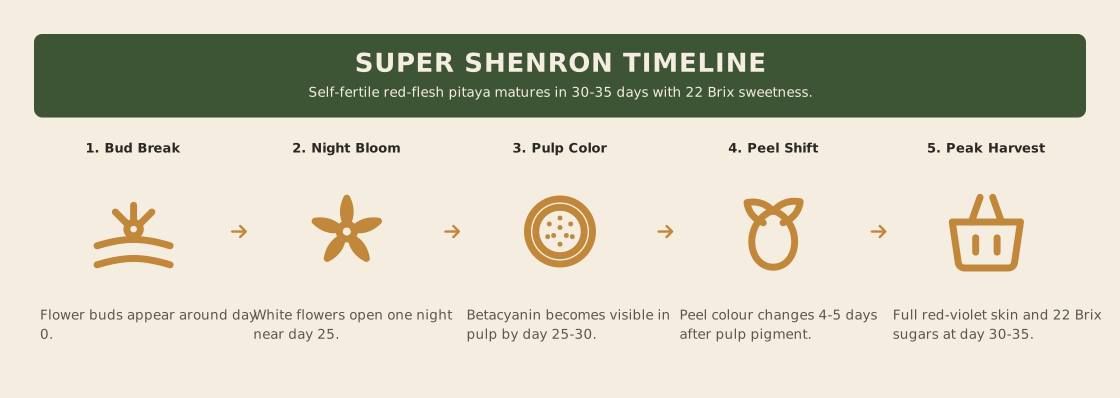
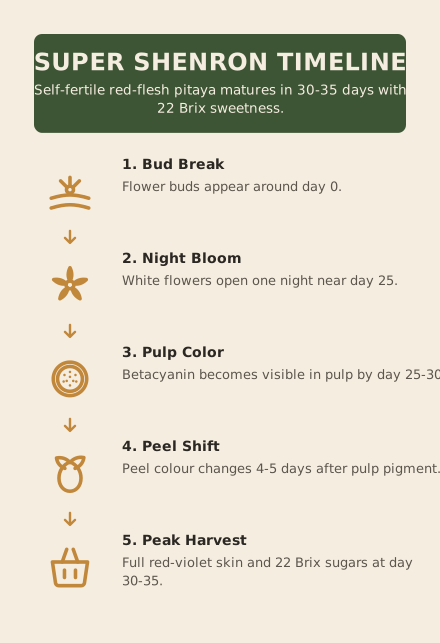
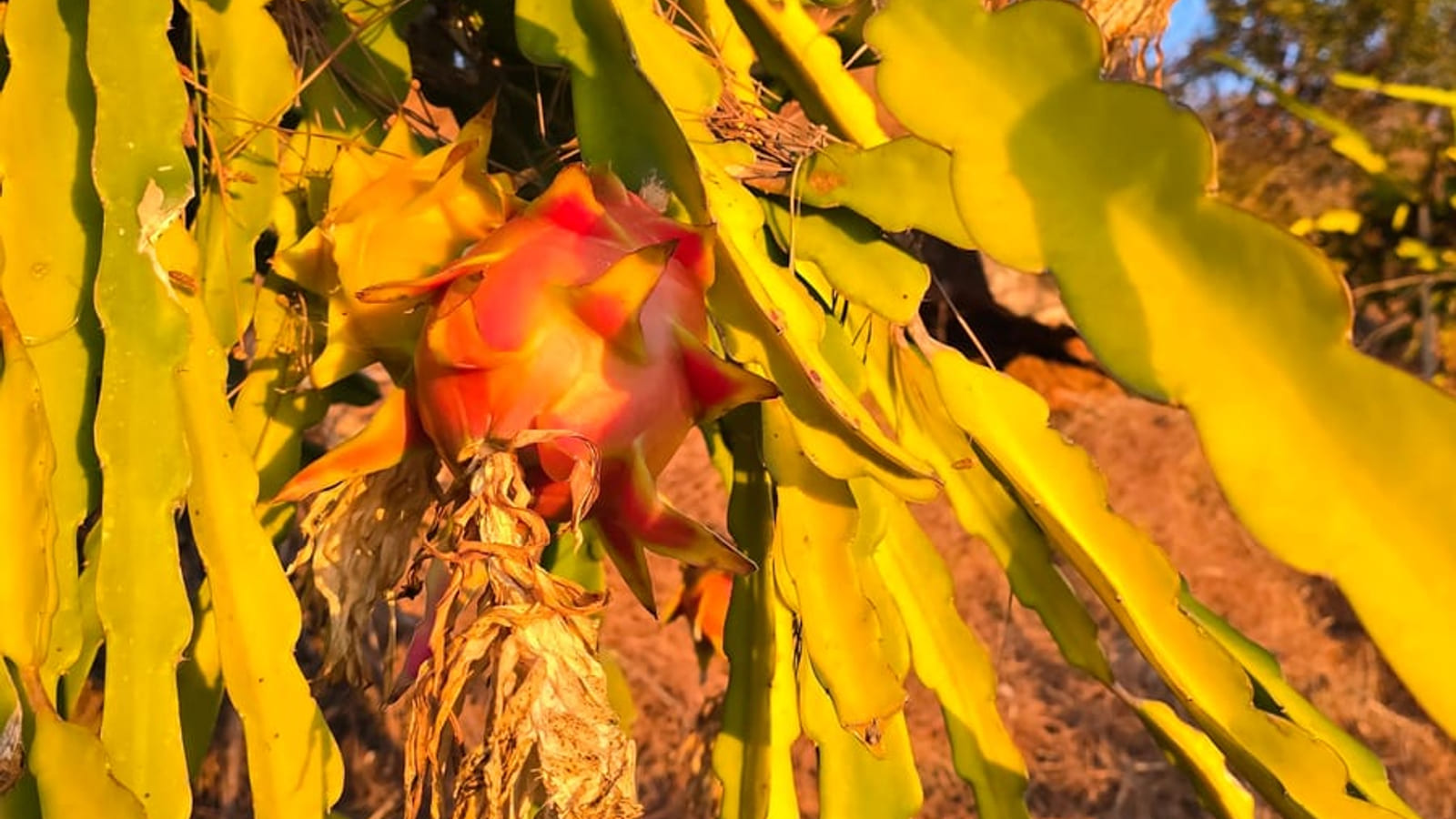
Understanding when Super Shenron develops its signature hue helps you time your harvest for maximum sweetness. The red-violet pigment, known as betacyanin, becomes visible in the pulp roughly 25 days after pollination [6]. The peel follows this change a few days later, with both the skin and the interior reaching full red-violet coloration by about 30 days after pollination [6].
Color is not the only signal to watch. Fruit growth follows a steady curve from five days after pollination through to thirty-five days [6]. During this period, soluble solids concentration rises significantly [6]. This means the fruit is still accumulating sugar in the final week before you pick it. Waiting for the peel to turn fully red ensures you capture that peak sweetness rather than stopping too early.
Growing Super Shenron (care specs)
Because Super Shenron is self-fertile, you can skip the tedious hand-pollination steps that plague other red-fleshed varieties. This trait simplifies your workflow significantly, allowing you to focus on structural support and light management rather than flower manipulation. The plant behaves like a standard Selenicereus undatus cultivar in terms of vigor, but its fruit set reliability is what sets it apart in the garden.
Lighting is the primary lever for triggering blooms. Dragon fruit is photoperiodic, meaning it flowers best when days are longer than nights. In regions with short winter days, commercial growers use artificial night-break lighting to extend the photoperiod. Standard practice involves 4 to 6 hours of supplemental light per night using 75 to 100 W incandescent lamps, a method widely used in Taiwan and Thailand.[4] Vietnamese growers often push this further, recommending roughly 10 hours of lighting per night to force off-season flowering for premium harvests.[4]
Lighting caution: Red-fleshed varieties are more sensitive to lighting interventions than white-fleshed types. Research from the Hebrew University showed that even a 9-hour light extension failed to induce flowering in some trials, and responses to night-breaking lights in Taiwan were temperature-sensitive for red pitaya.[4] Monitor your plants closely; if you see no buds after a few weeks of extended light, adjust your schedule or check for temperature stress before assuming the lights are ineffective.
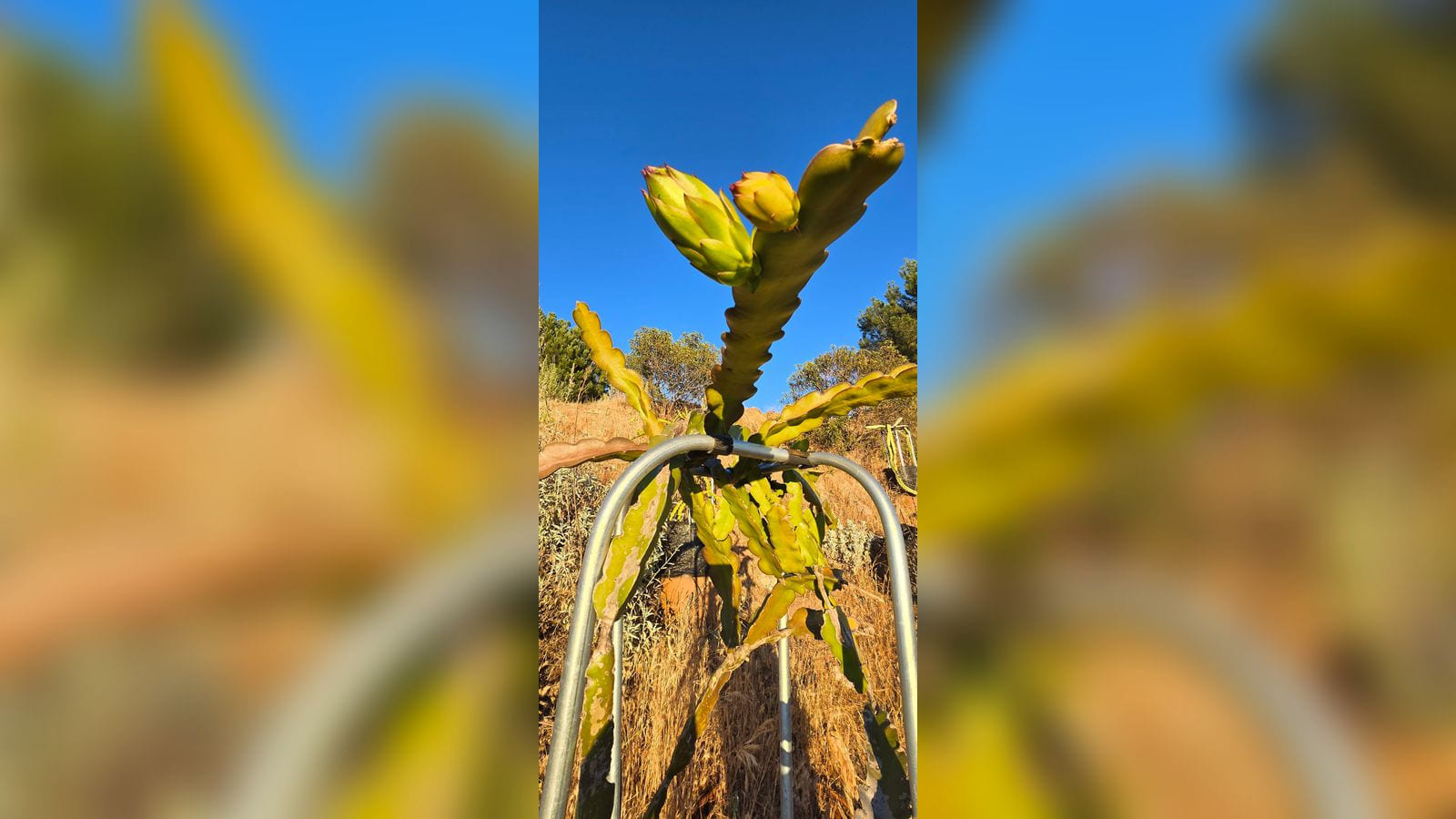
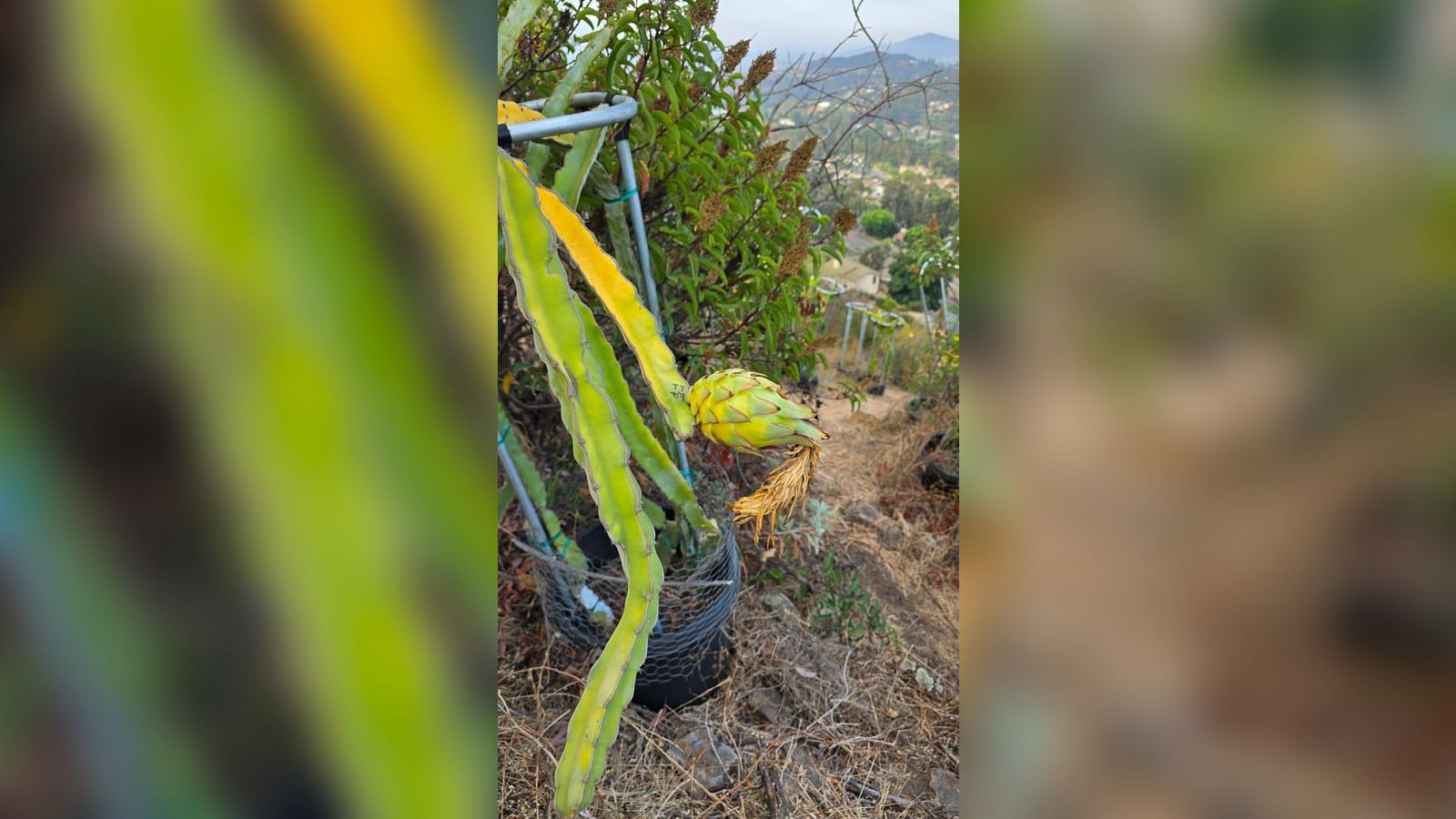
Support structures must be robust. While the text mentions heavy supports generally, Super Shenron’s vigorous growth and heavy fruit load demand a trellis that can handle significant weight. A single post with a cross-arm or a T-bar system works well, provided the post is deeply anchored. The plant’s hybrid nature gives it the vigor of white-fleshed types, so expect rapid stem expansion that can overwhelm a flimsy frame.
Water and feeding strategy
Consistent moisture drives fruit size and sugar accumulation. Since sweetness climbs in the final week before harvest, do not let the plant dry out during this period. Deep, infrequent watering encourages strong root systems, but during fruit development, keep the soil evenly moist. If you are growing in containers, check the top inch of soil daily; water when it feels dry to the touch. Overwatering leads to root rot, so ensure your pot or bed has excellent drainage.
Fertilization should support both vegetative growth and fruit production. A balanced fertilizer during the growing season keeps the stems green and healthy. As buds form, shift to a formula with higher potassium to support sugar development. Since Super Shenron sets fruit on its own, you do not need to adjust feeding for pollination labor, but you do need to feed heavily to sustain the high Brix levels that define this cultivar.[1]
| Care Aspect | Recommendation | Why It Matters |
|---|---|---|
| Lighting | 4-6 hours night-break (standard) or 10 hours (forced) | Triggers flowering in photoperiodic plants; red-fleshed types are temperature-sensitive.[4] |
| Pollination | None required | Self-fertile trait eliminates hand-pollination labor common in red-fleshed varieties.[5] |
| Support | Heavy-duty trellis | Hybrid vigor and heavy fruit loads require sturdy anchoring. |
| Watering | Even moisture during fruit set | Prevents fruit drop and supports final sugar accumulation. |
Pruning is minimal but strategic. Remove any stems that grow inward or cross over others to improve air circulation and light penetration. This helps prevent fungal issues, which can be a risk in humid environments. Since the plant is self-fertile, you do not need to manage specific pollinator branches, so you can prune for shape and airflow without worrying about disrupting fruit set.
Flower to harvest, week by week
Once pollination succeeds, the fruit enters a growth phase that follows a predictable biological curve. Red-fleshed dragon fruit expands in a sigmoid pattern from day 5 to day 35 after pollination.[6] This means the fruit grows slowly at first, accelerates rapidly in the middle weeks, and then levels off as it approaches maturity. Watching the size alone can be misleading because the internal chemistry is still shifting even when the fruit looks finished.
The most critical window for flavor development is the final stretch. Soluble solids concentration and titratable acidity rise significantly as the fruit matures.[6] In practical terms, sweetness is still increasing in the week leading up to harvest. Picking too early results in a fruit that looks vibrant but tastes flat or overly acidic. Patience during this final week ensures the pulp reaches its full potential.
Color changes serve as your visual cue, but they lag slightly behind internal ripening. In red-fleshed varieties, the red-violet pigment in the pulp becomes visible around 25 days after pollination.[6] The peel color follows this internal change by another 4 to 5 days.[6] By day 30, both the peel and the pulp have turned a full red-violet.[6] If you see the peel fully colored, the fruit is close, but waiting a few more days allows the sugars to peak.
Harvest tip: Do not rely on color alone. While the peel turning red-violet signals maturity, the internal sugar content continues to climb until day 35. If you can wait, leave the fruit on the vine for the full duration of the growth curve to maximize sweetness.
Super Shenron vs other red-flesh varieties (comparison)
Placing Super Shenron next to other red-fleshed cultivars highlights exactly why it has gained traction in both home gardens and commercial rows. While the biology of red pitaya often demands intensive human intervention, this variety streamlines the process without sacrificing the deep color or high sugar content growers expect. The comparison is not just about taste; it is about the labor required to get that taste to the plate.
| Feature | Super Shenron | Typical Red-Flesh Hybrids |
|---|---|---|
| Pollination | Self-fertile | Often self-incompatible |
| Sweetness | Nearing 22 Brix | Variable, often lower |
| Origin | Taiwanese hybrid | Various global sources |
| Grower Fit | Hobbyist & Commercial | Often commercial only |
Most red-fleshed options on the market are temperamental. They frequently require a partner variety or hand-pollination to set any fruit at all. Super Shenron removes that barrier. It is a hybrid noted for striking red flesh and a sweetness level that approaches 22 Brix, making it a high-value crop that does not demand a nursery worker with a paintbrush at dawn[3]. This self-fertility is the primary differentiator. It allows a single cutting to produce a full harvest, a trait that is rare in the red-fleshed category.
Why this matters for your harvest: When a variety is self-fertile, you are not gambling on weather or pollinator activity. You are managing a plant that is genetically programmed to set fruit on its own schedule. This reliability is what makes Super Shenron a practical choice for growers who want consistent yields without complex pollination strategies.
Flavor profiles also set this cultivar apart. While many red-fleshed types offer color, they sometimes lack the sugar punch that makes the fruit commercially viable or enjoyable for fresh eating. Super Shenron delivers both. The intense red-violet pulp is not just visual; it is a marker of the high soluble solids that develop as the fruit matures. Growers who have tried other red varieties often find them tart or bland by comparison. Super Shenron delivers the sweetness that makes red pitaya worth the space in your garden.
For commercial operations, the labor savings are significant. Hand-pollinating red-fleshed varieties is time-consuming and limits scale. A self-fertile red variety allows for larger plantings with fewer workers. For hobbyists, it means you can grow a premium, high-sugar fruit without needing to master the art of cross-pollination. You provide the support and light; the plant handles the rest.
Is Super Shenron right for you? + FAQ
You have the biology, the origin story, and the flavor profile. Now comes the practical question: does this specific cutting belong in your garden? Super Shenron is a low-labor, high-reward option for growers who want red-fleshed pitaya without the hassle of hand-pollination. It removes the need for a second variety, which simplifies your trellis layout and reduces the daily work during bloom season. If you have the space for a heavy support structure and can manage light levels, this plant delivers consistent sweetness and color.
However, it is not a "plant and forget" variety. Dragon fruit is photoperiodic, meaning it relies on day length to trigger flowering. While Super Shenron sets fruit on its own once flowers appear, getting those flowers to emerge can require intervention depending on your location. Commercial growers in Taiwan and Vietnam often use artificial night-break lighting to force off-season harvests, sometimes running lamps for 4 to 6 hours per night [4]. If you are in a region with short winter days, you may need supplemental light to keep the plant blooming year-round. Without it, you might get a strong spring crop and then silence until the days lengthen again.
Lighting note: Response to light interventions varies by cultivar. A trial in Israel found that even a 9-hour light extension failed to induce flowering in some cases, and red pitaya responses can be temperature-sensitive [4]. Test small before investing in a full lighting system.
Who should buy Super Shenron?
This variety suits growers who value flavor intensity and ease of pollination over sheer volume of white-fleshed fruit. It is ideal for home gardeners who want a single, striking plant that produces dessert-quality fruit without needing a partner variety. It also works for small commercial operations looking to reduce labor costs associated with hand-pollinating red-fleshed types. If you are chasing the highest possible yield per square foot, a white-fleshed variety might still outperform it in biomass, but you will likely sacrifice the deep red-violet pulp and the sweetness that makes Super Shenron special [1].
Frequently asked questions
| Question | Answer |
|---|---|
| Do I need a second variety for pollination? | No. Super Shenron is self-fertile, unlike many red-fleshed cultivars that require hand or cross-pollination to set fruit [5]. |
| How sweet is the fruit? | Expect around 22 Brix. Sweetness continues to climb in the final week before harvest [6]. |
| How long from flower to harvest? | Flowers open, then fruit matures over 30-35 days. Color appears around day 25 post-pollination [6]. |
| Is it hard to grow? | Culturally, it behaves like standard pitaya. The main challenge is managing light to trigger blooms if you are outside tropical latitudes [4]. |
If you are ready to skip the pollination brush and grow a red-fleshed dragon fruit that actually sets fruit on its own, Super Shenron is a verified, practical choice. It brings the flavor and color of a premium hybrid with the simplicity of a self-compatible plant.
References
- Super Shenron Cultivar — The Dragon Fruit Directory, Dragon Fruit Directory (Tendra) (2026).
- Super Shenron Cutting, Lee's Dragonfruit Plantation (AU) (2026).
- Super Shenron, Leewi Farms (2026).
- Modified compact fluorescent lamps improve light-induced off-season floral stimulation in dragon fruit farming, Food Science & Nutrition (PMC8116877) (2021).
- Determination of the effects of bumblebee (Bombus terrestris), hand, and natural pollination on fruit set, yield, and quality in pitaya (Hylocereus spp.) cultivation under subtropical conditions, BMC Plant Biology, PMID 42045992 (2026).
- Physico-chemical and structural changes of red-fleshed dragon fruit (Hylocereus polyrhizus) during fruit development, Journal of the Science of Food and Agriculture, PMID 21031359 (2011).